← On a small screen, scroll the diagram horizontally. →
01 /
Gnav and the chosen profile
Gnav is a Scandinavian exchange game played with named cards or wooden pieces drawn from a bag. A single hidden rank can travel around the table, so listening to refusals matters as much as inspecting your own piece. This guide follows the Norwegian manufacturer’s rules, including zero and the special Fool rules. It uses plain instructional labels rather than reproducing a commercial pack’s artwork. For a complete teaching match we specify two table agreements: elimination is checked after the round, and a final simultaneous elimination is a shared victory. These agreements should not be mistaken for universal rules of every Gnav edition.
02 /
The complete special pack
The pack has 42 cards or pieces: 2 copies of each of 21 ranks. Highest to lowest: Cuckoo, Knight/Dragoon, Cat, Horse, House, then XII down to I and 0, then Pot, Owl and Fool. The numeric ranks therefore run from 12 to 0 and contain 13 distinct values. Count them before playing: omitting zero leaves only 40 pieces and changes the game. The first 5 named ranks are matadors. Numbered pieces, Pot, Owl and Fool cannot refuse an ordinary exchange. An unmarked ordinary pack is not equivalent; use the dedicated set or fully label 42 blank cards with these names and duplicate counts.
03 /
Lives and the initial deal
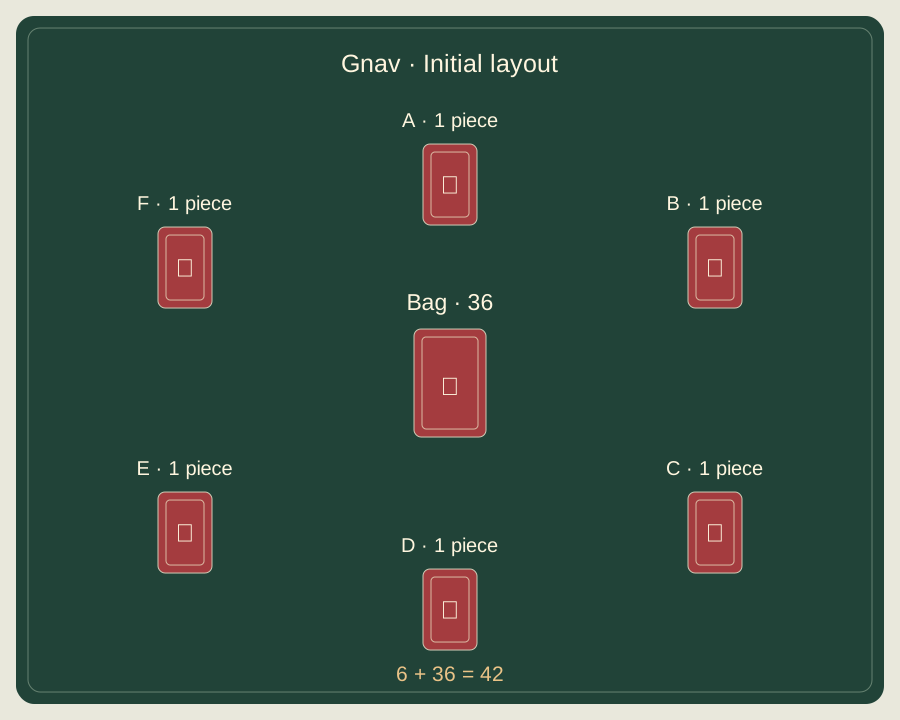
Seat 2–20 players around a table. Give everyone 3 lives, recorded with counters or on paper; the middle is the penalty pool. Choose a first dealer, mix all pieces and deal 1 hidden piece to each player. Nobody looks until the dealer gives the signal. The remainder is the bag or closed stock. A starting Fool holder must signal by tapping 3 times. If both Fools are dealt, both holders receive 1 counter from the pool and sit out this round with their pieces set aside; if the pool is short, this teaching match uses spare counters. If nobody remains to act, collect all pieces and redeal. The diagram uses 6 players and a remainder of 36.
04 /
Keep or exchange
The player left of the dealer starts; continue clockwise. On your turn keep your piece, or request an exchange with the next participating player on your left. An ordinary piece must be exchanged privately; the requester cannot inspect the offered piece and then withdraw. After a successful exchange, your turn ends with the received piece. The next player later takes their own turn with whatever they now hold and may pass that piece onwards. Do not choose a different neighbour merely because you dislike their likely rank. Keep a simple record of completed exchanges so a Cat can reverse them. Pieces whose holders sit out this round are not exchange targets.
05 /
The five matadors
- Cuckoo: reveal it when an exchange is requested. Stop the round immediately and reveal all participating pieces; no requested swap occurs.
- Knight/Dragoon: reveal it, refuse the swap and charge the requester 1 life. The requester keeps their piece and their turn ends; play continues.
- Cat: reveal it and charge the requester 1 life. Cancel the request and reverse all completed exchanges of this round in reverse chronological order. Clear the exchange record and continue the clockwise turn order.
- Horse and House: reveal the blocker and keep it. The same requester must try the next participating player beyond that seat. Repeated blockers are passed in the same way; this is still the original request, not an extra free turn.
A refusal exposes a special piece, not the requester’s ordinary piece. Merely holding a Cuckoo does not stop play: its response is triggered by an exchange request. Decide in advance which language to use for the calls so everyone recognises the effect.
06 /
The dealer and the bag
The dealer acts last and may keep their piece or request a replacement from the bag instead of a neighbour. Treat the bag as an exchange partner: first draw a candidate while keeping the original aside. An ordinary candidate completes the exchange and the old piece goes into the bag. A Horse or House is temporarily set aside and another candidate drawn; return skipped pieces after resolving the request. A Cuckoo stops the round, a Knight charges the requester and refuses, and a Cat charges the requester and reverses earlier exchanges. A refused candidate is not retained in the dealer’s hand. Once this last action is resolved, the dealer calls for all pieces to be shown. Do not make a second voluntary attempt after an ordinary result.
07 /
Penalties, elimination and a new round
At the reveal, the lowest participating rank loses 1 life to the pool. If equal ranks share the lowest position, all those holders pay. If a single Fool remains in play, its holder pays and the holder of the next-lowest rank also pays; tied next-lowest holders all pay. Matador penalties already incurred are additional, not replacements for this final comparison. Our teaching agreement checks elimination only now: a life balance of 0 or less means leaving before the next deal, and penalties beyond available counters are recorded on paper. If one player remains, they win. If the final remaining players leave together, they share the result. Gather all 42 pieces, including skipped and exempt pieces, mix again and pass the dealer role left. Do not carry hidden pieces from one round to the next.
08 /
Example: the Horse redirects a swap
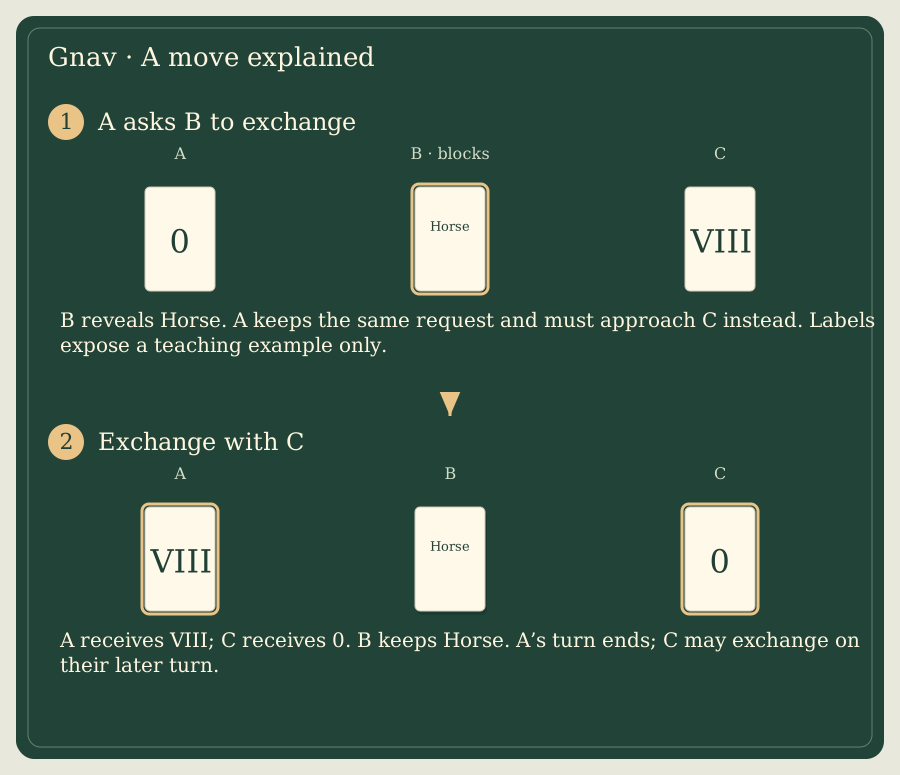
A holds 0, the next player B holds Horse, and C holds VIII. A requests B’s piece. B reveals Horse and keeps it; A must continue to C. C has an ordinary number and must exchange, so A receives VIII and C receives 0. A’s turn is now over. When the clockwise sequence reaches C’s own turn, C may try to pass 0 onwards; the illustration does not assume C has already lost. If the request to C had met a Knight instead, A would have kept 0 and lost 1 life without swapping. A Horse is a redirection, not a penalty or an immediate end to the round.
← On a small screen, scroll the diagram horizontally. →
Common questions
Is zero part of the pack?+
Yes. This Norwegian profile has all numeric ranks from twelve through zero, each duplicated.
Can a normal number refuse a trade?+
No. Only the matador effects interrupt or redirect a requested exchange.
Does the Fool only penalise its holder?+
A single Fool also brings down the next-lowest rank at the reveal. Both Fools dealt initially instead trigger the separate reward-and-sit-out rule.