← On a small screen, scroll the diagram horizontally. →
01 /
Players and cards
Two players use an ordinary 52-card pack without jokers. Each suit descends A, K, Q, J, 10, 9, 8, 7, 6, 5, 4, 3, 2. This selects Pagat’s main profile: follow suit in both stages, but count only the final 13 tricks. There are no wagers, bidding or individual card-point values.
02 /
Deal and opening
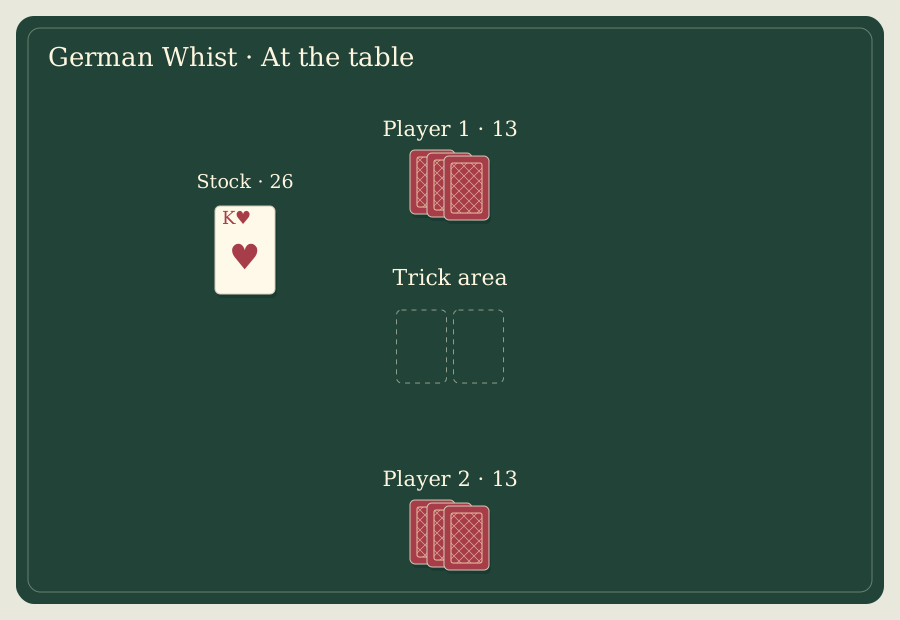
Choose the first dealer by lot and alternate next game. Shuffle, offer the opponent the cut and deal 13 hidden cards each, singly beginning with the opponent. The remaining 26 form stock. Expose its top card and leave it on the stock: its suit is trump for the entire game. It is already part of stock, not an extra card. The nondealer leads first.
03 /
Playing a turn
Each player plays 1 card to a trick. Lead anything; the responder must follow the led suit when able. When void, play anything, without compulsory trumping. Highest led-suit card wins unless trump is present, in which case highest trump wins. Overtaking is optional. The winner always leads next. Do not confuse the trick’s lead with the exposed stock prize: the prize is not played to that trick.
04 /
Stage one: win a card
After each trick the winner must take the exposed stock top into hand. The loser takes the next hidden card without showing it. Only then expose the new top. The new prize’s suit never changes trump. Set the played cards aside face down: they do not score. Both again hold 13 cards. Continue until stock is exhausted after 13 tricks; never recycle played cards. Do not swap prizes, refuse one or choose a hidden card instead of the exposed one.
05 /
Scoring
The last winner of stage one leads into stage two. Stock is empty: play the remaining 13 cards under the same rules, without replenishment. Keep each won trick separately before its winner. Only these 13 count: at least 7 wins the game. Do not add earlier tricks; tens and aces have no special score. An early trick therefore matters only for its prize and the next lead.
06 /
Ending the game
Complete stage two and compare tricks. A tie is impossible because their number is odd. For example 9 against 4 is a win regardless of stage one. One such deal is a complete game; alternate dealer for a new one. Repeat an incorrect opening deal before play. If an illegal response is discovered, restore a legal card before continuing; this is the home correction procedure.
07 /
History and selected variant
German Whist adapts Whist for two. Its name does not establish German origin: Pagat considers it British as far as its author knows, without identifying an inventor securely. Versions allowing free play in stage one or counting every trick create a different profile and are excluded. Do not confuse it with other Whist games sharing related names.
08 /
Worked example
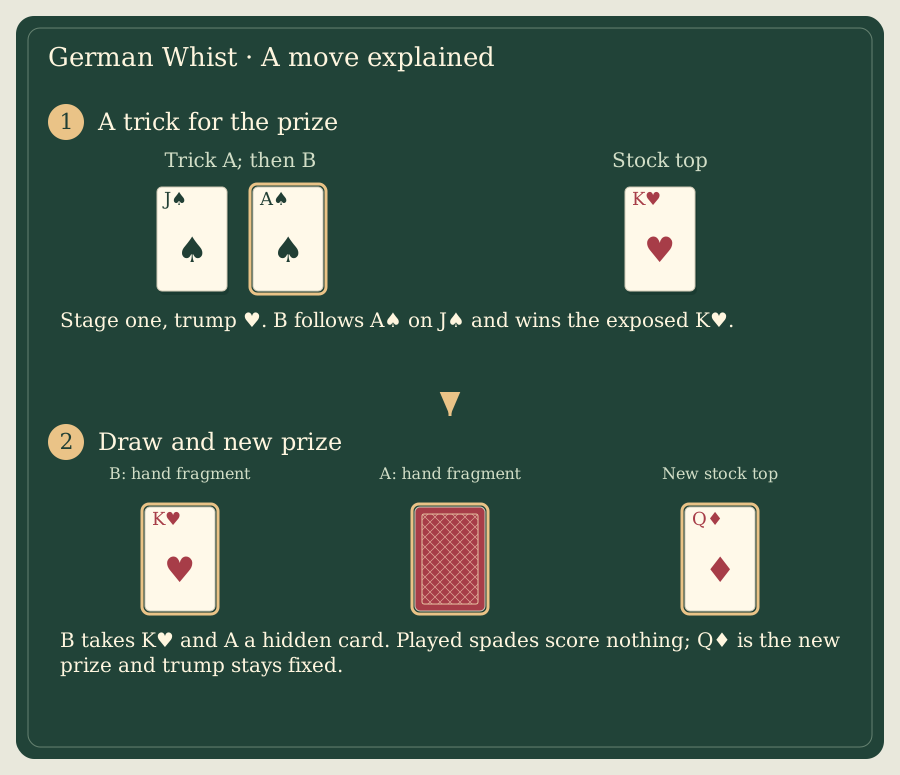
Hearts are trump and K♥ is the exposed prize. A leads J♠, B follows A♠ and wins: both followed suit. B receives K♥ and A the next hidden card. The new exposed prize might be Q♦, but hearts remain trump. The two played spades are set aside without scoring. B leads next and each again holds 13 cards.
← On a small screen, scroll the diagram horizontally. →
Common questions
Does trump change with the prize?+
No, only the first exposed card determines it.
May I refuse the card I win?+
No, the winner takes the open top and loser the next hidden card.
Do early tricks score?+
No, this profile counts only tricks after stock is empty.