← On a small screen, scroll the diagram horizontally. →
01 /
Players and cards
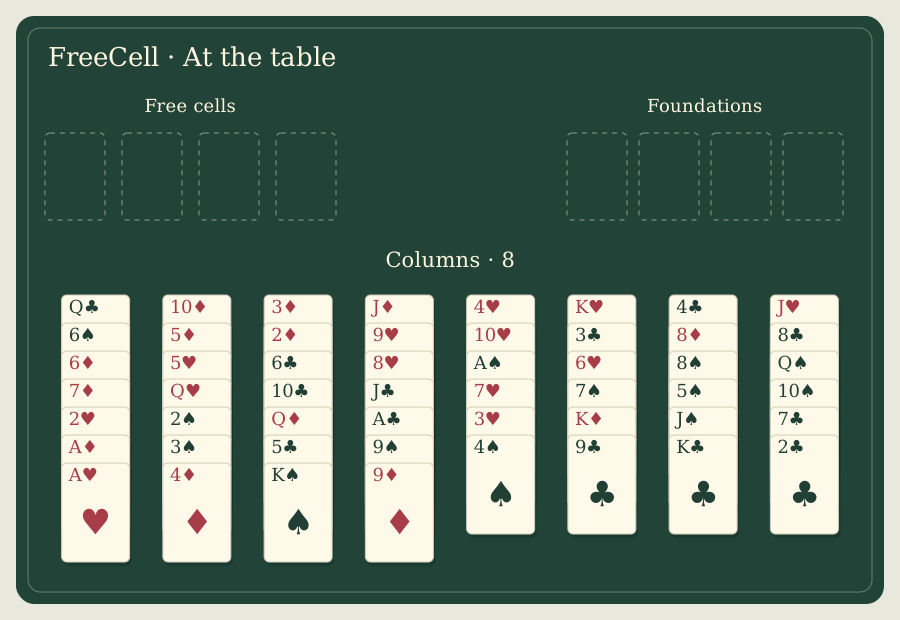
This patience for 1 player uses 52 cards without jokers. Build 4 suited foundations A–K. There are 8 columns and 4 temporary free cells holding one card each. Everything is exposed: chance sets the initial order but supplies no new random cards during play. Select ordinary alternating-colour FreeCell, not same-suit Baker’s Game.
02 /
Deal and opening
Shuffle and deal face up cyclically into columns from left to right. The first 4 get 7 cards each, the other 4 get 6. Cells and foundations start empty. A column’s top is the last dealt, fully available card; lower cards are visible only. There is no stock, waste or redeal.
03 /
Playing a turn
For a single move take a column top or a cell’s card. Send it to an empty cell, a fitting column top, an empty column or a foundation. An occupied cell accepts nothing. Columns descend alternating red and black: 7♥ on 8♠, not 8♦. Any available card fills an empty column. A foundation starts A and climbs in suit to K without gaps; this profile never returns foundation cards.
04 /
Sequence moves using empty spaces
A group transfer is only shorthand for legal single-card moves. With F empty cells and E usable empty columns, the ordinary capacity for a correctly packed descending alternating tail is (F+1)×2^E. If the destination itself is empty, exclude it from E: it cannot also be temporary storage. Count spaces at the start; the source is still occupied.
For example 1 empty cell and 1 intermediate empty column permit 4 cards onto an occupied destination. If the sole empty column is the destination, the limit is 2. The formula does not legalise a broken sequence or replace checking the first card’s availability. More complex rearrangement may always be done singly, demonstrating every legal step.
05 /
Scoring
Foundations determine a win, not speed. An optional personal record may count their cards out of 52, recording time or moves separately. Automatic foundation moves are not a special rule: each must be an ordinary legal move. Do not assume every random layout is solvable; impossible orders exist.
06 /
Ending the game
Win by moving all 52 cards to foundations. Without useful singles or legal combinations, the attempt is blocked. Stop or separately permit undos while studying; never redeal part of the table to continue. A fresh shuffle starts a new attempt. Merely cycling back to an earlier position does not prove a route to victory.
07 /
History and selected variant
FreeCell became widely known through computer editions, including Windows. Solitaire City and Semicolon explain that familiar sequence dragging merely automates single moves. Software history and the history of card rules are separate questions; no unverified invention date or sole author is assigned here. Other cell games may build in suit.
08 /
Worked example
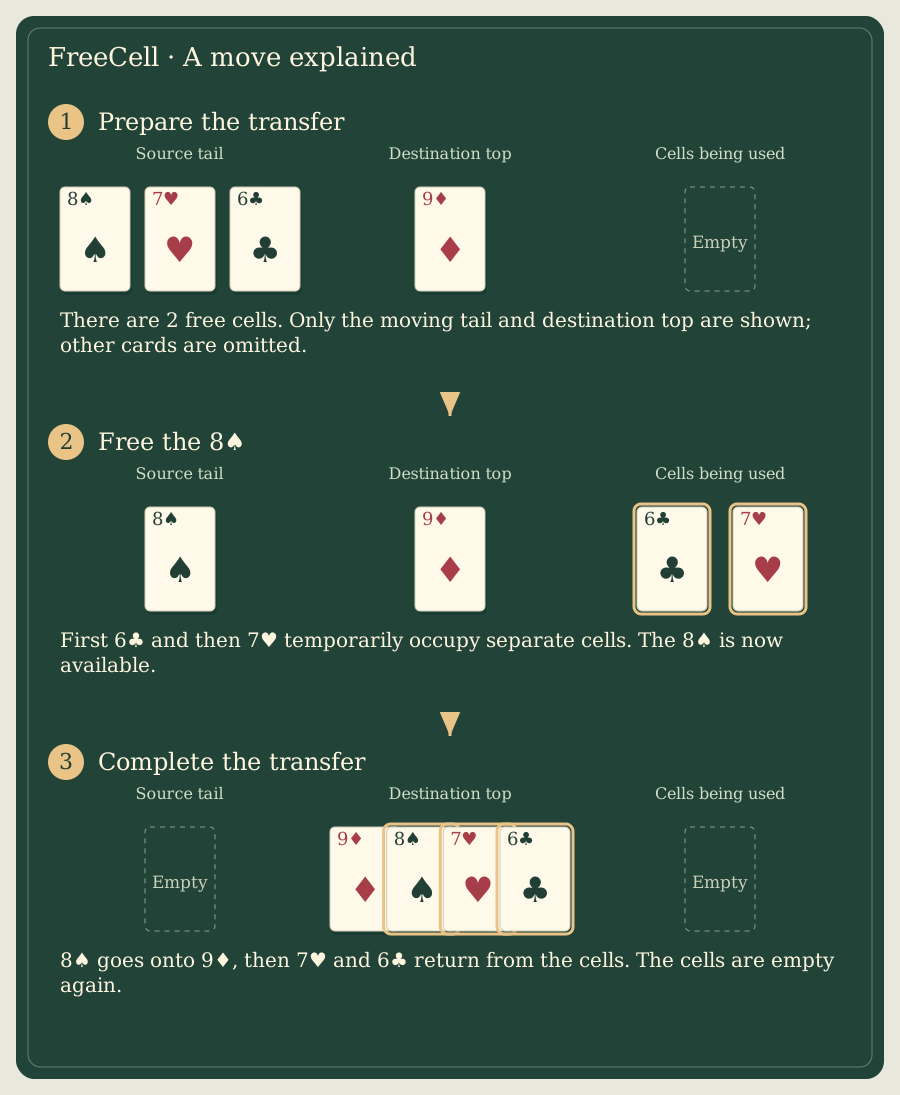
Transfer tail 8♠–7♥–6♣ onto 9♦ with 2 empty cells and no empty column. Other occupied cells and lower column cards are omitted. Put 6♣ in the first cell and 7♥ in the second; 8♠ can now move onto 9♦. Return 7♥ then 6♣ onto it. The three-card sequence has moved, but every individual step was legal and the cells are empty again.
← On a small screen, scroll the diagram horizontally. →
Common questions
May I drag any sequence?+
No, only a packed sequence with sufficient intermediate spaces.
Does an empty destination double capacity?+
No, exclude it from auxiliary empty columns.
May a cell hold two cards?+
No, each cell holds exactly one.