← On a small screen, scroll the diagram horizontally. →
01 /
History and selected rules
Klondike is among the best-known patience games. Origin attributions differ, so we name no inventor. Select the BVS profile: 1 player, 52 cards without jokers, draw 3, with 2 stock redeals. Win by moving every card to four suit foundations from A to K.
02 /
Setup and deal
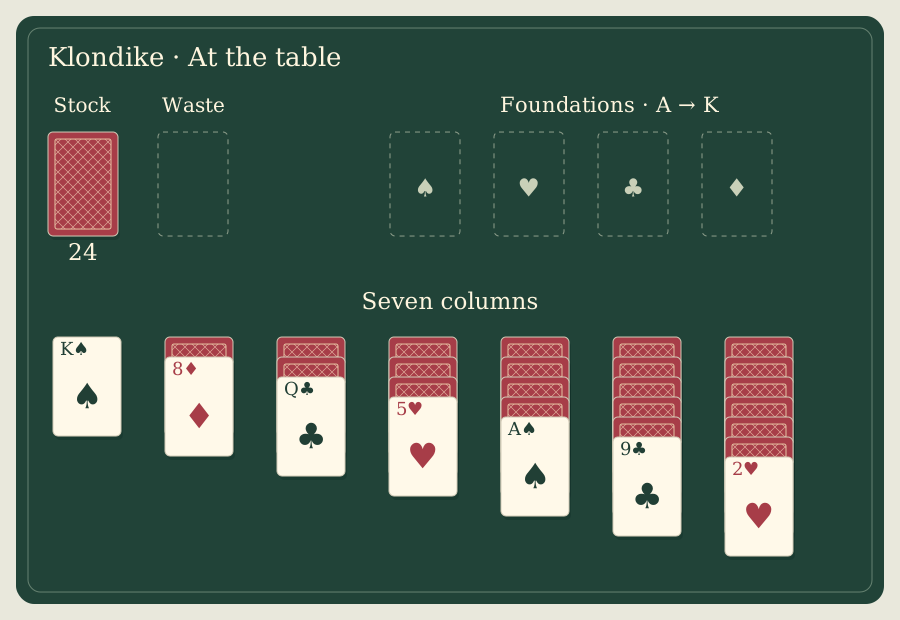
Shuffle. Seven columns contain 1, 2, 3, 4, 5, 6, 7 cards left to right, only each top card face up. That is 28 in the tableau, 24 in closed stock. Leave an empty waste and 4 empty foundations. Red suits are ♥/♦, black ♠/♣.
03 /
Playing a hand
Build tableau downward by one rank in opposite colours, for example black Q on red K. Move a single exposed card or a correctly ordered exposed run, whole or a suffix. Turn over any newly uncovered downcard. Only a K or a K-led run fills an empty column.
Move an available A to a foundation, then same-suit 2 through K singly; available means top of a column or waste. Here a foundation’s top may return to tableau by a legal move. Turn stock cards successively in groups of 3 onto waste: only the last exposed card is playable; removing it exposes its predecessor. With fewer than three remaining, turn the remainder. Never choose a buried card within a triple.
04 /
Ending and result
When stock empties, turn the entire waste face down without shuffling, preserving the original pass order. Allow 2 returns, hence 3 passes total. Accessible cards remain playable after the final pass. All 52 on foundations wins. No useful continuation with stock exhausted, or abandoning the attempt, is a loss. No points or draw; undo and a new deal are outside this rules profile.
05 /
Worked example
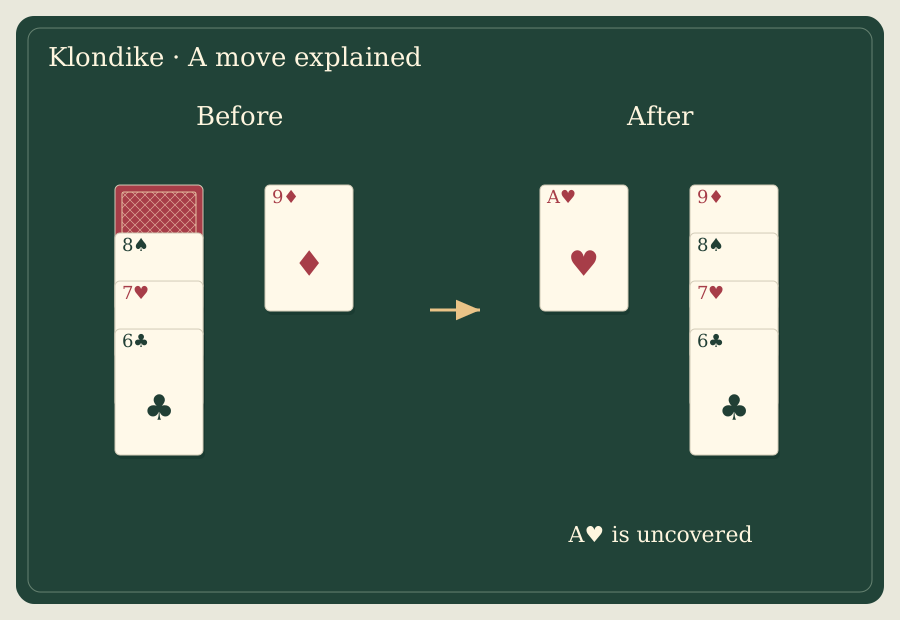
The open run 8♠–7♥–6♣ may move onto 9♦ as a unit. Reveal the downcard uncovered beneath the eight. But 7♥ cannot go on 8♦: both are red.
← On a small screen, scroll the diagram horizontally. →
Common questions
Is every deal winnable?+
No. Legal play does not guarantee a solution.