← On a small screen, scroll the diagram horizontally. →
01 /
Set up the row
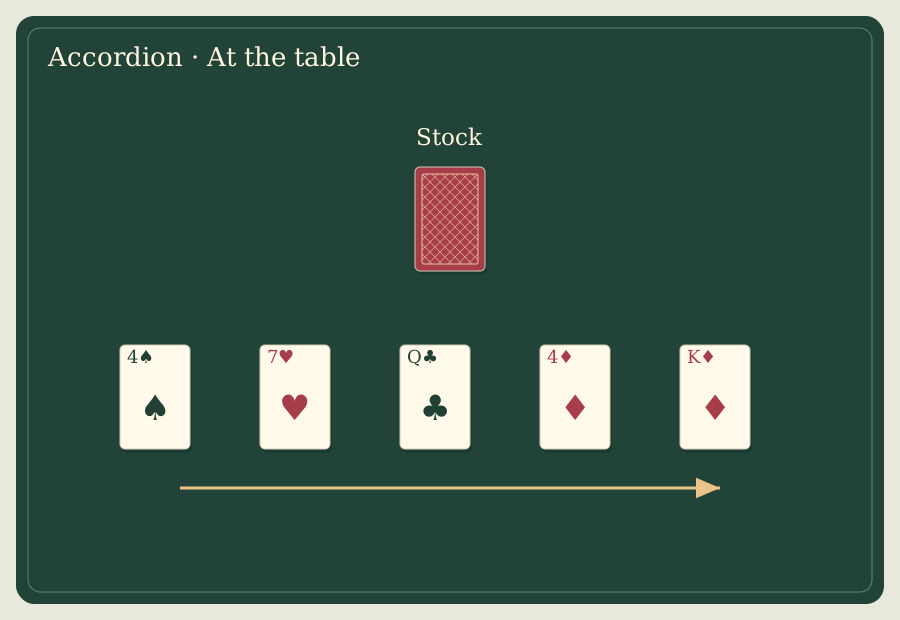
Use one 52-card pack without jokers. Shuffle it and keep the stock face down. Turn cards over singly, adding each to the right end of the row as a new pile. If the row wraps onto another line, treat the lines as one continuous sequence.
This guide uses the optional-move version: you may make an available move or deal another card first. Your aim is to compress the entire deck into one pile. There are no foundations to build and no separate discard pile.
02 /
Legal moves
Move an entire pile onto either its immediate left neighbour or the third pile to its left, jumping over two piles. The two top cards must share a suit or rank. Buried cards have no effect on a move.
Close the gap after every move and count distances again. Never split a pile, move right, or land two or four places to the left. Sharing a colour is insufficient: a heart does not match a diamond merely because both are red. A move changes the visible card of its destination, which can remove a future opportunity.
03 /
Worked example: a choice matters
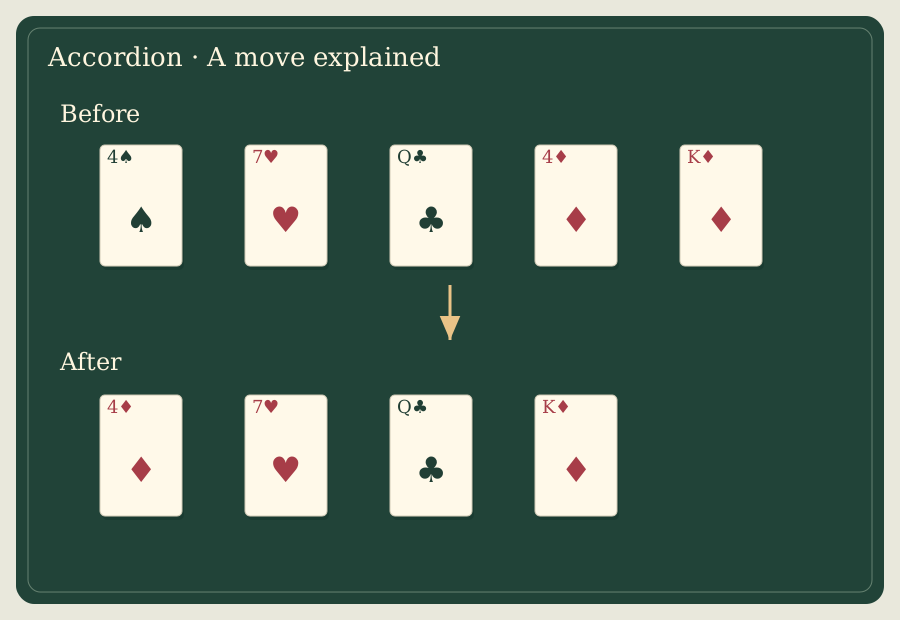
The row is 4♠, 7♥, Q♣, 4♦, K♦. Move 4♦ onto 4♠: the ranks match and the destination is three piles to the left. The visible row becomes 4♦, 7♥, Q♣, K♦, with 4♠ buried below 4♦.
K♦ can now jump three places onto 4♦ by suit, leaving K♦, 7♥, Q♣. Alternatively, your first move could have been K♦ onto its adjacent 4♦. That would cover the four with a king, preventing that pile from jumping onto 4♠ by rank. Both opening choices are legal; their consequences differ. Before moving, mentally replace the destination top card and recount the row.
← On a small screen, scroll the diagram horizontally. →
04 /
Winning and recording a result
Win by dealing the whole pack and finishing with one pile containing all 52 cards. Lose when the stock is empty, several piles remain and none can move. Do not redeal the remaining piles or reorder them.
A useful personal record is the number of piles left, with fewer being better. This is a practice measure, not a universal points system. Running out of moves while cards remain in the stock is not a loss: deal another card. A two-pile finish is close, but it is not a win under the one-pile objective used here.
05 /
Names, history and variants
The growing and shrinking row explains the musical name. Other published names include The Idle Year, Methuselah and Tower of Babel. Wikipedia traces printed Idle Year rules to William Brisbane Dick in 1883; this establishes a publication, not an invention date or inventor.
Older descriptions disagree about compulsory moves. Some versions expose the complete pack at the start; others require a playable pile to move before another card is dealt. These are meaningful changes to the puzzle. Choose one convention before shuffling and keep it throughout the attempt.
Common questions
Can I move two piles to the left?+
No. The allowed destinations are exactly one or three piles to the left.
Must I make a move before dealing again?+
Not in this optional-move version.
Can I move only the top card?+
No. Move the complete pile as one unit.