← On a small screen, scroll the diagram horizontally. →
01 /
Players and cards
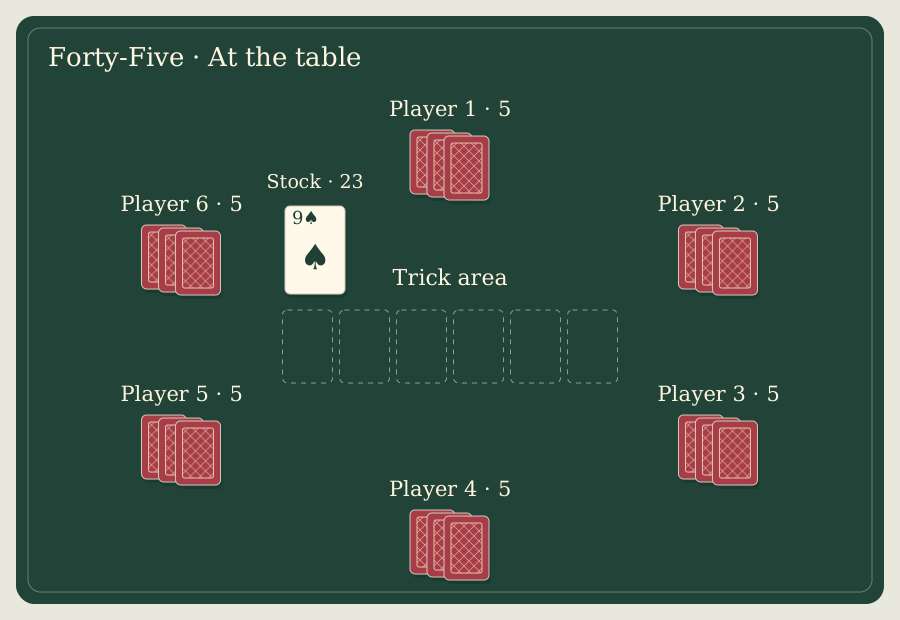
This guide selects the Irish Bruff profile: 6 players form 3 partnerships. Partners sit opposite, in clockwise order A, B, C, A, B, C. Partners combine points but do not show each other their hands. Use the ordinary 52 cards plus 1 joker, 53 total, and keep a score record. There is no auction: an exposed card determines trumps, and the first side to reach 45 wins. The joker is always a trump, not a substitute for any chosen card.
02 /
Deal and opening
Choose the first dealer randomly; the deal passes left afterwards. The dealer shuffles and the right-hand neighbour cuts. Starting on the left and going clockwise, deal 3 face-down cards to each player, then 2 more. Each has 5: 30 are dealt and 23 remain. Expose the top remaining card; its suit is trumps throughout the deal. Nobody draws during the tricks. For a turned joker, we use Parlett’s published procedure: dealer takes it, puts any unwanted card beneath the remainder and turns the next card to determine the suit. The dealer still holds 5.
03 /
Robbing the turn-up
The holder of the Ace of the named trump suit may exchange any hand card for the turn-up: first set an unwanted card aside face down, then take the exposed trump. If that Ace itself was turned, the dealer may exchange instead. Do so before your own first play. The exchange is optional, with no requirement to announce an unused Ace; declining does not weaken it. With spades trump, AS gives the right, not AH. Holding the joker gives no exchange right. Hand size stays unchanged and the face-down discard is not reused.
04 /
Complete card rankings
The complete trump order runs from strongest to weakest below. S means spades, C clubs, D diamonds, H hearts and T ten. AH always belongs to trumps, so hearts do not gain another Ace. The joker stands between the trump J and AH.
S : 5S > JS > Joker > AH > AS > KS > QS > 2S > 3S > 4S > 6S > 7S > 8S > 9S > TS. C : 5C > JC > Joker > AH > AC > KC > QC > 2C > 3C > 4C > 6C > 7C > 8C > 9C > TC. D : 5D > JD > Joker > AH > AD > KD > QD > TD > 9D > 8D > 7D > 6D > 4D > 3D > 2D. H : 5H > JH > Joker > AH > KH > QH > TH > 9H > 8H > 7H > 6H > 4H > 3H > 2H.
Plain suits use the following orders. K beats Q and J; numeral ranks descend in red suits and ascend in black suits. AH is absent from plain hearts.
S/C : K > Q > J > A > 2 > 3 > 4 > 5 > 6 > 7 > 8 > 9 > T. D : K > Q > J > T > 9 > 8 > 7 > 6 > 5 > 4 > 3 > 2 > A. H : K > Q > J > T > 9 > 8 > 7 > 6 > 5 > 4 > 3 > 2.
05 /
Playing a turn
The player left of dealer leads any card. Everyone contributes a card clockwise. The highest trump wins; without trumps, the highest card of the led suit wins. The winner leads next. There is no requirement to overtake a card already played. On a plain-suit lead you may trump even while holding the led suit. If you do not trump, follow that suit when able; if void, you may discard anything without being forced to trump. AH and the joker count as trumps for following purposes, not as ordinary hearts. A deal has 5 tricks unless the game ends sooner.
06 /
When top trumps may be withheld
On a trump lead you normally must play a trump. The trump five, trump Jack, joker and AH are protected from being forced out by a lower trump. You may discard a non-trump only when every trump you hold belongs to this protected group and each outranks the card led. If you hold any other trump, or a protected trump below the lead, you must play some trump. Compare with the lead, not a stronger card added later. The trump five cannot be forced; the five can force J, five or J can force the joker, and five, J or joker can force AH. AS, AC and AD have no such protection, even as trump Aces.
07 /
Scoring
Each trick gives its winner’s partnership 5. Another 5 goes to the side that played the deal’s highest trump: the bonus belongs to the trick it won, making that trick worth 10. A played trump five proves the bonus immediately; a lower trump requires establishing that no higher trump participated. Do not record an uncertain bonus as final. Normally a deal distributes 30. For the rare case where nobody holds a trump, our explicit table agreement awards no bonus and distributes only 25. This resolves a case not specified in the Bruff account.
08 /
Ending the game
A side wins as soon as its accumulated score reaches 45. Trick chronology matters, rather than comparing final totals after a deal. If the bonus is uncertain, play until it can be established and credit it to its corresponding trick; resolve any possible earlier finish involving that bonus first. Once chronology is established, the first side to reach the target wins even if later play also took another side over it. A clear finish stops play; unfinished tricks need not be played out. A partnership taking all 5 tricks of a deal also wins the game regardless of its earlier score: the local jink. Otherwise retain scores, collect the whole pack and deal again. A separate match may be agreed as first to 3 games.
09 /
Worked example
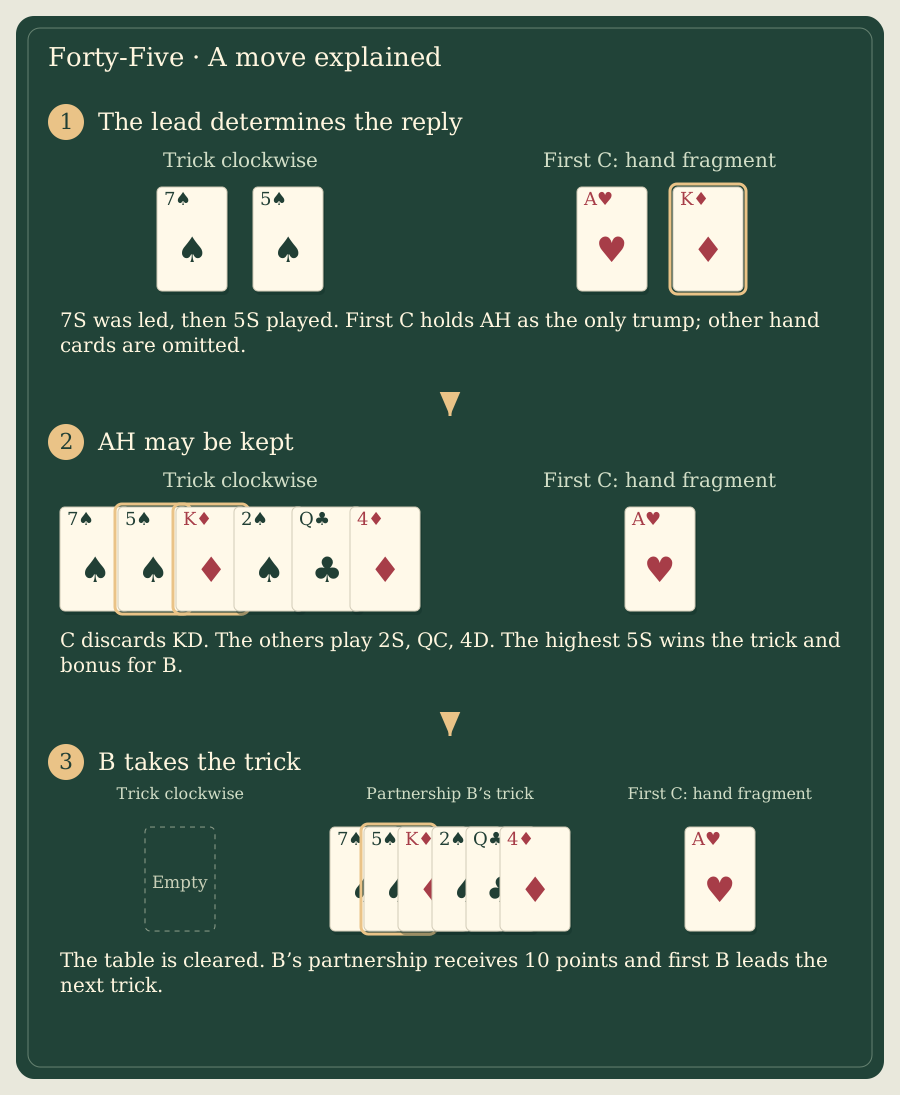
Spades are trump. Starting left of dealer, seats are A, B, C, A, B, C. The first A leads 7S; the first B plays 5S. The first C holds AH and no other trump: C may retain AH and discard KD because 7S was led. The higher five was added later and does not change this privilege. The second A follows with 2S; the second B and second C, void in trumps, discard QC and 4D. The first B wins with 5S and the partnership receives 10: 5 for the trick and the proven 5 for the highest trump. The diagram shows only these played cards and the first C’s hand fragment.
← On a small screen, scroll the diagram horizontally. →
10 /
History and selected variant
Forty-Five belongs to the Irish Maw, Spoil Five and Twenty-Five family. Historical forms retained reversed black numeral ranks and the five’s special power; no sole inventor of the modern game is established. This guide selects the reported Bruff joker game with three partnerships, not Canadian Auction Forty-Fives with bidding and a target of 120. Other localities omit the joker, score the bonus differently or finish only after a complete deal. Do not import those rules into this profile without a new agreement.
Common questions
Is AH always a heart?+
For following purposes AH is always trump. It may trump a plain heart, but is not obliged to follow hearts.
Is the joker strongest?+
No. The trump five and Jack beat it, but it beats AH.
May AH be kept after a five is played?+
Compare with the lead. If the five came later and AH is your only trump, a lower trump lead permits a non-trump discard.