← On a small screen, scroll the diagram horizontally. →
01 /
Aim and equipment
This selects Pagat’s Australian partnership profile: 4 players, partners opposite, 43 cards including one joker. Retain A K Q J 10 9 8 7 6 5 4 in red suits and A K Q J 10 9 8 7 6 5 in black; remove the rest. Trumps rank joker, trump jack, other same-colour jack, A K Q 10 and down. The second jack belongs to trump, not its printed suit. Without trumps jacks are ordinary and A high.
02 /
Setup and deal
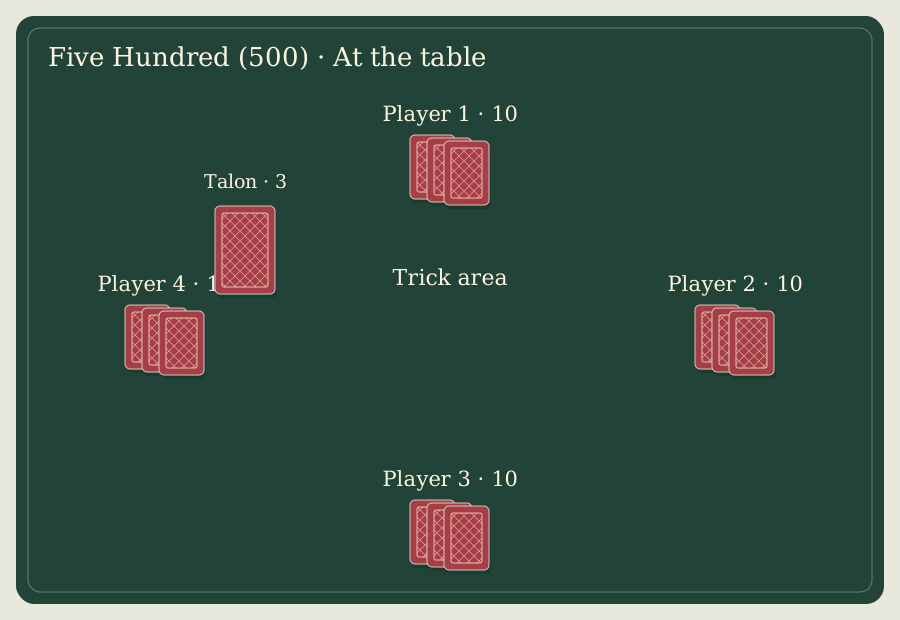
Choose first dealer randomly; deal, auction and play clockwise. Give 10 each and 3 concealed to kitty. Usual pattern: 3 each, one to kitty; 4 each, one to kitty; 3 each and the last to kitty. Shuffle and cut first. Do not expose kitty before bidding ends. Rotate dealer left after every deal, including an all-pass deal.
03 /
Bidding and contracts
Dealer’s left starts. Bid 6 to 10 tricks with a suit or no trumps, or pass. Each bid outranks the last: more tricks, or the same number in higher strain, ascending spades, clubs, diamonds, hearts, no trumps. A player who passes cannot re-enter. Once all but one have passed, that final bid is fixed; the winner cannot raise it afterward. All pass means the next dealer redeals. Misere means lose every trick alone: above every 7 and below every 8, available only after a 7 bid has already been made. Open misere ranks above 10 diamonds and below 10 hearts and may open the auction. These positions are not determined solely by point value.
04 /
Legal actions
The auction winner takes the 3 kitty cards and discards any 3 concealed, including picked-up cards, returning to 10. In miseres their partner sets the entire hand aside and does not play. Contractor leads first. Follow suit if able, counting left bower and joker as trumps in a suit contract; otherwise play any card. Neither overtaking nor trumping is compulsory. Highest trump wins, otherwise highest led suit; winner leads next. Play ten tricks. In open misere expose contractor’s hand after the first trick, while the contractor still chooses its cards.
05 /
Joker without trumps
Use Pagat’s selected rule in no trumps and miseres. A contractor holding joker may nominate its suit before the first lead: it becomes highest only in that suit. Unnominated, or held by a defender, it is suitless and wins any trick. On another player’s lead, such a joker is legal only when void in led suit; then compulsory in misere but optional in no trumps. Leading it requires naming a suit not led previously, which others must follow; after all suits have been led, only the last trick permits a joker lead and any suit nomination. An unnominated joker inevitably defeats its holder’s misere; a nominated one may be discarded off its assigned suit and lose.
06 /
Contract values
Contract values follow, always in columns spades, clubs, diamonds, hearts, no trumps. These are score values, not a different auction order. Misere is 250 and open misere 500. Partners share a total; kitty discards score nothing.
| Tricks | Spades | Clubs | Diamonds | Hearts | No trumps |
|---|---|---|---|---|---|
| 6 | 40 | 60 | 80 | 100 | 120 |
| 7 | 140 | 160 | 180 | 200 | 220 |
| 8 | 240 | 260 | 280 | 300 | 320 |
| 9 | 340 | 360 | 380 | 400 | 420 |
| 10 | 440 | 460 | 480 | 500 | 520 |
07 /
Scoring
A successful suit or no-trump contract earns its full value; failure subtracts it. Contractor overtricks earn nothing except all ten: if the bid value is below 250, score 250 instead. A higher-valued slam adds nothing. Defenders always score 10 for each trick they take, whether the contract succeeds or fails. Misere succeeds only with no contractor tricks, no partner assistance: +250 or −250, open +500 or −500. Defenders score 0 either way; once contractor takes a trick, play may stop because further tricks cannot alter scoring.
08 /
Ending the game
A team wins by reaching 500 or more through its own successful contract. Reaching the same total only through defence is insufficient: continue until a successful bid or the other side going backwards. A team at −500 or worse loses immediately. Check after complete deal scoring. There is no shared winning tie: one side contracts and its successful contract authorises victory. Variants capping defensive scoring at 490 are not used.
09 /
Context and variants
Five Hundred belongs to the Euchre family and has different Australian, New Zealand and North American codes. Even Australia has no single universally accepted treatment of jokers and miseres. This consistently selects Pagat’s main Australian account, including its disputed but precisely stated agreements. It is not presented as a universal tournament standard and other player-count rules are not imported. Checked sources establish no author for this particular edition.
10 /
Worked example
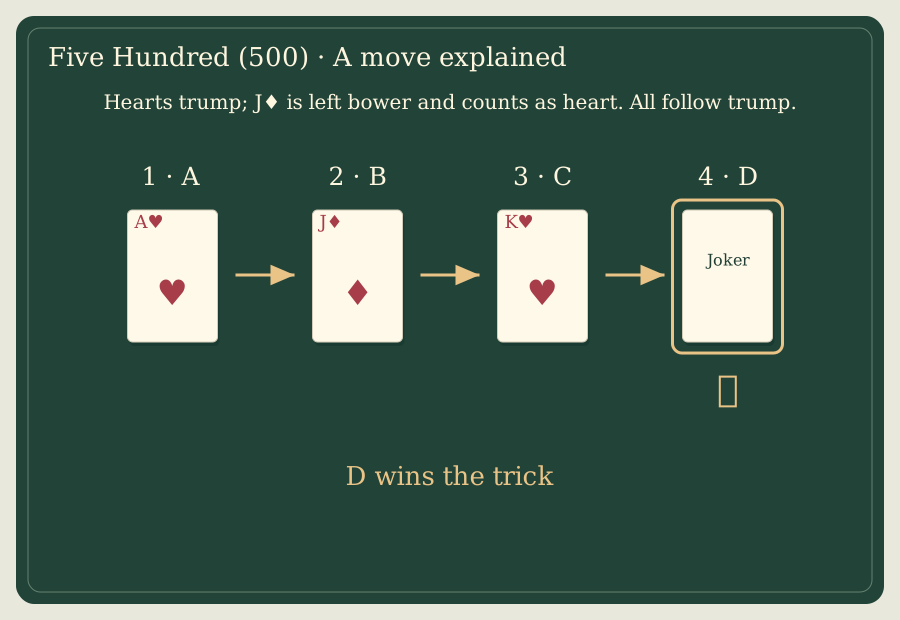
Hearts are trump. A leads A♥, B plays left bower J♦, C follows K♥, D joker. All follow trump and D wins. Separately, 8 hearts is worth 300: taking 8 scores 300, defenders’ 2 score 20. If contractors had 210, they reach 510 and win; defenders starting 490 also reach 510 but cannot win through defence alone. Card ranks and contract points are different comparisons.
← On a small screen, scroll the diagram horizontally. →
Common questions
Does left bower keep its printed suit?+
No: in a suit contract it is trump, including when following suit.
Does a misere player have a partner?+
Partner sets the hand aside and does not play.
Can defence win by reaching 500?+
No: win your own contract or opponents must fall to −500.