← On a small screen, scroll the diagram horizontally. →
01 /
Players and equipment
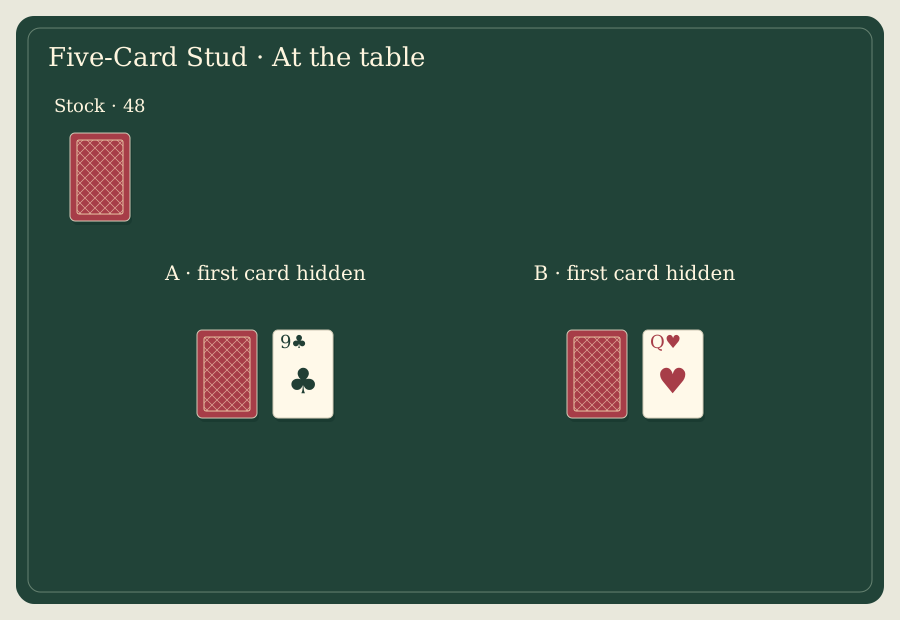
For 2 to 8 players, use one ordinary 52-card pack without jokers. This guide selects high Five-Card Stud with fixed limits, a low-card bring-in and the remaining cards face up. Everyone uses only their own hand: there are no community cards, exchanges or trumps. Give everyone equal accounting chips and agree the starting supply beforehand. Chips cannot be added or removed during a deal.
02 /
Deal and four betting rounds
Choose the first dealer by lot; the deal then passes left. Everyone antes 1. Deal clockwise from the left, one concealed card each, then one face-up card each. After the first betting round give every remaining player another face-up card and conduct another round. Continue until each has 5 cards: there are 4 betting rounds, one concealed card and four exposed cards. This home profile uses no burn cards and never reshuffles stock. Folded cards do not return to the deal. The ante does not count toward first-round calls.
03 /
Who acts first
The lowest exposed card opens the first round; ace is high. Equal ranks use suit order from low to high: ♣, ♦, ♥, ♠. That player posts bring-in 1 or opens for the full 2. Later rounds start with the strongest exposed holding: pairs, two pairs, trips and quads count, followed by the relevant high cards. Unfinished straights and flushes do not count. Break equal exposed holdings by the suit of their highest card; this determines action order, never showdown superiority.
04 /
Selected limits
The first-round unit is 2. Facing the bring-in, call 1, fold or complete to 2; raising becomes available after a full bet. The second-round unit is also 2, but any exposed pair permits any player to use 4. Once the larger unit is used, retain 4 for that round. Third and fourth rounds use 4. A round beginning with more than two active players permits one bet and 3 raises; completing the bring-in is not a raise. With two active players at the start, the number of raises is uncapped.
05 /
Player actions
With no bet outstanding, check to pass the action or bet. Facing a bet, match the current contribution, raise by the prescribed unit or fold, leaving previous contributions in the pot. Check-raising is allowed. Act clockwise, skipping folded and all-in players. A round ends when everyone remaining outside all-in has responded and matched the current bet; an all-check round also ends. If only one player remains, award the pot immediately.
06 /
All-in and side pots
If unable to call fully, put in the remainder and stay eligible with your hand. An ante can also put a player all-in; the bring-in’s full nominal amount still governs opponents’ calls if its payer cannot cover it. An incomplete all-in is allowed, but fixed limits forbid an arbitrary oversized shove. An increase below half a full unit does not reopen raising for players who already answered the last full bet; an unacted player may complete it. An increase of at least half counts as full for reopening and the raise cap; the next raise adds the normal full unit, the selected rule here. Separate equal contribution layers: a player may win only pots they funded, and a folded hand wins none. Return unmatched excess. With nobody left able to contest further bets, deal the remaining up-cards without more betting.
07 /
Comparing hands
From strongest to weakest: straight flush, quads, full house, flush, straight, trips, two pairs, pair, high card. A royal flush is the highest straight flush. Ace is high except A–2–3–4–5 makes the lowest straight; sequences cannot wrap. Within a category compare the main group, then remaining high cards in order. For full houses compare trips first; for two pairs compare the higher pair, lower pair, then the spare card. Flush and high-card hands compare their whole rank sequence. Suits never decide the winner.
08 /
Ending the deal
After final betting, remaining players expose their hole cards. The last bettor or raiser shows first; after all checks, the round’s first actor does so. Compare all cards in each personal hand; there are no extra cards to select. Each pot goes to the best eligible hand. Exact rank ties split it equally; our home odd-chip order gives the remainder to the first tied player left of dealer. Apply eligibility separately to side pots. The deal ends after pots are awarded; reshuffle fully and change dealer for another. Agree overall session length before starting.
09 /
History and variants
Pagat’s historical overview places the emergence of American stud in the eighteen-sixties. That does not establish a precise invention date or sole inventor. This profile uses the lowest card for bring-in and an exposed last card. Highest-card opening, a concealed last card, lowball and high-low are separate profiles. Accounting chip amounts, no burns and odd-chip order are explicitly selected here.
10 /
Worked deal
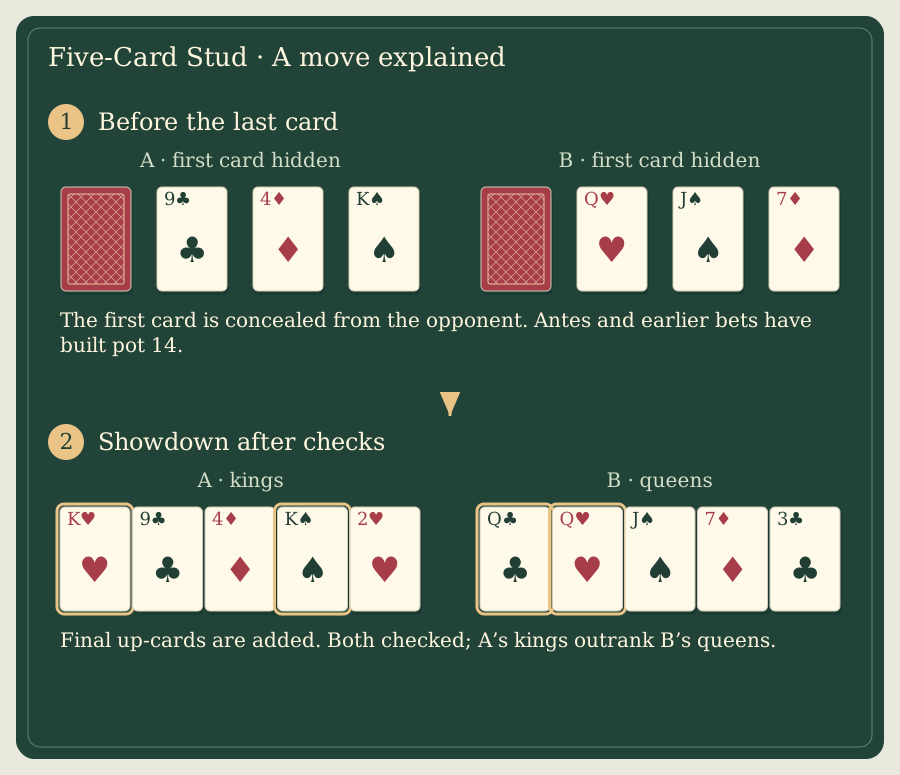
A has concealed K♥ and exposed 9♣; B has concealed Q♣ and exposed Q♥. After ante 1 each brings the first-round contribution to 2. Next up-cards 4♦ and J♠ receive all checks. A then gets K♠ and B 7♦: A has the higher exposed holding, bets 4 and B calls 4. Final 2♥ and 3♣ receive checks. A reveals K♥–9♣–4♦–K♠–2♥, B Q♣–Q♥–J♠–7♦–3♣. Kings beat queens. The pot holds 14: each contributed 1+2+4=7; A takes it, netting +7. The exposed cards alone had not revealed the pair.
← On a small screen, scroll the diagram horizontally. →
Common questions
May I exchange the hole card?+
No. There is no draw, and later cards arrive exposed.
Do suits decide a showdown tie?+
No. Exact rank ties split the pot; suits serve only to determine action order.
Why not push the entire stack?+
This is fixed limit: an all-in declaration does not permit exceeding the prescribed unit.