← On a small screen, scroll the diagram horizontally. →
01 /
Aim and equipment
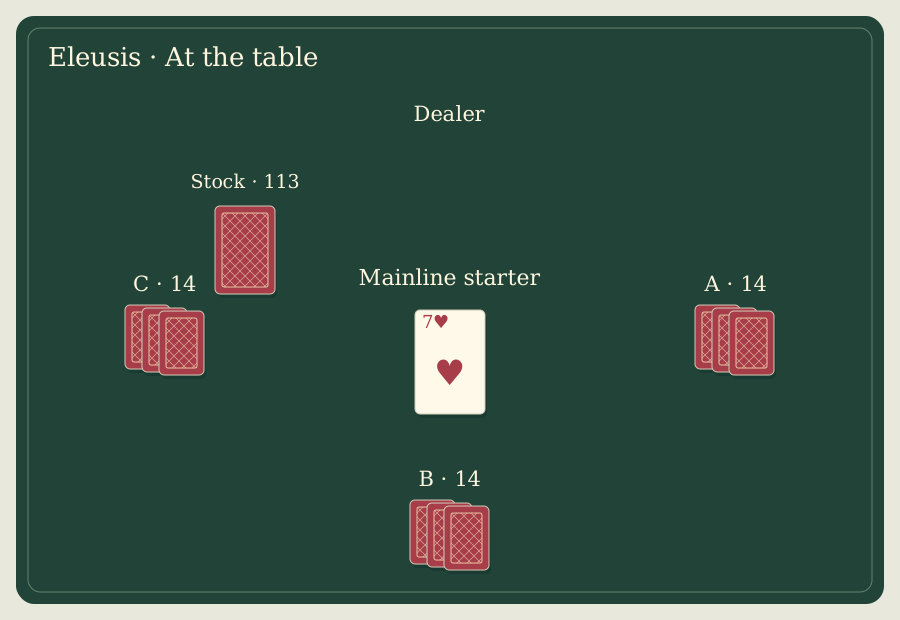
This selects Dave Howell’s complete profile for 4–8 people including one dealer. Shuffle 3 packs without jokers: 156 cards. Have paper, scoring and markers. Dealer secretly writes a fixed rule for legal sequence continuation using card properties, such as alternating red and black. It cannot depend on player identity, time or gestures. Every attempted play must have a definite judgement; for numerical rules A=1, J=11, Q=12, K=13. Guessing aloud does not itself end the deal.
02 /
Setup and deal
Choose first dealer randomly; everyone deals once, role rotating left. Dealer has no hand; others receive 14 concealed cards. From the remainder establish a legal starter card or the starting sequence the rule needs; return unsuitable cards to the bottom unseen. The remainder is stock. To find the first player count nondealers cyclically from dealer’s left using the last starter’s rank. Thereafter turns move left, skipping expelled players and the current prophet.
03 /
Legal actions
Offer one card or an ordered string of several. Dealer judges the whole attempt against the last accepted card and the rule. A wholly correct string extends the horizontal mainline. If any part is wrong, the entire attempt goes to a sideline at the old endpoint without changing it; dealer does not identify the faulty card. Draw 2 penalty cards per attempted card. Rejected cards do not return to hand. Keep all sidelines, ordering and string groupings visible.
04 /
Declaring no play
Instead of an attempt declare “no play” and expose your entire hand. If no single card is legal, return the hand to stock bottom and receive 4 fewer; with 4 or fewer the hand clears and the deal ends. If wrong, dealer selects a legal hand card for the mainline and the declarer draws 5 penalties. A correct declaration with 8 therefore gives 4 cards; an incorrect one with 8 leaves 8−1+5=12. Returned hands do not become sideline plays.
05 /
Prophet and judging
After your own turn, before the next, become prophet only if none exists, you have not been one this deal, and at least two other active players besides dealer remain. Set your hand aside without discarding, mark the last accepted endpoint and stop playing cards. You now judge attempts and no-play claims, with dealer checking every decision. An error makes dealer correct the layout, remove the marker, give you 5 penalties and return you to normal rotation. You cannot become prophet again.
06 /
Correcting prophetic judgements
The player whose action exposes the prophet receives neither penalty nor expulsion for it, even if their attempt was wrong. Correct cards enter mainline, incorrect ones sideline. For no play, dealer still applies the true result: replace the hand or select a correct card. If prophet correctly rejects a claim but selects an illegal “legal” card, return it to hand and dealer chooses a genuine one; prophet falls, claimant is not penalised. A wholly correct prophetic judgement applies ordinary penalties.
07 /
Expulsion from a deal
Count mainline and sidelines together, including the starter, marking every 10th card. At turn start without prophet, expulsion is active once 30 are already on the table: the next wrong attempt or false no-play draws its normal penalty and removes that player for this deal. With prophet instead require 20 cards placed after their marker; a new prophet restarts this count. Earlier expulsions remain. After deposition restore the overall threshold for the next turn. Checking before a turn is our explicit timing clarification.
08 /
Scoring
A legal empty hand, or all players except any prophet being expelled, ends the deal. For everyone, including expelled players and prophet, let H be the largest remaining hand: base score is H minus their hand size. A legally emptied player adds 4. A prophet surviving to the end adds 1 per accepted and 2 per rejected card after their marker. A deposed prophet gets no such bonus. Without a current prophet dealer scores the highest player score. With one, dealer gets the smaller of highest final player score and twice the total table-card count when that prophet was appointed. This follows Howell’s full Scoring section.
09 /
Ending the game
If stock cannot supply a compulsory draw, deal what remains and end the deal immediately with current hands; this is our finite-resource agreement for fixed packs. Never recycle the table or add packs. Reveal the written rule afterward. Sum scores through one deal hosted by everyone; highest total wins, tied leaders share victory. A prophet does not win by claiming knowledge alone: judgements and points demonstrate it.
10 /
Context and variants
Robert Abbott created Eleusis in 1956; later revisions added the prophet. It is inductive discovery of a rule rather than following one universally fixed sequence. We consistently select Howell’s profile with stated clarifications; other sources use different thresholds and pack counts. An obvious arithmetic typo in his no-play example is not reproduced: hand size decreases by the stated amount.
11 /
Worked example
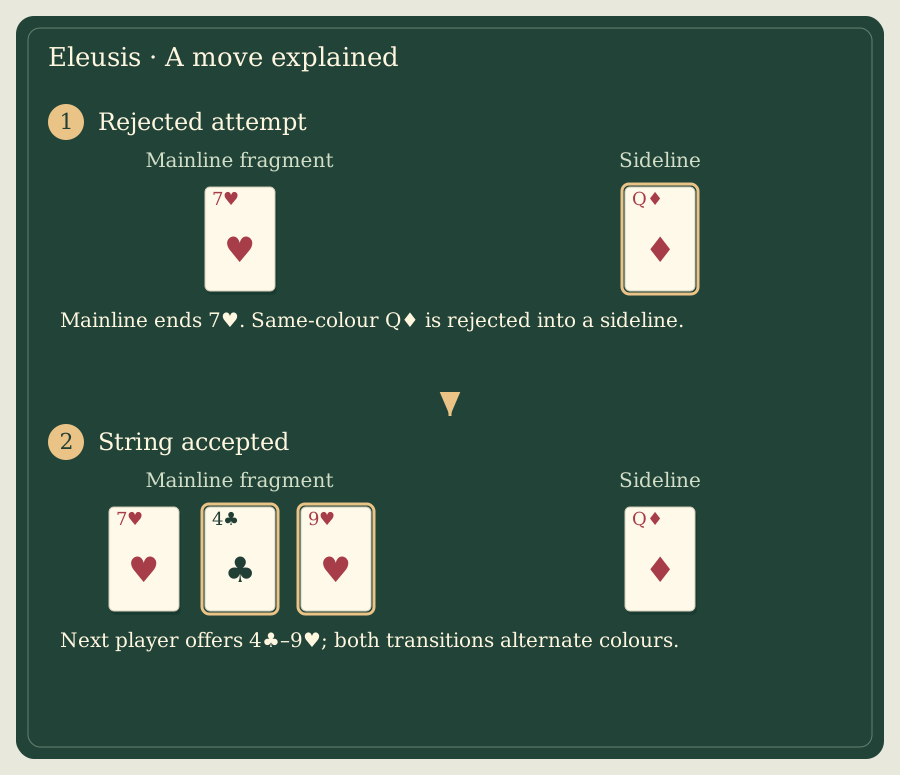
Teaching rule: red must follow black and black red. Mainline ends 7♥. A tries Q♦ incorrectly: it enters a sideline, A draws 2, and endpoint stays 7♥. B then offers 4♣–9♥, both accepted. If final H=12 and your hand is 5, base score is 7; an emptied player scores 12+4=16. The example reveals the rule to the reader, but at the table it remains a written secret.
← On a small screen, scroll the diagram horizontally. →
Common questions
Is a wrong string partly accepted?+
No: the whole attempt is rejected.
Must a prophet announce the secret?+
No: they judge legality under dealer supervision.
May the rule change during play?+
No: it is written beforehand and remains fixed.