← On a small screen, scroll the diagram horizontally. →
01 /
The same cards, different decisions
Duplicate bridge keeps contract bridge’s auction and play but compares results obtained with identical cards. Its first Laws were published in 1928. This guide specifies a complete introductory teams match: 8 participants, 2 tables, 4 prepared boards and International Match Points, or IMPs. These are declared conditions for a short home match, rather than a matchpoint pairs tournament. The rules follow the WBF Laws and ACBL’s account of team play.
02 /
Two tables and preparation
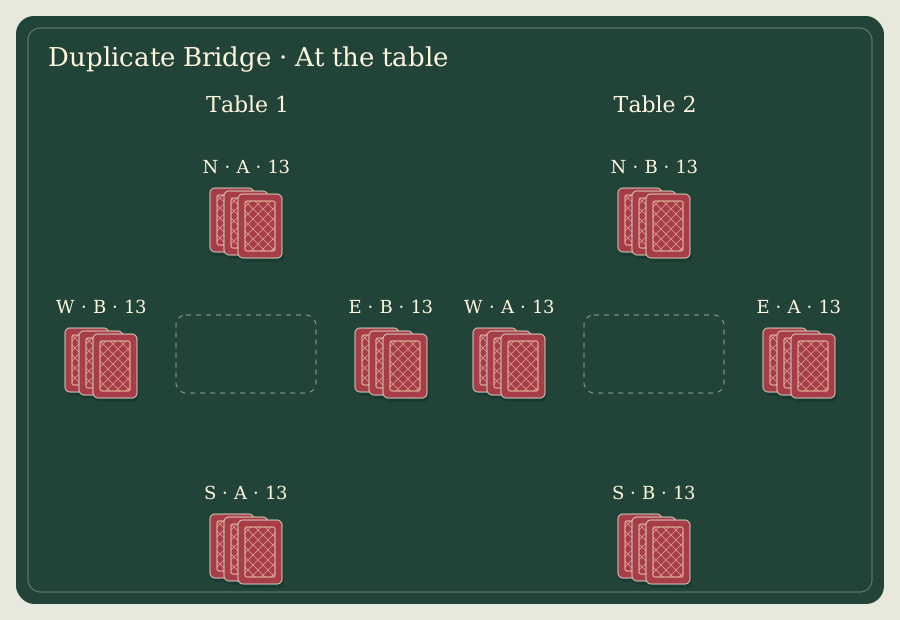
Use 2 complete 52-card packs without jokers, 104 cards in use simultaneously, deal records and pockets or envelopes N,E,S,W. Each table seats 4, with partners opposite. Team A sits N/S at table 1 and E/W at table 2; team B takes the other seats. A neutral organiser prepares identical hands for corresponding directions: 13 each, with no stock. Between boards the same packs are reset from a new concealed deal record; players must not learn other hands beforehand. Designate the organiser to adjudicate any irregularity as well. Every suit ranks A,K,Q,J,10,9,8,7,6,5,4,3,2.
03 /
Dealer and vulnerability
Board 1 has dealer N and neither side vulnerable; 2 has dealer E and N/S vulnerable; 3 has dealer S and E/W vulnerable; 4 has dealer W and both vulnerable. Vulnerability increases certain bonuses and penalties and belongs to the direction, rather than permanently to a team. It is identical at both tables and independent of earlier results. The dealer only starts the auction here: the hands are already prepared. Count your cards face down before looking; there must be 13. Then inspect only your own hand. Partnership agreements about calls are available to opponents; natural suit bids are a convenient agreement for a first match.
04 /
Auction and final contract
The dealer starts and turns proceed clockwise. A bid at level 1–7 promises 6 plus the level in tricks and names a trump suit or NT, no trump. Each new bid must exceed the last: compare the level first, then ♣,♦,♥,♠,NT within a level. You may pass and participate again if the auction continues. Double X is legal against the opponents’ latest bid if no intervening bid or double has occurred; redouble XX answers the opponents’ double of your side’s bid only while that X remains the last non-pass call. Intervening passes do not prevent either action. Any higher bid cancels X or XX. After 4 initial passes score 0 without redealing. Otherwise 3 consecutive passes after the last bid, X or XX end the auction. The last bid fixes the contract; declarer is the first member of the winning partnership who bid its final suit or NT, and partner becomes dummy.
05 /
Dummy and thirteen tricks
The opponent to declarer’s left makes the opening lead. Once that card is faced, dummy exposes all 13 cards arranged by suit; declarer chooses dummy’s plays, but a card is played from the correct hand only when that hand’s turn arrives. Each contributes 1 card clockwise. Follow the led suit if possible; when void you may play anything, with no duty to trump or overtake. The highest trump wins, or, without trumps, the highest card of the led suit. The winning hand leads next. NT has no trump suit. Play all 13 tricks. Keep your own played cards face down in order in front of you, lengthwise towards partner for a won trick and crosswise for a lost trick. Do not collect the four cards together: preserve the deal for comparison.
06 /
A made contract
First count only the contracted tricks above 6: each ♣/♦ trick is worth 20, each ♥/♠ trick 30; in NT the first is 40 and each additional one 30. Multiply this component by 2 for X or 4 for XX. If it reaches 100, add a game bonus of 300 non-vulnerable or 500 vulnerable; otherwise add 50 for a partscore. Do not combine these bonuses. Add another 50 for making X or 100 for XX. Undoubled overtricks beyond the contract earn 20 in minors or 30 in majors/NT; with X each earns 100 non-vulnerable or 200 vulnerable, and XX doubles those amounts. For bidding and making a small slam at level 6 add a further 500 non-vulnerable or 750 vulnerable; for a grand slam at level 7 add 1000 or 1500 respectively. Slam bonuses accompany the game bonus. There are no honours or rubber awards, and partscores do not carry between boards.
07 /
Defeat and the score’s sign
If declarer falls short, no positive contract bonuses apply. Undoubled, every missing trick costs 50 non-vulnerable or 100 vulnerable, credited to the defenders. With X non-vulnerable, the first costs 100, the second and third 200 each, and the fourth and later ones 300 each. With X vulnerable, the first costs 200 and each later one 300. XX doubles the applicable X penalties. Record contract, declarer, tricks and a signed N/S score: positive when N/S earned the points, negative when E/W did. Agree on tricks before returning cards. Everyone returns their own cards to their own pocket; do not unnecessarily expose other hands. If an irregularity occurs, preserve the position and consult the designated adjudicator rather than redealing on your own.
08 /
IMP conversion and match end
After both tables finish a board, subtract table 2’s N/S score from table 1’s N/S score. This is team A’s difference; the opposite sign belongs to B. Convert its absolute value to IMPs: 0–10→0; 20–40→1; 50–80→2; 90–120→3; 130–160→4; 170–210→5; 220–260→6; 270–310→7; 320–360→8; 370–420→9; 430–490→10; 500–590→11; 600–740→12; 750–890→13; 900–1090→14; 1100–1290→15; 1300–1490→16; 1500–1740→17; 1750–1990→18; 2000–2240→19; 2250–2490→20; 2500–2990→21; 3000–3490→22; 3500–3990→23; 4000 or more→24. Ordinary scores are multiples of 10. Restore the difference’s sign and total the IMPs over 4 boards. A positive sum means A wins, a negative sum B wins, and 0 is a draw. This short match has no further conversion to victory points. Do not exchange information about a board until both tables have finished it.
09 /
Example: a trick and a table swing
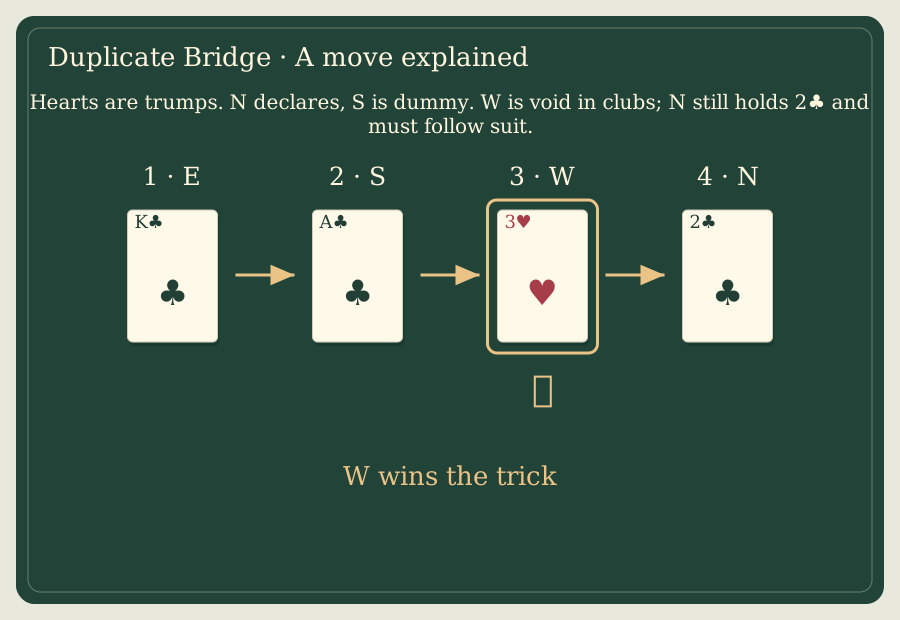
In a heart contract N declares and S is dummy. E leads K♣, S plays A♣ on N’s instruction, W has no clubs and plays 3♥, and N must follow with the available 2♣. W wins with the trump and leads next. That is a separate example of a legal play. For scoring, take a non-vulnerable board: at table 1 team A’s N/S makes 4♠ exactly, earning 4×30+300=420. At table 2 team B’s N/S makes 3♠ with 1 overtrick: 3×30+30+50=170. A therefore gains 420−170=250, worth 6 IMPs on the board. As a penalty check, vulnerable 4♥ with X down 2 costs declarer’s side −500 because 200+300=500. A single table score cannot become IMPs without the other table’s comparison.
← On a small screen, scroll the diagram horizontally. →
Common questions
Why two packs if a table uses one?+
This is a match for 8: 2 tables use identical copies of a board simultaneously, requiring 104 cards.
Does an earlier game change vulnerability?+
No. Every board has vulnerability assigned in advance and identical at both tables.
May we mix the played cards?+
No. Preserve each hand and trick order until the result is agreed, then return the cards to their correct pocket.