← On a small screen, scroll the diagram horizontally. →
01 /
Players and cards
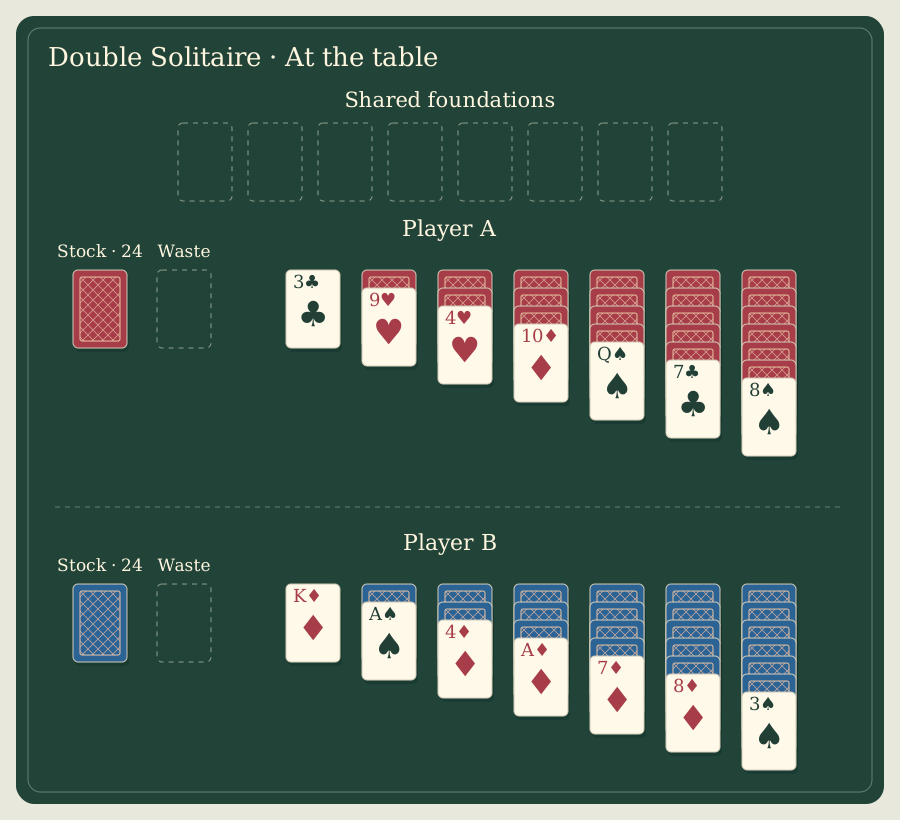
2 people use separate 52-card packs without jokers, making 104 cards. Distinct backs identify ownership afterwards. Hearts and diamonds are red; spades and clubs are black. You cannot take an opponent’s card. The aim is to send all your own cards to the shared foundations before your opponent does.
02 /
Deal and opening
Each player independently shuffles and lays out 7 columns containing 1, 2, 3, 4, 5, 6 and 7 cards. Only the last card of each column is face up; the others are face down. The tableau contains 28 cards, the personal face-down stock 24, and the waste is empty. Leave 8 empty shared foundations between the players, 2 per suit. An Ace does not reserve its foundation for its owner.
03 /
Playing a turn
After a common signal, both play simultaneously, each using only one hand. In your own tableau, put an exposed card on the next higher rank of the opposite colour: a red Q can go on a black K. A descending, alternating-colour face-up sequence, or its lower part, may move together. Immediately turn up an exposed face-down card. An empty column accepts only a K or a valid sequence headed by a K. An Ace is below a deuce; there is no wrap between K and A. You cannot use the opponent’s waste or columns.
04 /
Drawing and recycling
To see new cards, turn the next 3 cards from your own stock onto your waste, preserving their order. Only the top card, the last exposed in the packet, is available. Removing it exposes the card beneath. With fewer than 3 cards remaining, turn the remainder. When the stock is empty, turn the whole waste face down without shuffling or rearranging it to recreate the stock. Passes are unlimited; you cannot inspect hidden cards in advance.
05 /
Shared foundations and collisions
An empty foundation starts with A, then 2 and successive ranks of that suit through K. An available single tableau card or waste top may go on any fitting foundation, regardless of the backs already there. Identical ranks of a suit cannot go consecutively: the other copy needs another foundation of that suit. Foundation cards never return. Our collision agreement awards the space to the first legally placed card; if disputed, both pause, restore the disputed cards and restart together.
06 /
Ending the game
A player who has sent all their own 52 cards to foundations calls the finish and wins. Empty columns alone are insufficient if stock or waste cards remain. If both seem blocked, pause and check the layouts and a full cycle of each stock. The game ends if neither can advance without changing the position or rearranging the waste. Endless reversible tableau moves do not count as progress. This profile does not permit spreading the remaining stock as an extra face-up row.
07 /
Scoring
At a mutual blockage, sort foundation cards by their backs and count each player’s contribution. The higher count wins; equal counts are a draw. Contributions of 31 and 28, for example, give the first player victory; their remaining personal cards number 21 and 24 respectively. Remainders include tableau, stock and waste. There are no extra points for individual speed or exposed columns.
08 /
Worked example
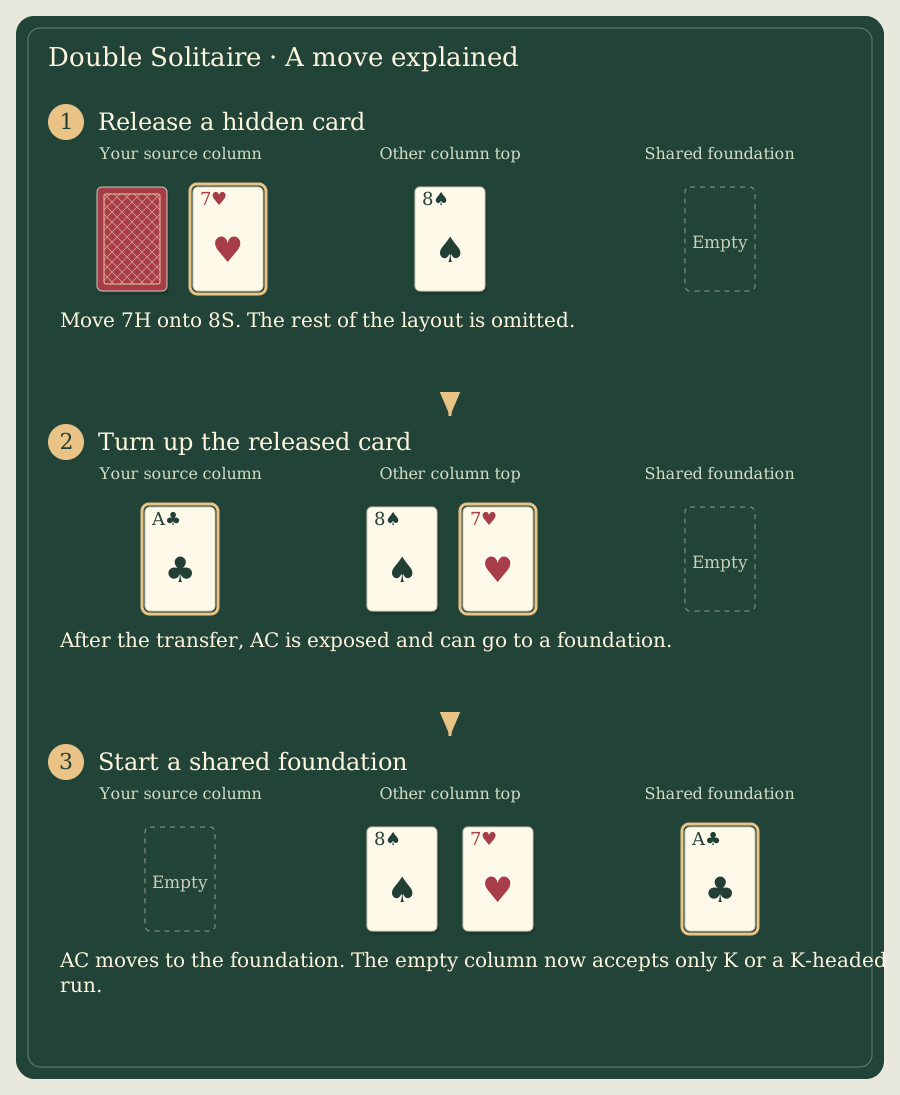
In one of your columns, an exposed 7H covers a single face-down card. Another column ends with 8S. Move 7H onto 8S: the rank descends and red follows black. Turn up the released card: it is AC. While the opponent works on their own layout, put AC on an empty shared foundation. Your source column is now empty and accepts only K or a K-headed run. Other columns and stocks are omitted from the diagram.
← On a small screen, scroll the diagram horizontally. →
09 /
History and selected variant
Double Solitaire combines Klondike layouts with shared foundations. The name covers alternating play as well as the race called Simultaneous Solitaire; this guide selects a race for a pair, drawing 3 with repeated passes. A secure invention date or sole inventor is not established. First-placement disputes and drawn equal contributions are explicitly agreed above rather than presented as a universal tournament code.
Common questions
Can I use the opponent’s foundation?+
All foundations are shared; the opponent’s columns and waste are forbidden.
May I retrieve a foundation card?+
No: in this profile, a foundation play is permanent.
How is a tie resolved?+
Equal contributions at a mutual blockage produce a draw.