← On a small screen, scroll the diagram horizontally. →
01 /
A coherent DDV system
Doppelkopf developed from the German Schafkopf family using doubled cards and is especially widespread in northern Germany. DDV was founded in 1982 to standardise play. Card play, announcements and scoring here follow DDV 2026. Our home session chooses 12 deals and voluntary solos only, without a tournament compulsory solo for each player. Armut, Schweinchen, Bock and “second 10♥ wins” are not included.
02 /
Double pack and deal
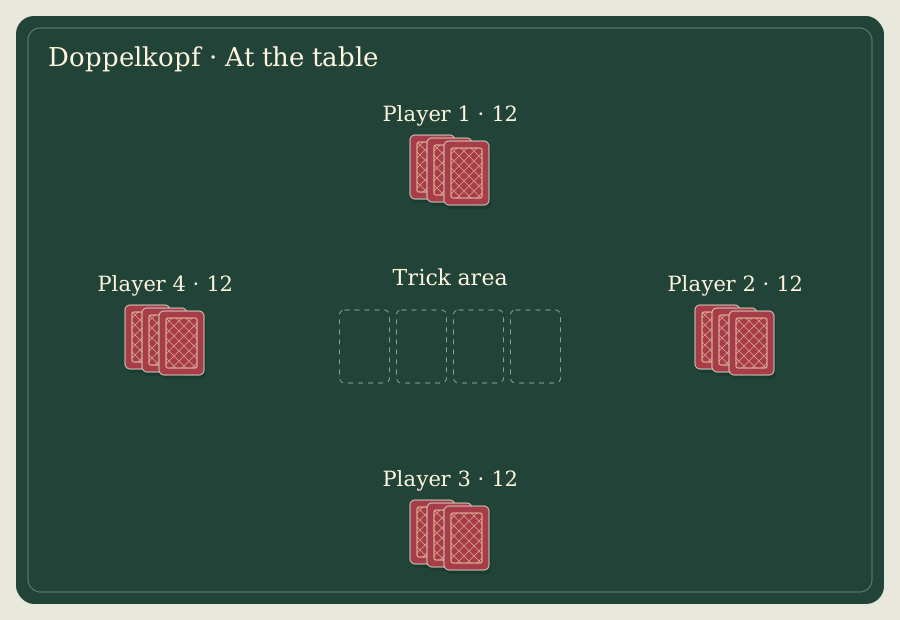
There are 4 players without fixed partners. From two packs retain A,K,Q,J,10,9 in each suit: 48, two copies of every card. Values A=11,10=10,K=4,Q=3,J=2,9=0 total 240. These card points determine results and differ from recorded game points. Choose dealer by lot, shuffle and cut at the right with at least 3 in each part. Deal clockwise from the left, four batches of 3, giving 12 each with no stock. Next dealer is left.
03 /
Normal trumps
Descending normal trumps: 10♥; Q♣,Q♠,Q♥,Q♦; J♣,J♠,J♥,J♦; A♦,10♦,K♦,9♦. Each exists twice, making 26 trumps. They form one suit: Q♠ is not a spade for following. Plain clubs/spades rank A,10,K,9, plain hearts A,K,9. Follow the led plain suit, or trump when trump is led, if able. When void, any card is legal, with no compulsory trumping or overtaking. Highest trump wins, otherwise highest led suit. Equal copies always favour the first, including 10♥.
04 /
Game selection and marriage
Before leading, each clockwise from dealer’s left says gesund or Vorbehalt. Here voluntary solo outranks Hochzeit, equal solos favour the first in order. Name the selected type before play. If all say gesund, Q♣ holders form hidden Re, others Kontra. Do not directly disclose partnership outside permitted announcements.
Holder of both Q♣ may announce Hochzeit: the first other player winning within the first 3 tricks becomes Re partner. Winning all 3 yourself makes a diamond solo. Keeping both Q♣ unannounced makes a silent solo immediately. Normal games, marriages and voluntary solos begin with dealer’s left, then each trick winner leads. Play 12 tricks.
05 /
All selected solos
In solo, one player is Re against three Kontra. Suit solo substitutes the chosen suit’s lower A,10,K,9 for those diamonds; 10♥, all Q and J keep the upper order. In heart solo 10♥ is not duplicated as a lower trump, leaving 24 rather than 26 trumps. Q-solo has only Q as trumps in ♣,♠,♥,♦ order; plain suits A,10,K,J,9. J-solo has only J in that order; plain suits A,10,K,Q,9. Fleischloser has no trumps, each suit A,10,K,Q,J,9. The selected type fully determines following obligations.
06 /
Re, Kontra and denial deadlines
After game selection, announce Re or Kontra with at least 11 cards in your own hand, not necessarily on turn. Following a timely initial call, your side may deny 90 with at least 10, 60 with 9, 30 with 8, schwarz with 7. Each promises opponents less than that threshold; schwarz promises no trick. Skipping words includes all levels only while earlier levels remain timely. Repeating a side’s call adds nothing.
A reply Re/Kontra is allowed with one card fewer than the opposing level’s deadline, but a late reply does not permit your own later denials. Hochzeit forbids calls before its determining trick; determination on the first leaves deadlines unchanged, second reduces them by 1, third by 2. State your side with a denial if partnership remains unclear.
07 /
Who won the deal?
Without denials Re needs 121, Kontra 120; if only Kontra was called, reverse to Re 120, Kontra 121. Your own no-90/60/30 requires respectively 151/181/211, schwarz every trick. Against an opposing denial, without a stronger own obligation, respectively 90/60/30 or one trick against schwarz suffices. Your own obligation remains even if theirs fails. If both fail their own denials, neither wins: use the special settlement below, not an ordinary 120:120 tie. Complete all tricks and score afterwards.
08 /
Game points without doubling
Winning side receives base 1; another 1 each for opponents actually under 90, under 60, under 30 and taking no trick; 2 each for spoken Re and Kontra; 1 for every denial level by either side, including implicit levels. These add, never double. Separately each side earns 1 for its 120 against opposing no-90, 90 against no-60, 60 against no-30, 30 against schwarz; offset opposing credits.
If both fail denials, omit winning base 1, Re/Kontra and declared-denial charges: retain actual under-levels, credits against denials and specials below, offsetting both sides.
09 /
Specials and session result
Only in normal games: Kontra gets 1 for beating Q♣; each trick of at least 40, each enemy A♦ fox captured, and winning the last trick with your J♣ Karlchen gives 1. Merely capturing an enemy J♣ gives no bonus. Offset both sides’ specials and combine with main settlement. Each partner records the resulting game value positively or negatively.
Solos have no specials; soloist records triple value with the appropriate sign and each opponent single value oppositely. Entries sum to 0. Our session is 12 deals starting at 0, highest personal total wins, ties remain. This is a home duration, not the full DDV tournament procedure.
10 /
The first 10♥ remains higher
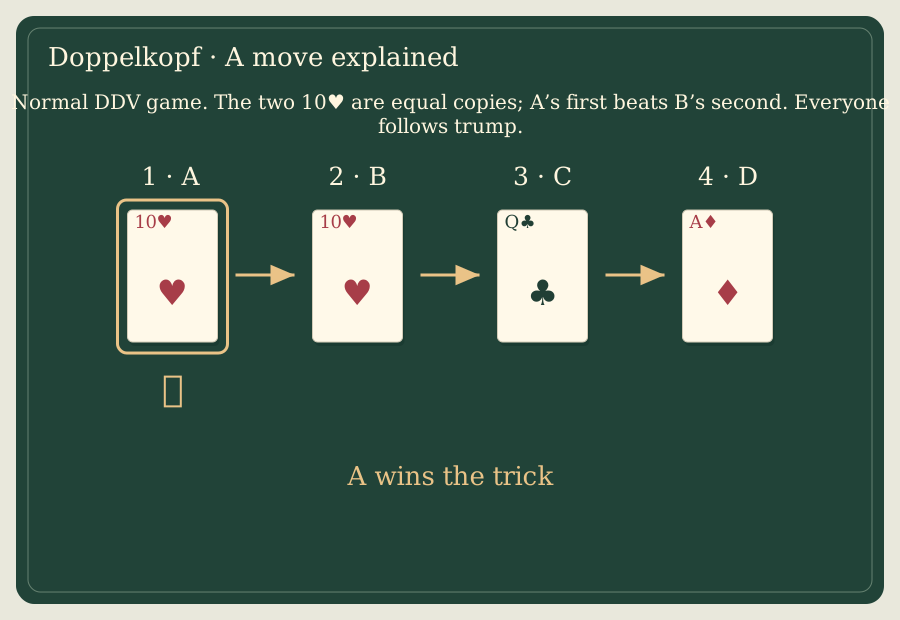
In a normal game A leads 10♥, B plays the other 10♥, C Q♣, D A♦. All follow trump. A takes it: the later identical copy cannot overtake the first. Cards total 10+10+3+11=34, so no 40-point bonus.
Separate settlement: Re earns 160 against 80, with Re and no-90 announced. Main value is 1+1+2+1=5. One Re fox and one Kontra trick of 40 offset to 0: Re partners record +5 each, Kontra −5 each, summing to 0.
← On a small screen, scroll the diagram horizontally. →
Common questions
Is the second 10♥ higher?+
No. Selected DDV rules give equal copies to the first.
Does Re double?+
No. Re adds 2 game points.
May I follow plain spades with Q♠?+
In a normal game only when void of real spades: Q♠ is trump.