← On a small screen, scroll the diagram horizontally. →
01 /
Players and cards
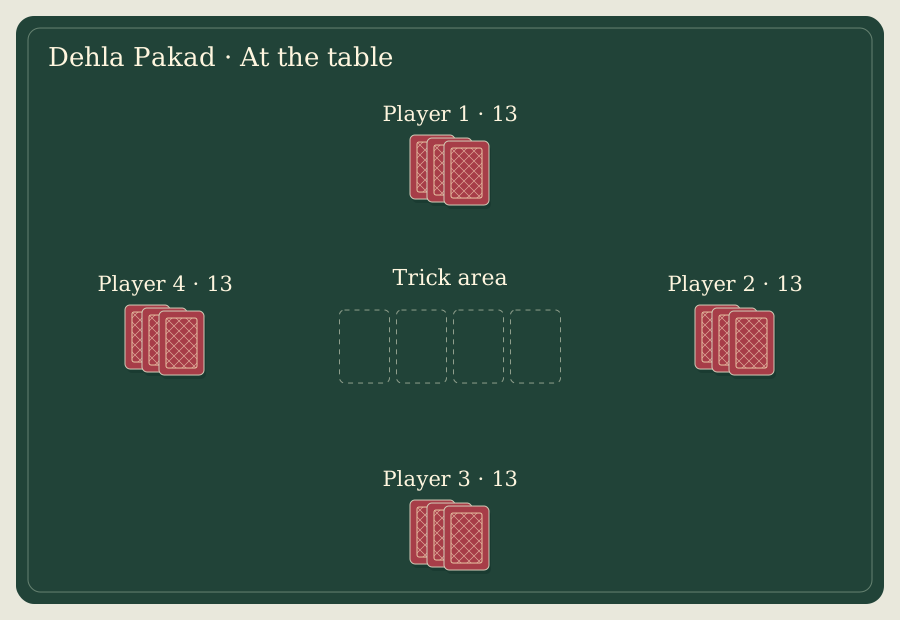
Four players form fixed partnerships, partners opposite. Use an ordinary 52-card pack without jokers, with each suit descending A, K, Q, J, 10, 9, 8, 7, 6, 5, 4, 3, 2. Deal and play counterclockwise. Only the four tens matter. This selects trump nomination from the opening cards and a match to 1 kot, awarded for all tens or a winning streak.
02 /
Deal and opening
Choose the first dealer by lot. Shuffle and deal 5 hidden cards each, beginning on the right. The right neighbour inspects their cards and announces a suit as trump. Deal another 4 and another 4 each: everyone has 13 and no stock remains. The trump maker leads any card. This documented method establishes trump before play; the first inability to follow suit does not select it here.
03 /
Playing a turn
Each player contributes 1 card, following the led suit when able. When void, play anything including trump; neither trumping nor overtaking is compulsory. Highest trump wins, otherwise highest led-suit card. The winner leads next, but the cards do not necessarily enter that partnership’s captures yet. Play all 13 tricks without drawing or discussing concealed hands with a partner.
04 /
Two in a row collect the centre
After a trick place it face down in the common centre. Only when the same player wins 2 consecutive tricks do they collect the entire accumulated centre, including the current trick, into their partnership’s face-down captures. Partners winning consecutively does not qualify. Collection resets the sequence: a third consecutive win stays in the centre, and a fourth collects the new packet. The winner of trick 13 takes the remaining centre regardless of the previous winner. Winning an isolated trick containing a ten therefore does not guarantee ownership of it.
05 /
Scoring
Count tens only in the finally collected captures. All 4 give a kot and win this selected match. With 3 tens a partnership wins the deal. At 2–2 the nondealing partnership wins: the dealing side needs at least 3. Ordinary trick totals do not break this tie. Record the deal winner and its current streak; a win by the other partnership starts its new streak.
06 /
Ending the game
A partnership winning 7 consecutive deals also earns a kot and wins. The target here is exactly 1 kot, so no further deals or ambiguous streak continuation follow a kot. Before a kot: if the dealing partnership won with 3 tens, the deal passes right; if the nondealing side won with 2 or 3, the same dealer deals again. Redeal an incorrect deal before play; correct an illegal card by checking the hand. There are no monetary wagers or extra bonuses.
07 /
History and selected variant
The name refers to collecting tens; Pagat’s detailed account comes from Ankit Bhageria and describes a North Indian game. Do not substitute Mendikot’s ordinary immediate trick collection. Its distinctive feature is deferred ownership of the centre. The checked source establishes neither a sole inventor nor an exact date.
08 /
Worked example
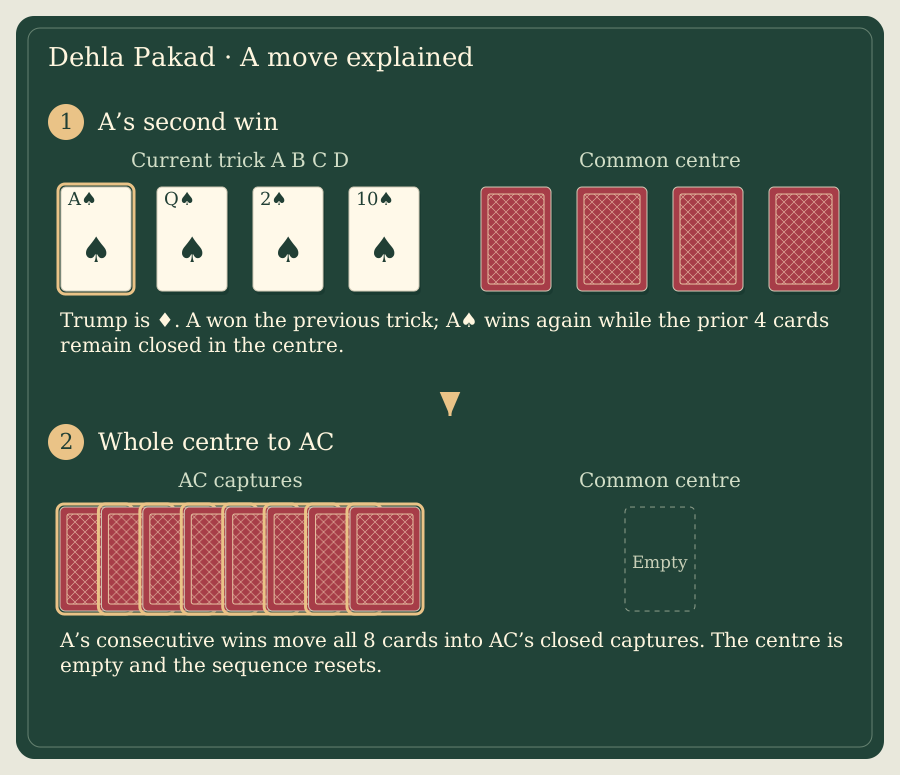
Diamonds are trump and the order is A, B, C, D. A leads A♥; the others play 10♥, 3♥, 7♥. A wins, but these 4 cards remain in the centre. A then leads A♠; replies Q♠, 2♠, 10♠ again give A the win. One player has won 2 in a row: A collects all 8 cards and both tens for partnership AC. Had partner C won the second trick, the centre would remain common.
← On a small screen, scroll the diagram horizontally. →
Common questions
Do consecutive partner wins suffice?+
No, the same individual must win both consecutively.
Is the third consecutive trick collected?+
No: collection requires a fresh pair of consecutive wins; the final trick is the exception.
May I discard while holding trump?+
Yes, when void in the led suit: trumping is optional.