← On a small screen, scroll the diagram horizontally. →
01 /
Players and cards
Two players use an ordinary 52-card pack without jokers. Each has a concealed hand and an open side of the table, sharing a hidden stock and face-up scrap pile. This selects the published classic profile with a 21-point goal, the glasses eight and no hand limit. A card may have different roles, but declare one when playing it. Modern online editions’ effects are not mixed in.
02 /
Deal and opening
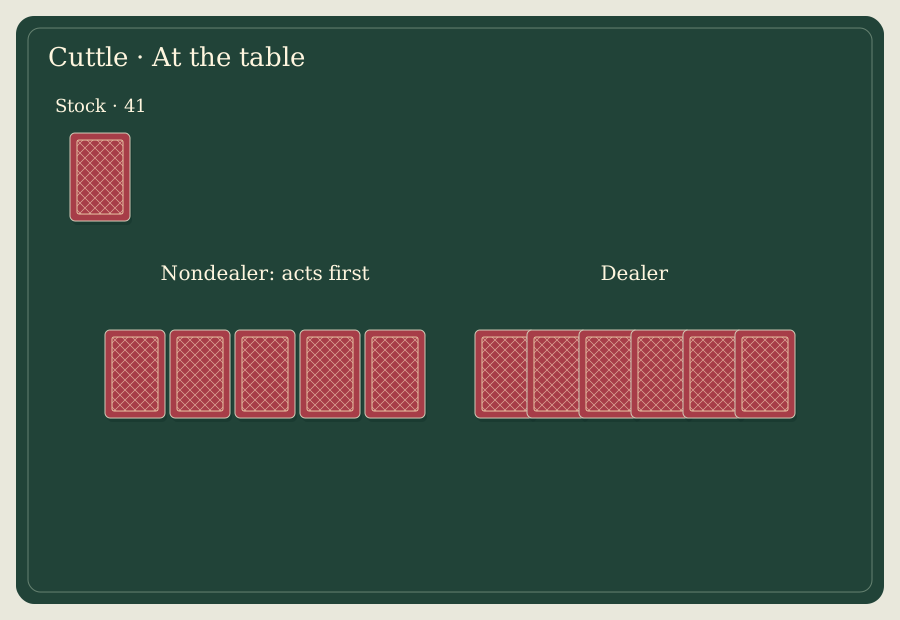
Choose the first dealer by lot. Shuffle; deal the nondealer 5 cards and dealer 6, leaving 41 as hidden stock. Table layouts and scrap start empty. The nondealer acts first, then alternate. An ordinary turn is exactly one action: draw stock top into hand or play one card as points, a scuttle, a one-off or a permanent effect. Drawing does not include a free play.
03 /
Points and scuttling
A–10 may be laid before you as points: A=1, others face value. Cards in hand do not score. Alternatively an A–10 may scuttle an opposing point card: use a higher rank or an equal rank of higher suit, ordered ♣ < ♦ < ♥ < ♠. Scrap both cards; the attacker adds no points. Scuttles cannot target permanents and cannot be blocked by a two or queen. Any J stacked on a scrapped point card are also scrapped.
04 /
One-off effects
A, 2, 3, 4, 5, 6, 7 and 9 may be played as one-offs instead of points; scrap them after resolution. A scraps every point card on both sides. A 2 on your turn scraps one permanent. A 3 chooses any card already in scrap and takes it into hand; it cannot retrieve the three being played, which is not scrapped yet. A 4 makes the opponent choose and reveal 2 hand cards, then scrap them. A 5 draws the stock’s top 2 into hand. If fewer cards can be drawn or discarded, do as much as possible.
A 6 scraps all permanents on both sides but not point cards. A 7 draws the top card and immediately plays it in any legal way chosen; this is part of the effect. If unplayable, scrap it. A 9 returns one permanent to its current controller’s hand. A targeted effect needs an available legal target. The 8 and 10 have no one-off effect in this edition.
05 /
Countering with twos
Before an opponent’s one-off resolves, play a 2 to cancel it. This is the only response outside your turn and does not consume your next ordinary turn. It cannot cancel points, a scuttle or entering a permanent. A counter-two may immediately be countered by another two; alternate until someone declines. The last unblocked counter cancels its preceding effect; cancelled cards and used counters are scrapped. Two successive counter-twos cancel each other and let the original effect resolve. Do not apply an effect before responses finish.
06 /
Permanent effects
An 8 laid sideways as glasses scores 0 and exposes the opponent’s entire hand while one of your glasses eights remains. It is not an ordinary 8-point card. A J goes on a point card and transfers the whole packet across the table. Further J may be stacked, each changing control. Removing any J changes the packet’s control back; when a six removes all J, the point card returns to its original side. With a 9 the removed J enters its current controller’s hand and the remaining packet changes sides.
If a 7 forces a J play and no opposing point card exists, you must give away an eligible point card of your own; with no point cards anywhere the J is unplayable and scrapped. Q and K are simply laid before you, scoring 0 and working while on the table.
07 /
What Q protects
Q protects your point and permanent cards against opposing targeted 2, 9 and J, but not itself or other Q. A two may therefore remove a Q even with several queens present. Global A and 6 effects and scuttling ignore protection. In this classic profile your Q also prevents the opponent countering your played 2 with another two. Do not extend protection to every card in hand; Q does not stop a 4’s hand discard.
08 /
Scoring
Total only your currently controlled point cards. Your K count sets the target: 0 K needs 21, 1 K needs 14, 2 K needs 10, 3 K needs 7, 4 K needs 5. Even four kings do not win without the required points. After your action and all responses fully resolve, meeting your target wins. A counter-two is not a separate ordinary turn. Do not continue after a completed win hoping to remove points later.
09 /
Ending the game
With stock empty, passing replaces the ordinary draw, even if a card could be played. Three consecutive passes produce a draw; any play resets that count. Never reshuffle scrap. An empty hand alone is not defeat: draw from stock or pass when it is empty. After the game collect every card and alternate dealer; repeat an incorrect initial deal before the first action.
10 /
History and selected variant
Cuttle’s exact origin is unknown. Pagat documents it by the 1970s at the latest and preserves Richard Sipie’s FAQ published in 2000. It is an early ordinary-pack combat game, but resemblance to later collectible games does not prove direct influence. Modern communities change 7 and 9 effects, Q protection and hand limits; this deliberately retains one classic profile.
11 /
Worked example
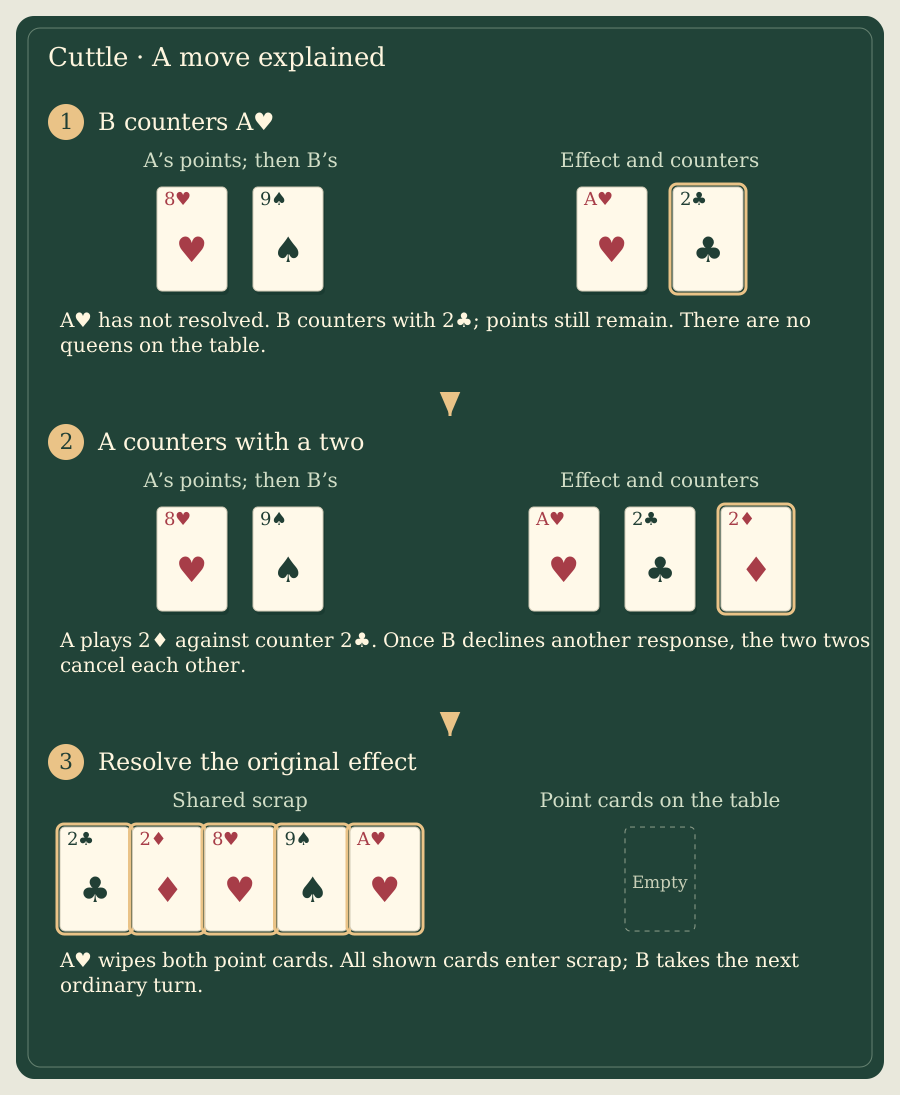
A controls point card 8♥ and B controls 9♠; no queens are on the table. A plays A♥ as a global wipe. B immediately counters with 2♣, but A counters that two with 2♦. The two responses cancel each other and are scrapped; the original A still scraps both point cards and is then scrapped itself. No points remain on the table. B takes the next ordinary turn: the response did not consume it.
← On a small screen, scroll the diagram horizontally. →
Common questions
Does a queen stop scuttling?+
No. It is a separate point-card attack, not a targeted one-off.
Can a two counter a king?+
Not on entry. On your next turn a two may destroy a king already in play if Q does not protect it.
Can a three retrieve itself?+
No, scrap it only after choosing a card already in the scrap pile.