← On a small screen, scroll the diagram horizontally. →
01 /
Players and cards
This selects Danish Agurk for 2–7 individual players with an ordinary 52-card pack and no jokers. Ranks from high to low are A, K, Q, J, 10, 9, 8, 7, 6, 5, 4, 3, 2; suits have no strength. Winning the last trick is dangerous: its winner receives the penalty. Everyone has 2 lives and an initial score of 0.
02 /
Deal and opening
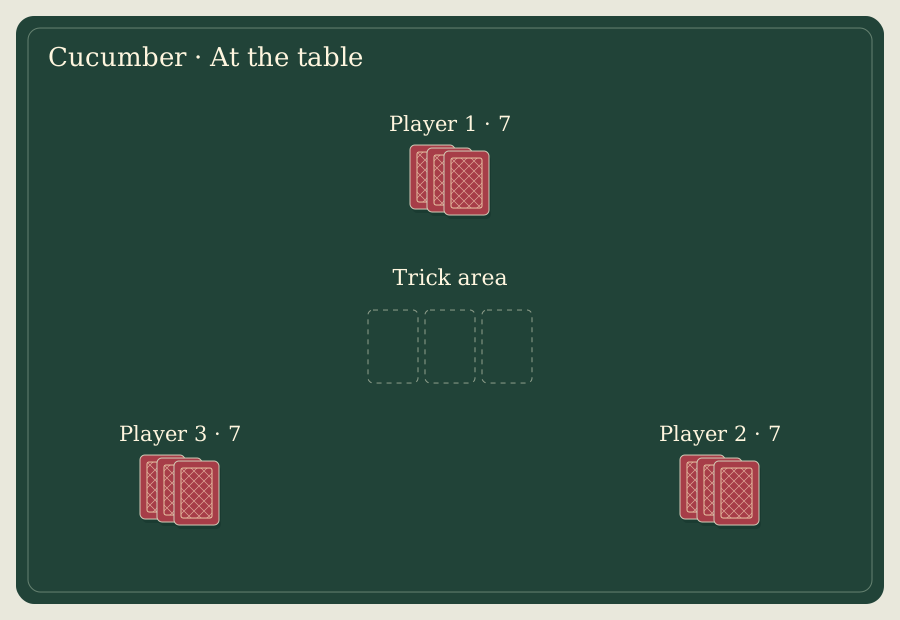
Choose the first dealer by lot. Shuffle the complete pack and deal 7 hidden cards each, beginning on the left and proceeding clockwise. Set the remainder aside face down, unseen and unused. The left neighbour leads first; play runs clockwise. After the deal, the next active player on the left becomes dealer; skip eliminated players.
03 /
Playing a turn
The leader plays any 1 card. Each follower chooses either a card at least as high as the highest already in this trick or their lowest card. The second option remains legal even when a higher card is held. Ignore suits; there is no follow-suit rule. If several hand cards share the lowest rank, choose any of them. A is an ordinary high rank: another A may equal it, with no special prohibition.
04 /
Winning a trick
The highest card wins; among equal highest cards, the last played wins. That player leads the next trick. Leave earlier trick cards face up before their players so anyone may inspect them; do not hide them in capture piles. Play all 7 tricks without drawing. Earlier tricks determine the next lead only and score nothing.
05 /
Scoring
Only the last trick’s winner adds a penalty: 2–10 at face value, J=11, Q=12, K=13, A=14. Others score nothing, even if they shared the highest rank: play order decides. The first time your score reaches 21 or more, lose a life, mark it, and replace your score with the highest current score of any other active player. Exactly 21 also loses a life; there is no reset to 0.
06 /
Ending the game
Reaching the threshold a second time eliminates you permanently. The others return all 52 cards to the pack and continue with a full new shuffle. The last active player wins. Everyone cannot be eliminated simultaneously, since only one player receives a penalty. Redeal an incorrect initial deal before play; correct a disputed response by checking the remaining hand.
07 /
History and selected variant
Cucumber is a North European family known as Agurk, Gurka and Kurkku. Pagat compares Danish, Swedish and other local rules; there is no single international code. This uses the Danish choice between equalling the current maximum and playing lowest, without a Swedish restriction after A or mixed thresholds. An exact inventor is not established.
08 /
Worked example
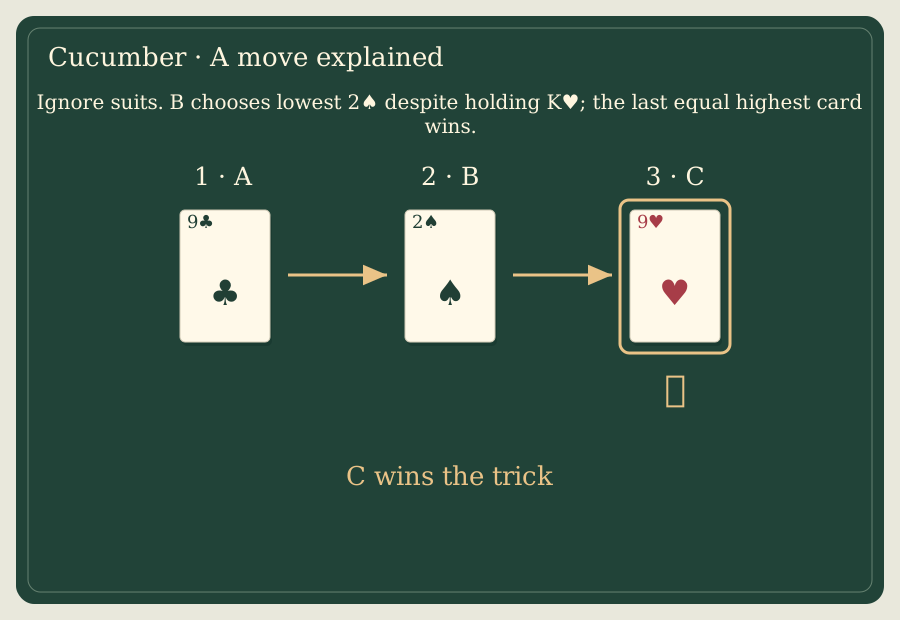
A leads 9♣. B holds K♥, 6♦, 2♠ and may play 2♠, keeping the king: overtaking is not compulsory. C plays 9♥ and, being last of the two nines, wins despite a different suit. This is an early trick. In another deal, the same sequence of final cards would penalise C by 9. In a separate count C’s 14+9=23 crosses the threshold for the first time; with others on 5 and 12, C loses a life and returns on 12.
← On a small screen, scroll the diagram horizontally. →
Common questions
Must I overtake when able?+
Not in this Danish profile: playing your lowest card is always allowed.
Do equal aces all win?+
No, the last equal card wins; only its holder takes the penalty.
Is there trump or drawing?+
No, suits are irrelevant and the undealt pack remains unused.