← On a small screen, scroll the diagram horizontally. →
01 /
Aim and equipment
This selects Foster’s historical Commit: remove only 8♦ from a standard 52-card pack, leaving 51. For 2 to 6 players, all individual. Runs ascend in one suit through A 2 3 4 5 6 7 8 9 10 J Q K, without K–A wrapping. The special 9♦ is the Comet, not a universal joker. Be first to empty your hand.
02 /
Setup and deal
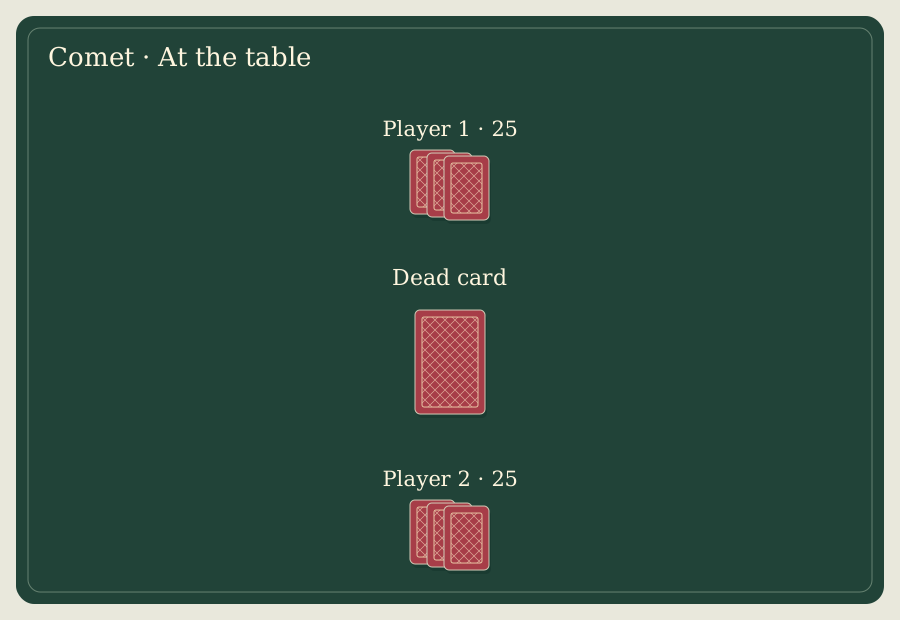
Choose the first dealer randomly, then rotate left. Everyone contributes 1 accounting point to a pool; negative balances are allowed and no cash stakes are needed. Deal equal hands singly: 25 with 2 players, 17 with 3, 12 with 4, 9 with 5, 8 with 6. Set leftovers aside concealed as dead cards, never a draw stock. The dealer’s left neighbour starts.
03 /
Legal actions
A leader may start with any card, then must play the ascending continuation in that suit while able. When the next card is missing, name it and pass left. The next player either supplies that card and continues as far as possible or passes. There is no out-of-turn play. If all others pass and continuation is impossible, the player who laid the last part starts a new run with any card. K always stops a run; its player starts the next.
04 /
Declarations
Only when unable to continue the ordinary run on your turn may you play 9♦ instead of passing. The next player chooses between continuing the old run from its missing card or beginning the diamond continuation at 10♦. The Comet does not substitute a missing rank in the old suit. For the edge case where neither branch can continue after a full circuit of passes, explicitly agree that the Comet player starts anew. Without 8♦, a run normally stops at 7♦. As an unrestricted lead, 9♦ may start a diamond run as an ordinary nine; 10♦ is then required.
05 /
Scoring
Starting a run with an ace earns 1 point from every opponent. Playing K also earns 1 each; playing the Comet earns 2 each. Apply that payment even when the card empties its hand. At the finish an unplayed Comet costs its holder 2 to every opponent; each unplayed K costs its holder 1 to every opponent. Multiple kings produce cumulative transfers; opposing entries may be netted. Other cards have no point value.
06 /
Ending the game
The first empty hand ends the deal immediately and takes the pool. There is no per-leftover-card payment in this profile. Play one deal per participant; highest balance wins and tied leaders share victory. Do not inspect dead cards before the finish or use them to restart a run. Reshuffle all 51 cards for the next deal, keeping 8♦ excluded.
07 /
Context and variants
Comet is associated with French comète; Foster titles his version Commit. The checked edition was revised in 1914 and documents turn-by-turn play with a distinct 9♦ action. That does not prove a precise invention date. CRP gives a different profile with out-of-turn play and a freely substituting Comet. Its mechanics and payment scale are not imported here.
08 /
Worked example
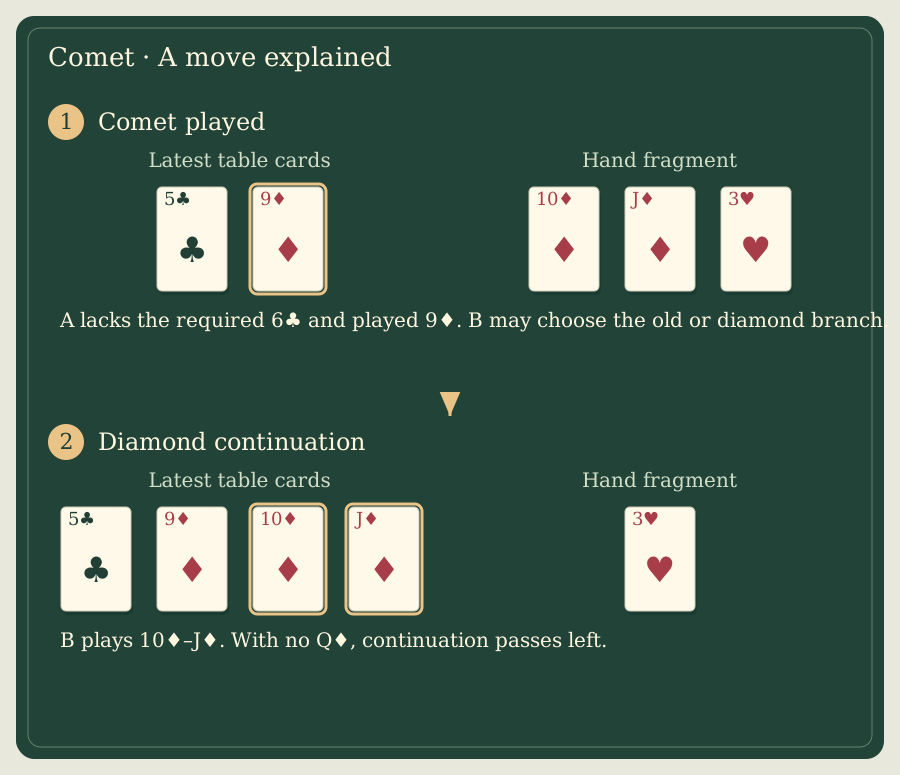
The club run has reached 5♣; A lacks 6♣ but holds the Comet. On their turn A plays 9♦ and receives 2 points from each opponent. B holds 10♦ and J♦: instead of the club branch, B plays 10♦–J♦ and announces the missing Q♦. The 6♣ has not been played and remains with its holder; 9♦ did not become that card.
← On a small screen, scroll the diagram horizontally. →
Common questions
Does the Comet replace any card?+
Not here: it opens a choice between the old run and the diamond continuation.
May I play out of turn?+
No: turns proceed successively to the left.
May I draw the dead cards?+
No: they create stops and stay outside hands for the deal.