← On a small screen, scroll the diagram horizontally. →
01 /
Deal and auction
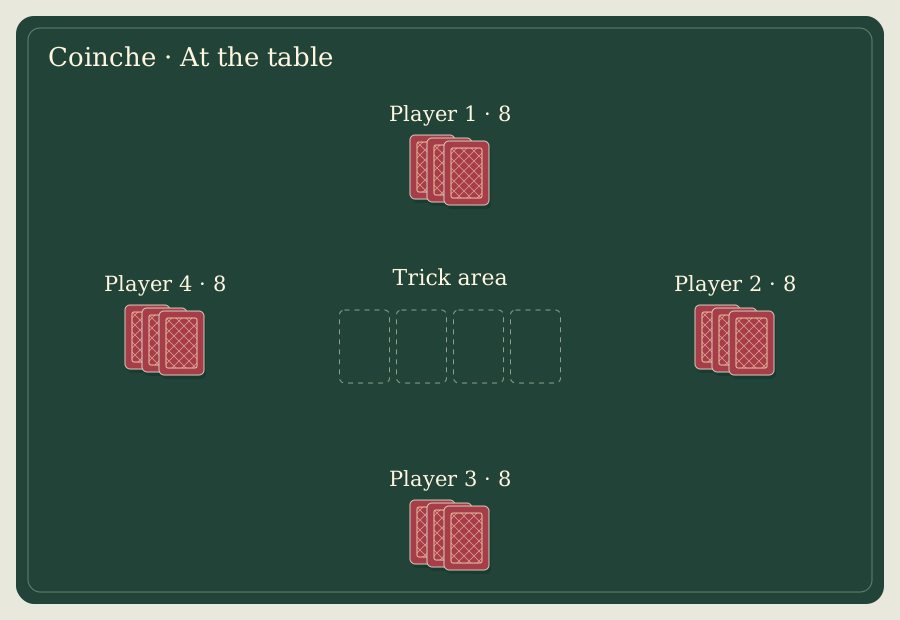
There are 4 players in 2 opposite-seat partnerships, using 32 cards from 7 to ace. Choose the first dealer randomly; the deal, auction and play run anticlockwise. The dealer rotates right after every deal. Agree a 2000-point target. Shuffle every deal, have the left neighbour cut with at least 3 cards in each packet, then deal 8 each in packets of 3, 2, 3.
Starting on the dealer’s right, pass or name a trump suit and a bid of at least 80, in multiples of 10 strictly above the previous bid. Passing does not withdraw you permanently. Capot promises all 8 tricks and outranks every numerical bid. Initial 4 passes mean a new deal; after a bid, 3 successive passes settle it. You cannot raise your own bid without an intervening bid.
On your turn you may coinche an opponent’s bid: the contract freezes and its award doubles. The next 3 passes end the auction unless the bidders surcoinche, which ends it immediately and makes the multiplier 4. A coinched contract cannot be raised. No player can double out of turn.
02 /
Ranks and card play
Trump ranks J, 9, A, 10, K, Q, 8, 7; the corresponding values are 20, 14, 11, 10, 4, 3, 0, 0. Other suits rank A, 10, K, Q, J, 9, 8, 7, worth 11, 10, 4, 3, 2, 0, 0, 0. The player on the dealer’s right leads any card.
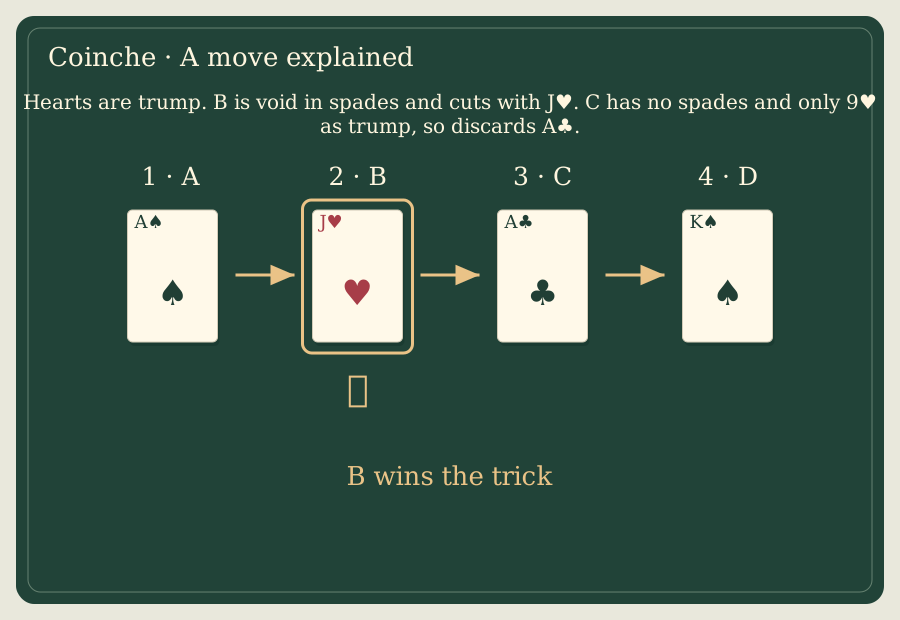
The dealer’s right-hand neighbour leads. Follow suit whenever possible. On a trump lead, overtake the highest trump if able. Void in a plain suit, you may discard freely if your partner wins. Otherwise cut and overtrump if able; unlike the classic profile, if an opponent’s trump cannot be beaten, you may discard rather than undertrump. If your partner has cut and you hold only trumps, undertrumping is allowed. Highest trump, or highest of the led suit if none, wins and leads. Play all 8 tricks.
03 /
Announcements
During the first trick, declare every intended meld when playing your card. A square scores 200 for 4 jacks, 150 for 4 nines, or 100 for 4 aces, tens, kings or queens; sevens and eights do not score. A same-suit run in A K Q J 10 9 8 7 order scores 100 for 5 cards, 50 for 4, or 20 for 3. For a longer run our stated convention uses only its highest 5 cards; cards cannot be reused in another ordinary meld.
After the first card of the second trick, compare the best meld of each side. Squares beat runs; squares rank by value, then card rank. Runs rank by length category, highest card, then trump status. An unresolved tie cancels ordinary melds for both sides. Otherwise the winning side shows and scores all its declared melds. A player originally holding K and Q of trump separately claims belote, worth 20, by saying “Belote” on the first and “Rebelote” on the second. We explicitly allow these cards also in a run; belote is independent of the meld comparison and remains protected.
04 /
Contract and score
Add card points, 10 for the last trick, valid ordinary melds and belote for each side. Capturing every trick replaces the last bonus by 100: card totals are 162 normally or 252 for capot. Before rounding, the bidders must reach the bid and strictly exceed the defenders’ total; a capot bid also requires every trick. An equality is a failed contract.
For an undoubled success, bidders record their total plus the bid; defenders record their own total. A successful capot bid adds 250 as its bid. On a taker sweep, the defenders’ ordinary melds transfer to the takers, but their belote stays with them. On failure, bidders retain only belote; defenders score 160 plus both sides’ ordinary melds, their own belote and the bid, valued at 250 for a capot bid.
For a coinched or surcoinched success, the bidders receive 160, or 250 for a sweep, plus both sides’ ordinary melds, their own belote and the bid, multiplied by 2 or 4. Defenders retain only their belote. For a doubled failure, multiply the defenders’ failure award by 2 or 4; the bidders’ protected belote is not multiplied. Round awards to the nearest 10: 85 becomes 90, 84 becomes 80. Never round first to make a contract succeed.
After a deal, the first side reaching 2000 wins; if both do, the higher total wins, with further play on equality. A side reaching the target only through belote while falling or being swept must still win an additional trick in a later deal to validate victory.
05 /
Check the promise before rounding
A partnership bids 90 hearts and finishes with 89 points, no melds or belote. The contract fails even though rounding would produce 90. Without a double, defenders score 160 + 90 = 250 and bidders 0. This is a scoring example, not a suggested bidding strategy.
← On a small screen, scroll the diagram horizontally. →
06 /
Context and variants
Coinche is a French bidding branch of Belote, in the Jass family. The federation’s publication is a documented rules profile, not evidence for an exact invention year. Regional versions may omit ordinary melds, permit immediate doubles or use different scoring. Agree a complete code in advance; those alternatives cannot be combined with this guide’s federation profile without changing the game.
Common questions
Can I double whenever I hear a bid?+
Not in this profile. You must wait for your turn.
Is belote lost when the contract fails?+
The selected FFB PDF protects it. Some web summaries use another convention.
Can rounding rescue a bid?+
No. Test the contract against unrounded totals, then round the award.