← On a small screen, scroll the diagram horizontally. →
01 /
Two Pedros, one pack
Cinch, or Double Pedro, developed in the American Pitch family during the nineteenth century. “Double” refers to two scoring fives, not two packs. We select Pagat’s main American profile to 62, including replenishment after bidding and ownership of the low-trump point. Versions to 51 and other scoring systems are separate alternatives.
02 /
Trumps and fourteen points
Four play in fixed opposite partnerships with one 52-card pack, no jokers. After trumps are chosen, the five of the other suit of that colour becomes left Pedro: it is a trump for every purpose, not its original suit. Trump order descends A,K,Q,J,10,9,8,7,6,5 right Pedro,5 left Pedro,4,3,2. Other suits rank normally without the transferred five.
Trump A,J,10 each score 1 for their capturers, both fives score 5 each. Trump 2 scores 1 for the side holding it before play, even if opponents capture it. Total is 14.
03 /
Deal and one bidding circuit
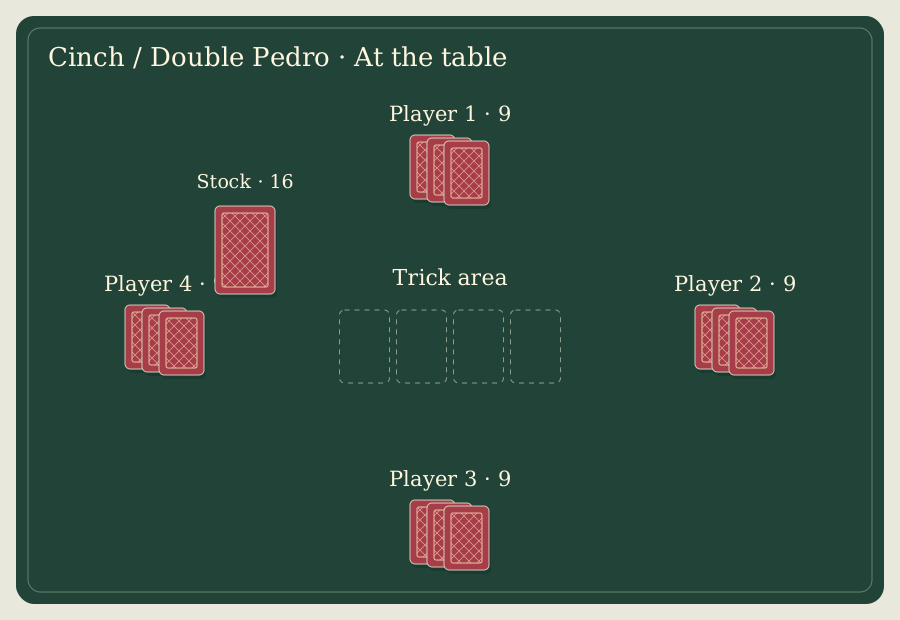
Choose first dealer by lot. Shuffle, cut at the right, then deal clockwise from the left in batches of 3 until each has 9. Deal passes left. There are 16 undealt cards. Each player from dealer’s left through dealer gets one opportunity: pass or a bid of 7–14 strictly above the previous. If the first three pass, dealer must bid 7. Winner names trumps; the promise concerns the partnership’s points, not tricks.
04 /
Discarding and replenishment
Everyone discards all non-trumps face down, retaining every trump. Dealer replenishes the others from undealt cards to 6; anyone already holding 6 or more trumps gets none. Dealer then inspects the undealt remainder, taking all its trumps and enough other cards to reach 6. Dealer does not inspect other discards. Thus hands above 6 are not reduced by discarding trumps. All scoring trumps stay in play.
If undealt cards run out before hands are replenished, shuffle the concealed non-trump discards into a new stock. This explicit teaching agreement for a rare shortage is also used by Card Games Cafe; it does not allow discarding or burying scoring trumps.
05 /
Play and excess trumps
Auction winner leads any card. Follow trump with trump if able. On a plain suit, a holder may either follow it or trump; when void, anything is legal. Overtaking is not required. Highest trump wins, otherwise highest of the led suit. Winner leads next.
Anyone starting above 6 plays excess cards together with the main card so that 5 remain after the first trick. Use a face-up stack: only its top competes to win, the buried cards are captured with it. Burying scoring trumps is forbidden. There are 6 tricks in total.
06 /
Scoring and bidder goes out
Start both sides at 0. Defenders always add earned points. Bidders also add earned points if they reach the bid; otherwise subtract the whole bid, not the shortfall. Negative scores are allowed. Normally the first side at 62 or more wins. If both had at least 55 before a deal, bidder goes out applies: successful bidders win that deciding deal; failure is scored normally. If both first reach 62 together without that condition, play one further bidder-goes-out deal. Scores may tie during the match, but victory follows this resolution.
07 /
Left Pedro is not a diamond
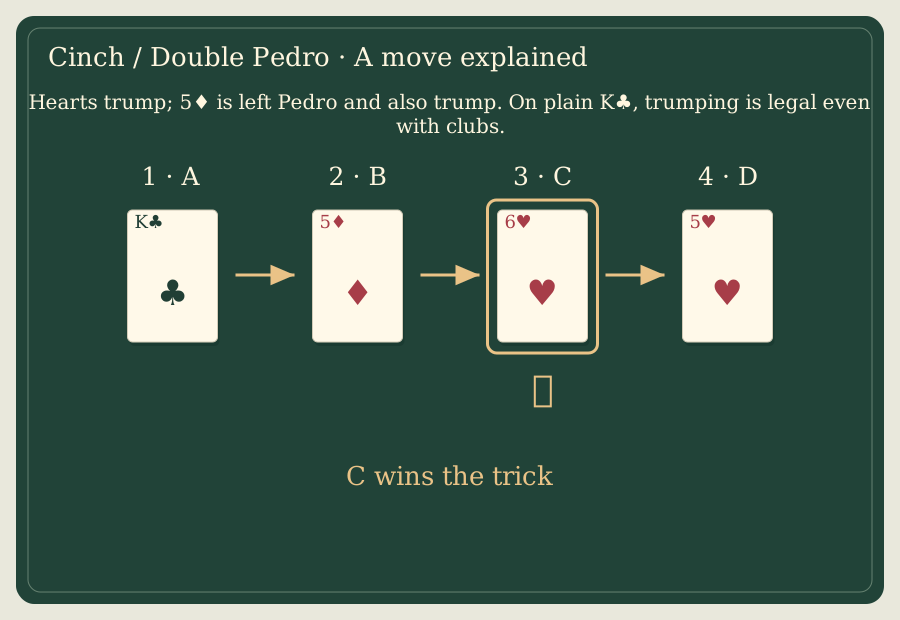
Hearts are trumps, partners A–C and B–D. A leads K♣, B plays 5♦ as left trump, C plays 6♥, D plays 5♥. B and C may trump even if holding clubs. 6♥ outranks both Pedros, so C captures 5+5=10 points in fives.
In a separate settlement, a side bids 10 but earns 9: its score falls by 10 and opponents add the remaining 5. The loss is not just the missing 1 point.
← On a small screen, scroll the diagram horizontally. →
Common questions
Do we need two packs?+
No. The Pedros are doubled, not the pack.
Must I capture 2 for its point?+
No. Trump 2 gives 1 to the side that held it.
May I trump while holding the plain suit?+
Yes; on a trump lead, however, following trump is compulsory if able.