← On a small screen, scroll the diagram horizontally. →
01 /
History and selected form
Bura is documented in Russian-speaking card culture and belongs to the ace-ten point-trick family. The account provided by Alexey Lobashev and Alexander Tvaladze records three-card Bura alongside distinct Kozel forms. No reliable inventor or precise starting year is established here. This guide selects two-player play with exposed responses; concealed discards belong to another form.
02 /
Pack and setup
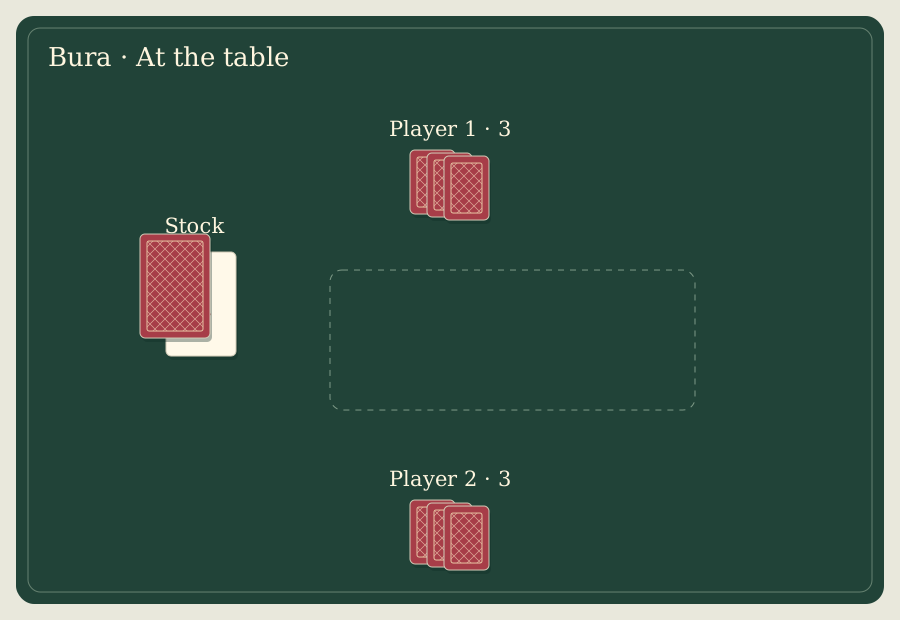
Use 36 cards. Rank A–10–K–Q–J–9–8–7–6; values 11–10–4–3–2–0–0–0–0. The whole pack contains 120 points, but play usually stops earlier. Draw for first dealer. Shuffle, cut and deal 3 each singly; expose the next card for trumps and place stock crosswise above it.
Before the opening deal each puts 1 virtual counter in a common pot. Nondealer leads. Keep hands concealed except for permitted declarations; store captured tricks face down and remember their running value.
03 /
Lead and trick
Lead 1 card or 2–3 sharing a suit. Opponent must answer with the same number but any suits: following and trumping are optional. A higher same-suit card beats a card; any trump beats a nontrump. To win against a group, match every card to a separate superior response. Partial covering does not win: the leader then takes the whole table.
Responses are face up. Trick winner leads next. Replenish to 3 by drawing singly, winner then opponent, repeating as necessary. The indicator belongs to stock. If the remaining stock cannot restore both hands fully, set all that remainder aside and stop drawing. With shortened hands, never lead more cards than opponent holds.
04 /
Bura, aces and molodka
Before the next lead, a special hand may be declared to take over the lead. Priority descends: 3 trumps, Bura; 3 aces; 3 cards of one nontrump suit, molodka. Equal types favour the player who would normally play earlier.
Bura immediately wins the pot. If both hold it, the normal leader exposes first; opponent wins only by covering every trump with their own. Three aces and molodka grant the lead, not an automatic win. Verify declarations by showing the complete hand.
05 /
Claiming 31 and settling the pot
The aim is to stop play by claiming at least 31 points in captured tricks. Reaching it alone is insufficient: claim and expose tricks for verification. Do not inspect older tricks to recount before a claim. A correct claim takes the pot. With 30 or fewer, the claimant adds as many counters as the pot already contains, doubling it without a winner.
In either case the claimant deals next; after a Bura win, its winner deals. Our bookkeeping agreement takes no new ante after a false claim; after a won pot, each contributes 1 again to continue. If all available cards are played without a claim, there is no winner: each adds 1 to the existing pot and the same dealer deals. No split-pot draw applies; continue until the pot is won. Agree session duration beforehand.
06 /
A grouped trick and a claim
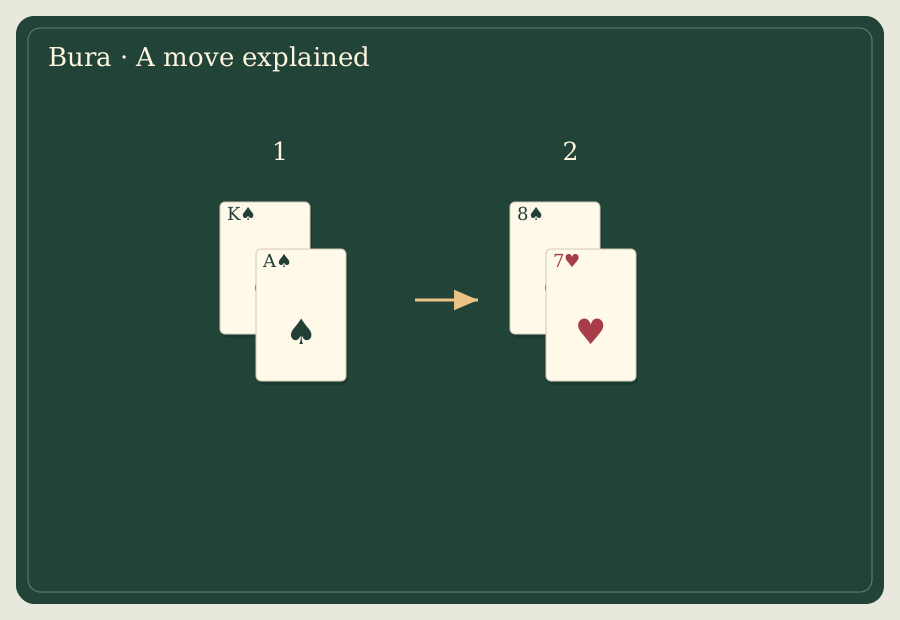
Hearts trump. Against K♠ and 8♠, opponent plays A♠ and 7♥. Ace covers king and trump covers eight, so the responder takes 4 + 0 + 11 + 0 = 15 points. Replacing 7♥ with 7♣ would fail to cover everything, leaving the trick with the leader.
The winner previously held 17 points: now 17 + 15 = 32, enough to claim 31 and win on verification. If a claim instead reveals only 30 with 2 counters in the pot, add 2: the pot becomes 4 and a new deal begins.
← On a small screen, scroll the diagram horizontally. →
Common questions
Must I follow suit?+
No. Even with that suit in hand, you may play other cards and concede the trick.
Do three aces win immediately?+
They only take over the lead in this profile. Three trumps, Bura, give the immediate win.