← On a small screen, scroll the diagram horizontally. →
01 /
Aim and equipment
For 3–8 individual players, use 52 cards without jokers. Ranks matter for matching, not superiority. Empty your hand first; the winner then changes the rules of the next deal.
02 /
Setup and deal
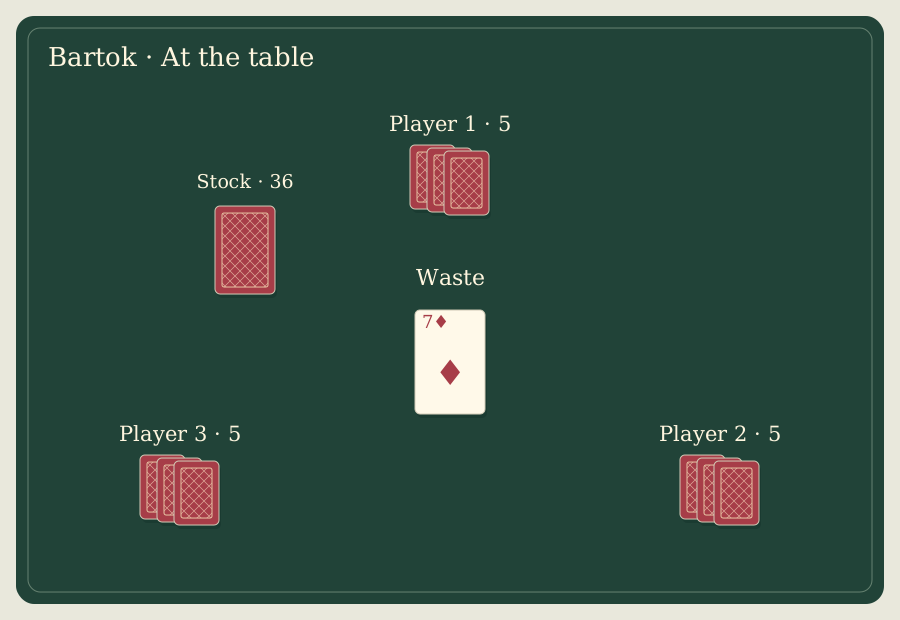
Choose a dealer randomly. Shuffle, deal 5 face down each, leave a stock and expose its top card as discard. This opening card triggers no effects. Dealer’s left starts clockwise. Keep a shared list of added rules; the first deal has no special ranks, so even an eight is ordinary.
03 /
Legal actions
On your turn play exactly 1 card matching the discard’s suit or rank, or draw 1 stock card and end the turn. Drawing is allowed even with a legal play; never play the drawn card immediately. Whenever your hand changes from 2 or more cards to 1, immediately say “Bartok”. Questions and provably false statements are forbidden during play. Added rules can change eligibility and card effects.
04 /
Scoring
A promptly noticed violation accepted by general agreement costs 1 penalty card. This does not replace the normal turn. Undo an illegal discard; its penalty does not legalise it. Call a timeout for disputes: questions about an unclear rule are then allowed and its creator explains it. Conflicts are resolved by the newer rule’s creator. Do not penalise good-faith clarification during timeout.
05 /
Ending the game
An empty hand wins immediately, before the final card’s effect. Award 1 deal win; its winner deals and announces 1 clear impartial new rule. It may repeal an older rule but must not control future rule creation. It begins next deal: for example, “a queen reverses direction”. Play 6 deals; most wins leads, exact ties share places. When stock empties, shuffle all discards except the top as stock. If impossible, players without a play pass; a full circuit without a discard ends that deal without a winner or new rule.
06 /
Context and variants
Bartok, Bartog and Warthog name a family of self-modifying games. Malcolm Ryan’s public rules document this approach without proving a sole inventor of the tradition. Joker packs, secret rules and different opening effects exist. Here rules are public, and suggested effects do not apply until introduced.
07 /
Worked example
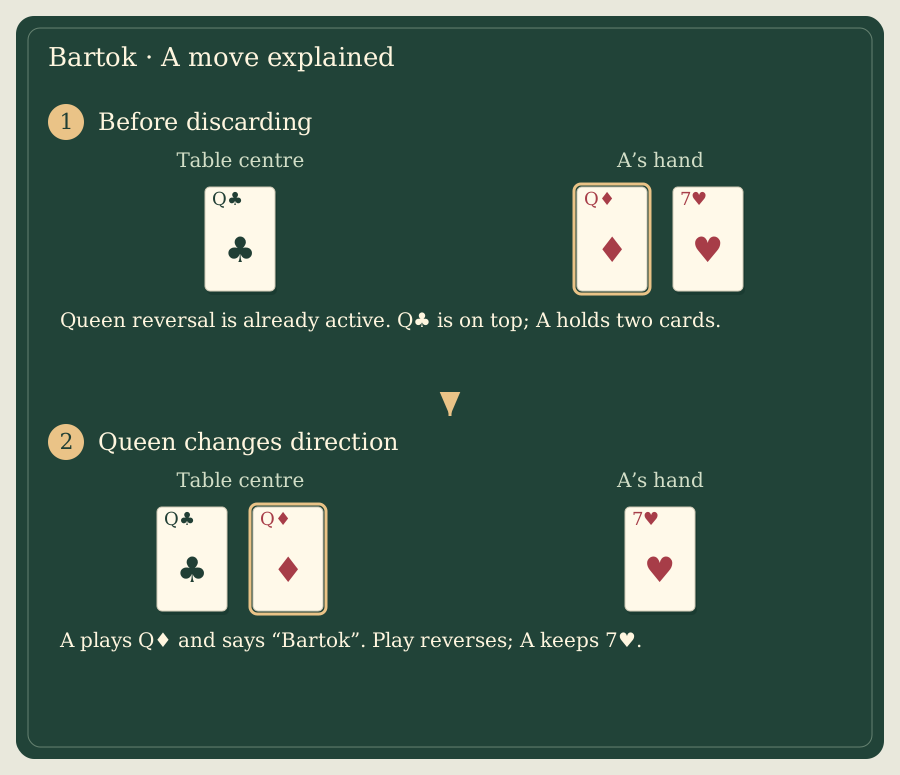
The discard is Q♣ and A holds Q♦ and 7♥. If the queen-reversal rule has been introduced, A plays Q♦ by rank, says “Bartok” and passes anticlockwise. A retains 7♥. Without that added rule the direction would not change. The queen mentioned in an example is not automatically special in the first deal.
← On a small screen, scroll the diagram horizontally. →
Common questions
Are eights always wild?+
No; special properties require an explicit added rule.
Does a penalty replace my turn?+
No, a penalty draw is separate from the normal action.
May I clarify a rule?+
Yes, during a declared clarification timeout.