← On a small screen, scroll the diagram horizontally. →
01 /
Aim and equipment
Four players form opposite partnerships; deal and play anticlockwise. Use 32 cards, 7–A. Hokum trumps rank J, 9, A, 10, K, Q, 8, 7, worth 20, 14, 11, 10, 4, 3, 0, 0. Plain suits and every Sun suit rank A, 10, K, Q, J, 9, 8, 7, worth 11, 10, 4, 3, 2, 0, 0, 0. Last of 8 tricks adds 10: totals 162 in Hokum and 130 in Sun. Projects use a different order, A K Q J 10 9 8 7. Converted game points accumulate from 0 towards 152.
02 /
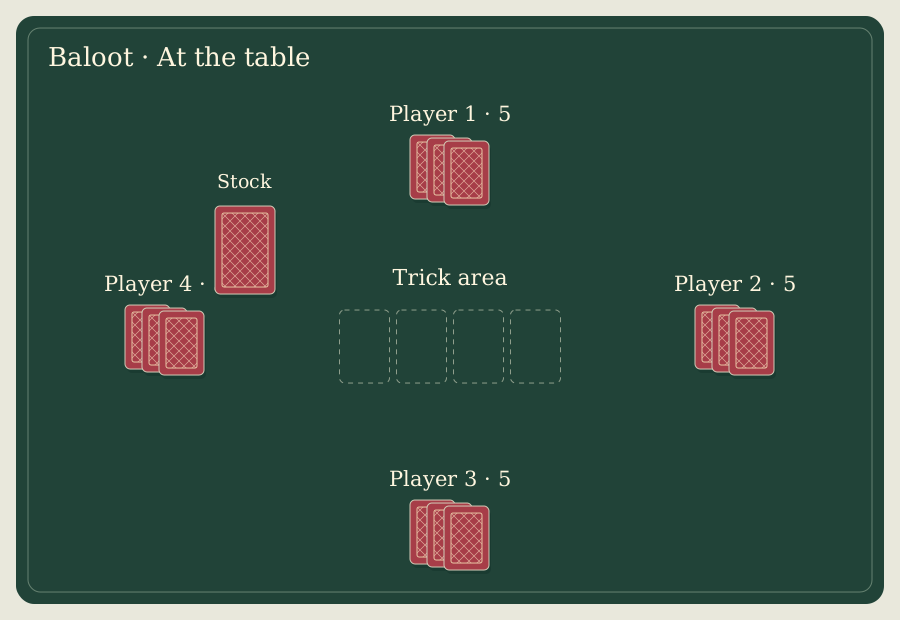
Setup and deal
Choose first dealer randomly, then rotate right. Shuffle and let the left neighbour cut. Deal 3 then 2 each from the right; expose card 21 and hold the rest until bidding. Afterwards the taker receives the exposed card plus 2, others 3 each: everyone has 8. In Ashkal the bidder’s partner takes it and is the declarer for scoring. There is no draw during play.
03 /
Bidding and contracts
Speak from dealer’s right. First circuit: pass, Hokum in the exposed suit, or Sun without trumps. Sun overrides Hokum; after Hokum even earlier passers may call Sun, with priority to earlier seats from dealer’s right. A Sun may also be replaced by Sun from a seat earlier than its bidder; a later seat cannot take it from an earlier one. Ashkal is available only to third seat or dealer after all earlier passes: it is Sun but gives the exposed card to partner.
After all pass, hold a second circuit. Hokum now requires another suit, named before completing the deal; remaining players not yet speaking may override it with Sun. A Sun ends selection. A second-circuit passer cannot later call Sun; no Ashkal here. All pass again: cancel without score and rotate dealer.
After completion and before opening lead, a declarer’s opponent may Double Hokum. Declarer may Triple, the same doubler Quadruple, and declarer Gahwa: winning that deal wins the match. On Double and Quadruple explicitly choose open or locked; locked forbids any trump lead unless the hand contains only trumps. Undoubled, Triple and Gahwa are open. Sun may be doubled only if one team has more than 100 and the other less than 100; no Triple or locked Sun.
04 /
Legal actions
Dealer’s right always leads, regardless of declarer. Follow suit; highest trump, otherwise highest led-suit card, wins and leads. In Sun, void players discard freely and overtaking is optional.
In Hokum on a trump lead, overtake the highest trump when an opponent wins and you can; with partner winning any trump suffices. Without a higher trump still follow trump. On a plain lead, any card of that suit suffices when held. When void: second player must trump; third against a winning second player must win with trump if able, otherwise may discard anything; fourth against a winning opponent does likewise. Fourth is free when second-player partner wins.
Third-player exception: if first-player partner wins, a void third player is free only after an ace lead or Ekka announcement. Otherwise third must trump when holding one, even if partner would surely win. Ekka is legal when leading the highest remaining plain card; with a higher card still unplayed it is false. It never excuses following suit. Locked adds the trump-lead restriction.
05 /
Declarations
Projects below score game points, not card points. Runs use setup’s project order; cards cannot serve twice.
| Project | Hokum | Sun |
|---|---|---|
| Four aces | 10 | 40 |
| Four K, Q, J or T | 10 | 20 |
| Run of 5 in one suit | 10 | 20 |
| Run of 4 in one suit | 5 | 10 |
| Run of 3 in one suit | 2 | 4 |
On your first-trick turn declare 1 project if no better project has already been announced. The best single project determines which team scores all its projects. Compare value; for equal value a four-kind beats a five-card run; then type and highest rank; exact equality favours the earlier player from dealer’s right, without trump priority. After trick one give only information needed for comparison, not cards. On second-trick turns the winning side shows projects: best declarer may add a second and partner may show even unannounced ones. An already played card does not erase the original combination. After trick two return unplayed displayed cards to hands. The losing side shows and scores nothing.
Baloot is originally held trump K and Q, worth 2 game points, announced on the second of them played. Both sides may score it independently of projects. A shown Siri or four-card run containing trump K–Q scores it automatically. A shown five-card run containing K–Q, four K or four Q prevents a separate Baloot.
06 /
Scoring
The counting team is declarer’s opponents, or after increases the opponents of the last side to say Double/Triple/Quadruple/Gahwa. Include last-trick 10. In Hokum round their card total to nearest ten, a final 5 down, then divide by 10; the other side receives the remainder of 16, not an independent rounding. In Sun round to nearest ten but retain a final 5; divide by 5 and give the remainder of 26 to the other side. Add eligible projects and Baloot.
Higher game-point total wins comparison. Hokum tie: counting total endings 2,3,4,5 make counters win; 6,7,8,9,0 make them lose; 1 favours declarer. Sun tie: endings 1,2,3,4 make counters win, 6,7,8,9 lose; 0,5 favour declarer.
Undoubled declarer success lets each team record its own total. Declarer failure awards opponents the whole 16 or 26 plus all scoring projects and Baloot from both sides, declarer nothing. On Double/Triple/Quadruple winners take everything: card budget multiplied by 2/3/4, both sides’ projects only by 2, Baloot remains 2. Gahwa decides the match immediately.
Taking all 8 tricks, Al-kaboot, awards 25 Hokum or 44 Sun plus only the winner’s shown projects; opponents’ projects disappear. With increases multiply this card budget by 2/3/4 in Hokum or 2 in Sun, own projects by 2, and add 2 for own Baloot. Narrow teaching agreement: ordinary undoubled Hokum sweeps also add 2 for the winners’ properly announced Baloot. The source does not expressly resolve that particular case; this is not a claim of universal national practice.
07 /
Ending the game
After the full calculation add the awards to cumulative scores. When a side reaches 152 the higher total wins; equal totals of at least 152 require another deal. Gahwa ends the match regardless of previous scores. Do not confuse card budgets 162/130 with the target 152 game points.
08 /
Context and variants
Baloot is related to French Belote and well established in Saudi Arabia and Kuwait. Sun is associated with French sans, meaning no trumps. This linguistic relationship proves neither an exact date nor a sole inventor. This selects the detailed Saudi profile with published player clarifications; Ashkal access, trump-project priority and scoring variants exist. The teaching clarification for Baloot in ordinary sweeps is explicitly separate from verified rules.
09 /
Worked example
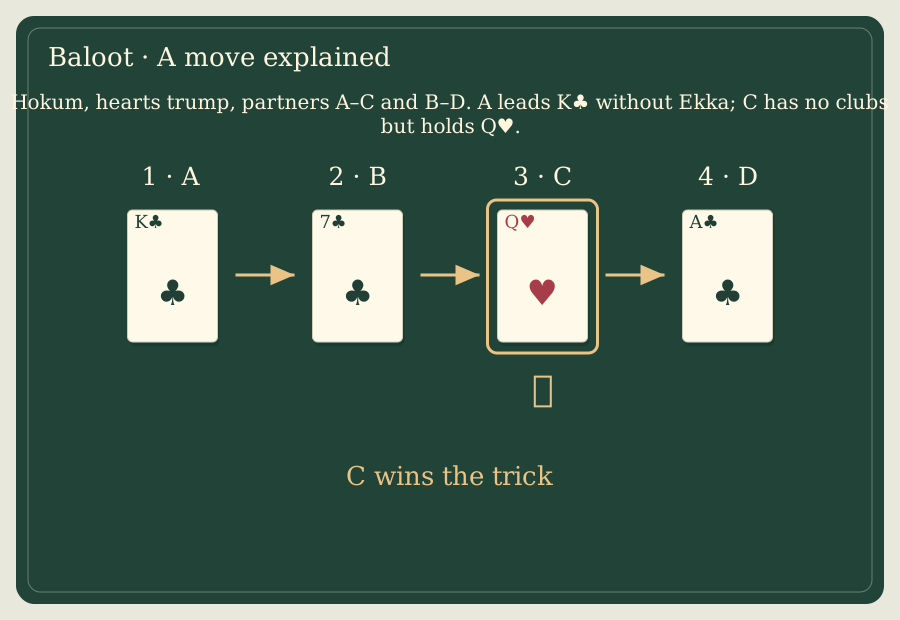
Hokum, hearts trump. A leads K♣ without Ekka; B plays 7♣. Void C must play Q♥ even though partner A currently wins. D follows A♣: C takes with trump. Ekka on K♣ would have been illegal because D still held A♣.
In a separate undoubled Hokum without projects, declarer takes 84 and defenders 78, total 162. Defenders count: 78 rounds to 80, giving 8. Declarer gets the remaining 8. The game-point tie with counter ending 8 makes counters lose, so each records 8. Never round both sides independently.
← On a small screen, scroll the diagram horizontally. →
Common questions
May I discard when partner is winning?+
Not always: a void third player may still have to trump without an ace or Ekka from first.
Are projects ever tripled here?+
No; even on Triple or Quadruple eligible projects are only doubled.
Does each team round its own cards?+
No; the designated counting team converts and the other receives the budget’s remainder.