← On a small screen, scroll the diagram horizontally. →
01 /
Partners and 144 cards
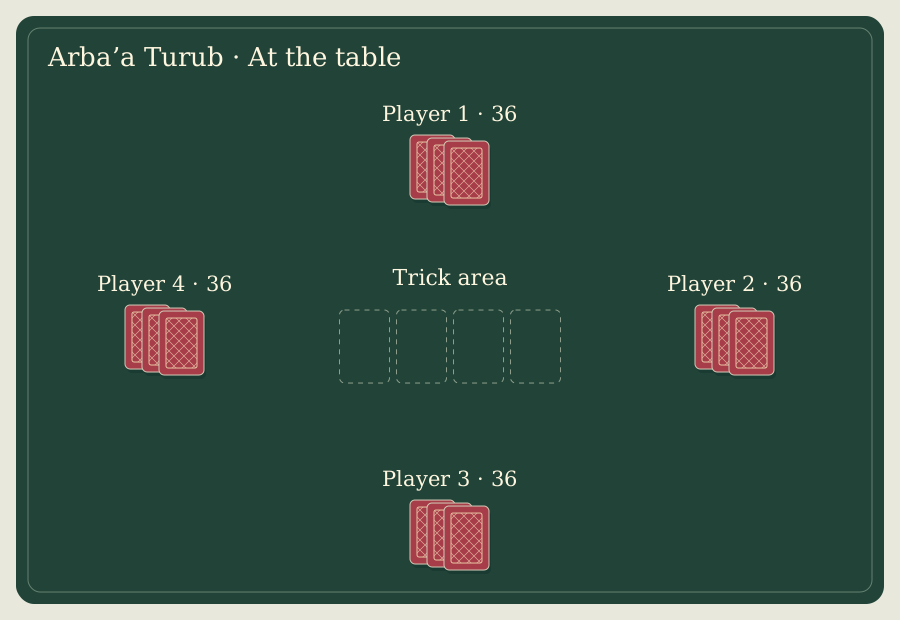
Four play in fixed partnerships, sitting opposite. Combine four identical 52-card decks after removing everything below six, leaving 144 cards. Each suit has four copies of A K Q J 10 9 8 7 6, ranked in that descending order. Remove jokers. Card values are irrelevant: every trick counts as one trick.
02 /
Choose trump from three cards
Expose one card per person to choose the first dealer, highest dealing. Our practical tie convention is to repeat among tied highest players. Dealer’s left-hand neighbour cuts. Deal in packets of three. Stop after the player left of dealer receives the first packet: that player looks at those three cards and names trump. Resume until everyone has 36.
Dealer shows that the final packet dealt to the dealer contains exactly three; an incorrect count requires a redeal. Sort hands by suits. With so many duplicate cards, checking counts prevents avoidable mistakes.
03 /
Thirty-six tricks
The player left of dealer leads. Follow suit when possible; if void, trump or discard freely. There is no compulsory trumping or overtaking. Highest trump wins, otherwise highest card of the led suit. Among identical cards of the same suit and rank, the earliest played ranks higher. The trick winner leads next. There is no drawing: play every card.
Only the player leading the current trick may signal a partner. The documented examples use a table knock after leading to indicate a strong suit and a finger click for a weak one. Other players cannot signal in this way.
04 /
Win again with more tricks
The partnership taking more tricks wins the game; 18–18 is a draw. Winning the match requires two wins without an intervening loss, with more tricks in the final qualifying win than in the first. A subsequent win with an insufficient number is treated as an intervening draw and does not lower the original benchmark.
For example, A first wins 20–16. Winning 19–17 next is insufficient: A still needs more than twenty. A later 22–14 wins the match. If B wins instead, A’s sequence ends and B’s first victory establishes a new benchmark. Ordinary drawn games do not break a sequence.
05 /
The next dealer
If dealer’s partnership wins, the opposing partnership deals next. If it loses, the other member of dealer’s partnership deals. After a draw the same dealer remains. Where a choice of member in the opposing partnership is unspecified, this guide explicitly selects the next eligible player clockwise.
06 /
Duplicate aces in one trick
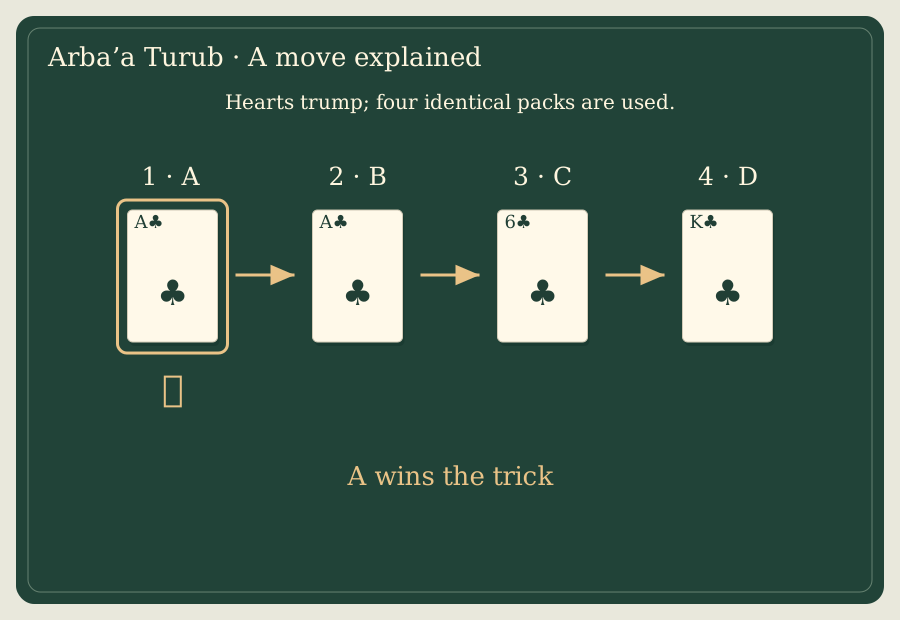
Hearts are trump. The cards played are A♣, another A♣, 6♣, K♣. The first ace wins. If the third player instead has no clubs and plays 6♥, that trump takes the trick. The later identical ace never overtakes the earlier ace by itself.
← On a small screen, scroll the diagram horizontally. →
07 /
Context and limits of the record
The available account documents Somali play through a named Mogadishu informant. It cannot establish a precise invention year or uniform rules throughout Somalia. Arpaa Turup is an alternative transcription; this guide uses Arba’a Turub. The mechanics and match structure work without monetary stakes.
Common questions
Which identical card wins?+
The one played earlier, when both rank and suit are equal.
May I choose trump from my full hand?+
No. Choose from your first three cards before dealing resumes.
Are any two consecutive wins enough?+
The final qualifying win must take more tricks than the original win.