← On a small screen, scroll the diagram horizontally. →
01 /
Cards and play chips
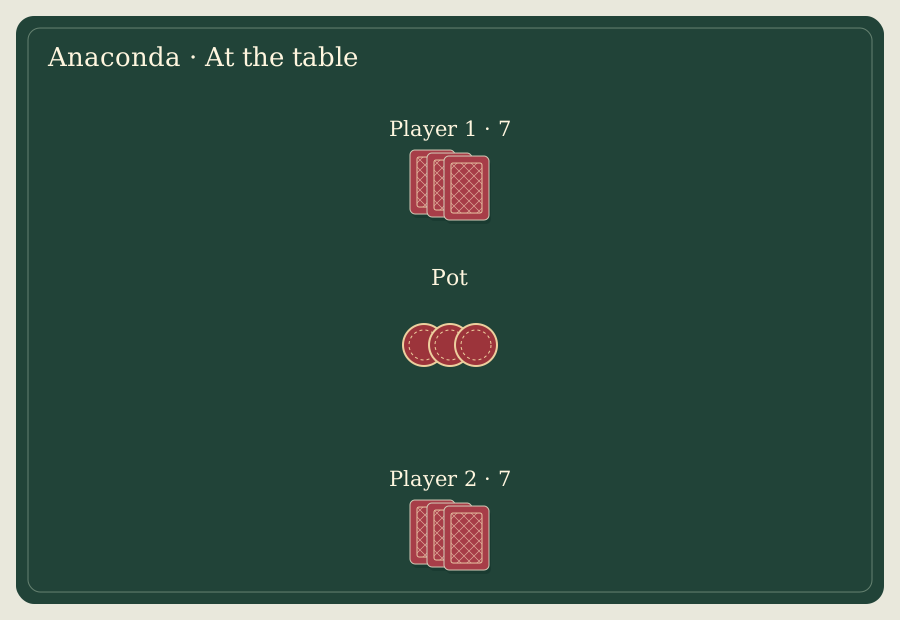
This guide selects Pagat’s high-only version: one three-card pass to the left, followed by rolling a chosen five-card hand. Use 52 cards without jokers for 2–7 players, each playing individually. Everyone antes 1. Deal seven cards face down, singly clockwise from the dealer’s left. Seven players consume 49 cards; the rest of the pack is unused.
Our teaching limit is a bet of 1 and raises of 1, with one bet and at most three raises in each round. Require a starting reserve of 25 per new deal: the ante plus six rounds of at most four. This avoids all-ins and side pots.
02 /
One pass of three cards
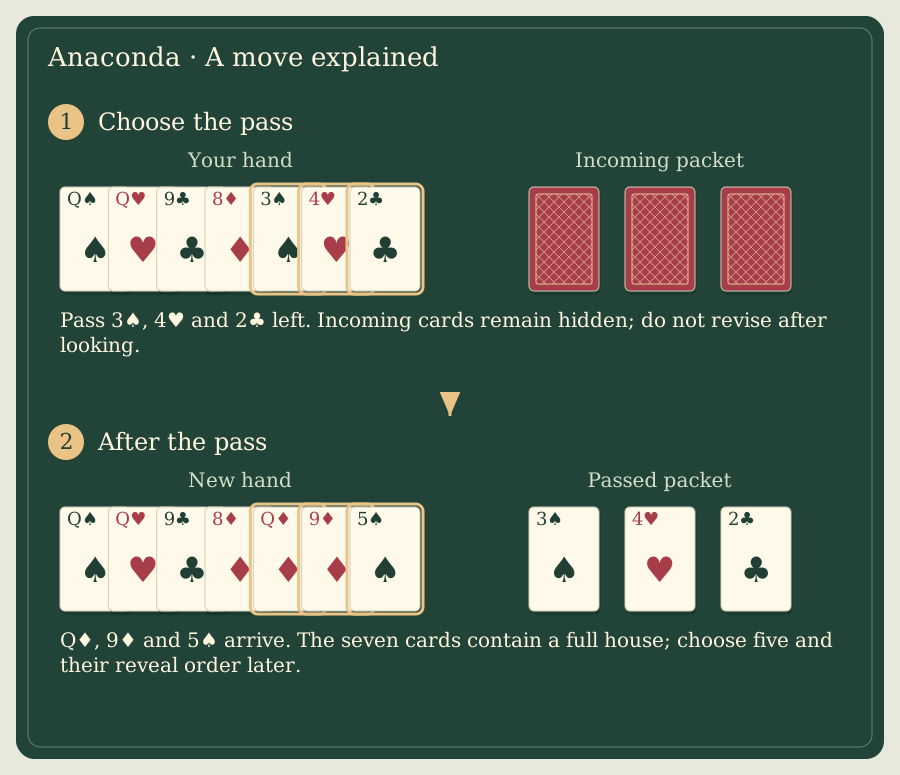
Look at your seven cards and hold the first betting round, starting to the dealer’s left. Each remaining player then selects three unwanted cards and places them face down. Once everyone has committed, pass each packet simultaneously to the next active player on the left, skipping anyone who has folded. Do not inspect incoming cards before committing your own packet.
Add the three received cards to the four you kept, restoring a seven-card hand. Hold a second betting round, again beginning with the first active player to the dealer’s left. There are no further passes in this selected version.
03 /
Choose and roll five cards
After the second betting round, discard two cards. Arrange the remaining five in the order you want to reveal them, then stack them face down. That order is now fixed. Everyone reveals their first card simultaneously and bets. Repeat for the second, third and fourth cards, with a betting round after each. The fifth stays concealed until showdown.
Each rolling round begins with the strongest exposed hand. Compare any pairs, two pairs, trips or quads first, then remaining high cards; aces are high. Unfinished straights and flushes have no value. Our positional convention breaks an exposed-hand tie in favour of the first active player clockwise after the dealer.
04 /
Betting and the finish
With no outstanding bet, check or bet 1. Facing a wager, call, raise by 1 or fold. Check-raising is permitted. Continue clockwise until everyone remaining has answered the last raise, or all check. Folded players take no further part and cannot win. If only one player remains, award the pot immediately.
After betting on the fourth exposed card, reveal the fifth without another betting round. Highest hand takes the pot. The category order is straight flush, quads, full house, flush, straight, trips, two pair, pair, high card. Compare main groups first, then kickers from highest down; compare the higher pair first for two pair and the triplet first for a full house. Identical hands split the pot, with no suit ranking. Give an indivisible chip to the first tied winner clockwise after the dealer.
05 /
What a pass can change
You hold Q♠ Q♥ 9♣ 8♦ 3♠ 4♥ 2♣. Pass 3♠, 4♥ and 2♣. You receive Q♦, 9♦ and 5♠, producing a seven-card hand containing the full house Q♠ Q♥ Q♦ 9♣ 9♦. Discard 8♦ and 5♠.
One possible reveal order is 9♣, Q♠, 9♦, Q♥, with Q♦ last. Your first four exposed cards show two pair while your complete hand is a full house. That concealed information affects betting, but you cannot change the reveal order after seeing an opponent’s wager.
← On a small screen, scroll the diagram horizontally. →
06 /
Names and different versions
Pagat gives Anaconda as another name for Pass the Trash. Bicycle describes a different game under Anaconda: pass three left, two right and one left, then choose the best five of seven without the rolling procedure above.
High-low versions with declarations and versions with a 3–2–1 passing sequence also exist. They are alternatives, not extra compulsory stages of this hand. The consulted sources do not establish a single inventor or invention date. Agree the passing and showdown format before dealing.
Common questions
How many passes are there?+
One three-card pass in this selected version. 3–2–1 passing belongs to other versions.
Can I reorder my stack while rolling?+
No. The order is fixed before the first reveal.
Is there betting after the fifth card?+
No. Reveal it after the fourth rolling betting round and compare hands.