← On a small screen, scroll the diagram horizontally. →
01 /
Partners and card order
Four play in fixed partnerships, sitting opposite. Retain A K Q J 10 9 in every suit, making 24 cards. Deal and play anticlockwise. Q♣ and J♣ are the two highest trumps. Ordinary trumps follow A K 10 Q J 9, omitting duplicate club courts. Non-trumps instead rank A 10 K Q J 9; Q♣ and J♣ are removed from ordinary clubs.
02 /
Draw partners and cut
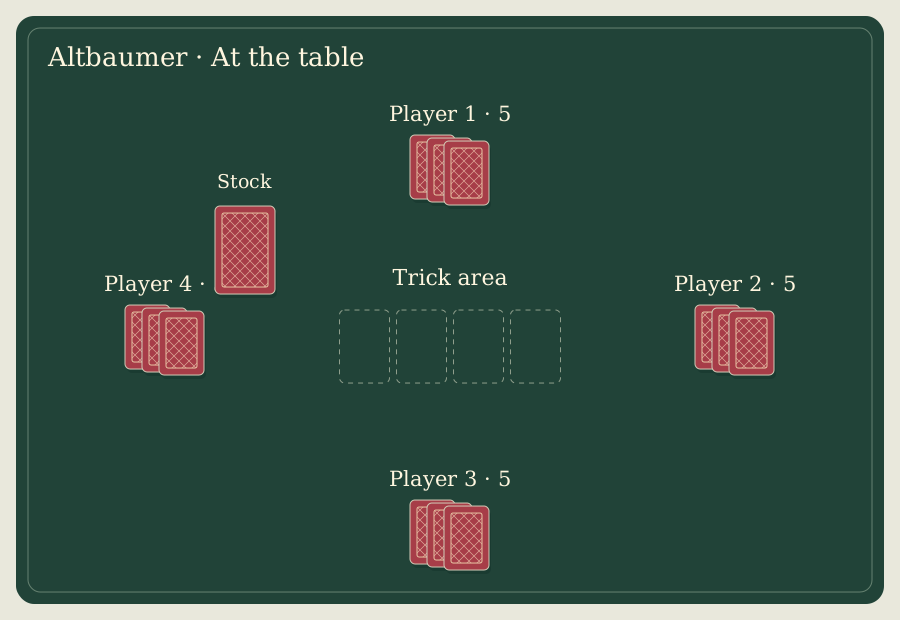
Shuffle the four nines and draw: red nines partner against black nines; 9♣ deals first. The player left of dealer cuts. If a Tree appears at the cut, the cutter may take it face up; if the next card is the other Tree, that may be taken too. Deal five each, three then two, reducing the cutter’s first packet for any Trees already taken. Four cards remain face down as stock. The next dealer is on the right.
03 /
Making trump
Expose the top stock card. Forehand, on dealer’s right, may accept its suit, take it and discard one face down. Alternatively refuse: expose further stock cards until a different suit appears and automatically becomes trump. Forehand takes that indicator and discards one. If all four stock cards share a suit, that suit is compulsory; forehand takes all four and discards four. A turned Tree represents clubs when deciding the suit.
Forehand’s partnership makes trumps. Either member may elect to play alone, putting the partner’s hand aside for this deal.
04 /
Following and trumping
Forehand leads. Follow suit if able; otherwise trump if able; only when unable to do either may you discard freely. Overtaking is not required. Highest trump wins, otherwise highest card of the led suit; the winner leads next.
Trees normally belong to the trump suit. Exception: when an ordinary club is led with another suit trump, a player may follow with an ordinary club or a Tree. Without ordinary clubs, a Tree must be played before an ordinary trump; without clubs or Trees, trump if possible. A Tree lead instead requires trumps. A Tree always retains its winning power as a top trump.
05 /
Rounds and the match
A team winning three or four tricks scores +1; all five scores +2. Losing trump makers additionally score −1, while losing defenders score zero. Accumulate to 5: the first team reaching at least five wins a round, then reset both totals. A lone player taking all five wins the current round immediately, regardless of the running scores.
Two round wins win the match. At one round each, however, the deciding third round consists of just one deal: its three-trick winner wins the match. Five tricks cannot divide equally.
06 /
A club lead with diamonds trump
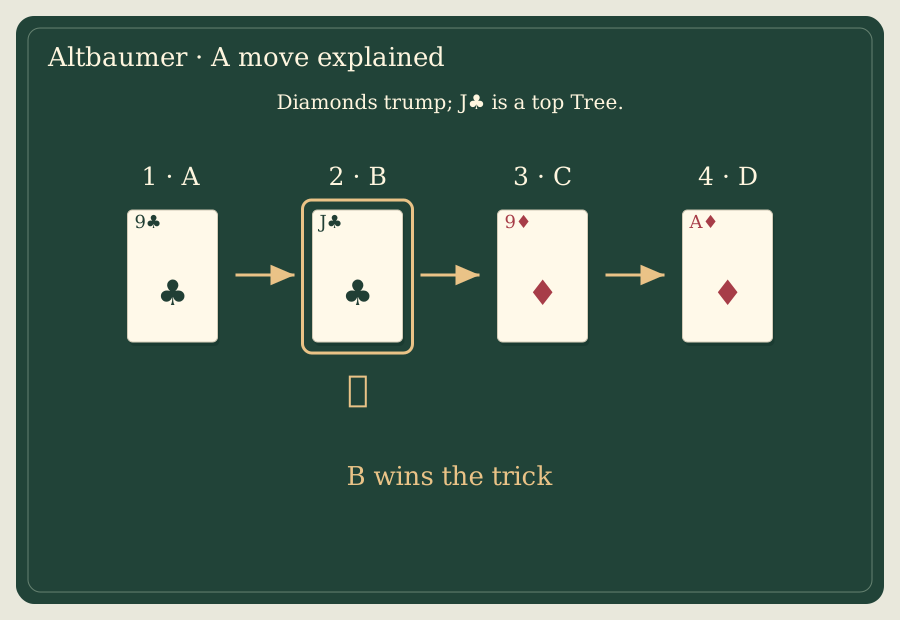
Someone leads 9♣ and you hold A♣ and J♣. Either is legal, but J♣ even beats A♦. The next player has neither ordinary clubs nor Trees but holds 9♦: that trump must be played rather than saved by discarding a heart.
← On a small screen, scroll the diagram horizontally. →
07 /
A local living tradition
The published account records play in Röthenbach in the High Black Forest, with field sessions in 2025 clarifying details. Memories of play in St. Märgen establish a regional connection, without providing an exact invention year. Traditional scoring erases branches on a drawn tree and clears negative marks before making positive progress. The older St. Märgen scoring is incompletely documented and is not reconstructed here.
Common questions
What is the highest card?+
Q♣ in every trump suit, followed by J♣.
Does a ten beat a king?+
In non-trumps, yes. In the trump suit the king ranks higher.
Can someone play alone?+
Yes: either trump maker may set the partner out; winning all five immediately wins the round.