← On a small screen, scroll the diagram horizontally. →
01 /
Partners, cards and setup
Fixed partners sit opposite. Use 52 cards without jokers, ranked A K Q J 10 down to 2 in every suit. Deal and play clockwise. Arrange partners and choose a first dealer beforehand; drawing cards with tied draws repeated is a practical selection method. This organisational choice does not change the trump procedure.
02 /
Six cards and a request
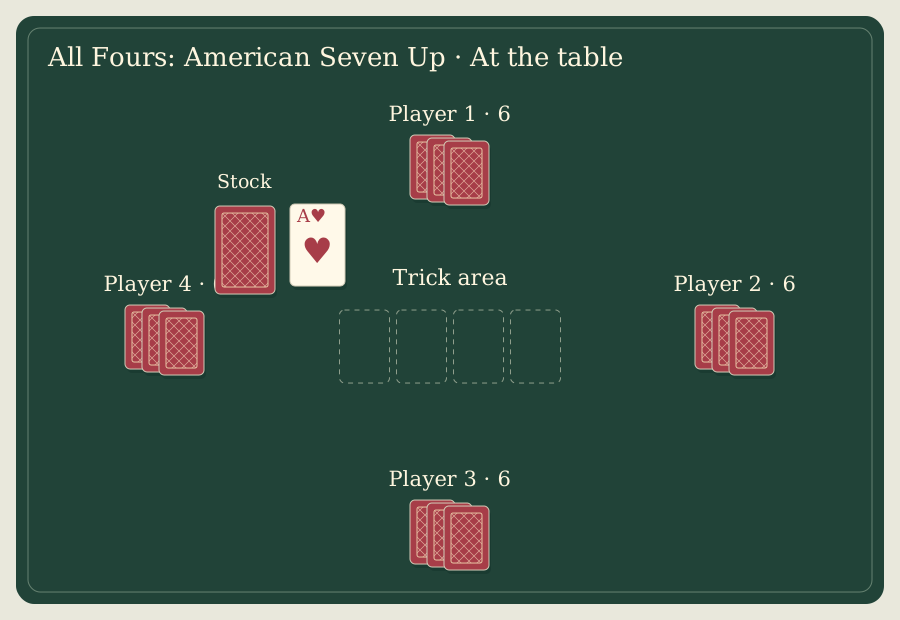
Dealer shuffles and the right-hand neighbour cuts. Deal three each twice, then turn up the next card to propose trump. The player left of dealer may accept or beg for another suit.
Dealer can keep that suit by giving the opposing partnership one point. Otherwise set the turn-up aside, deal three more each and expose another card. Repeat while the original suit reappears, stopping when a different one becomes trump. If the pack runs out first, gather, shuffle and redeal with the same dealer.
03 /
New trump and discards
After a different suit appears, anyone may propose bunching: a fresh deal by the same dealer. Everyone must agree. One player insisting on continuing preserves the deal, and no point is awarded for that refusal. When playing on, everyone discards face down to six cards. Discards and the remaining pack take no part.
An exposed jack scores one for dealer’s partnership only when that exposed card finally determines trump. A jack in the rejected original suit scores nothing, and bunching cancels the turn-up bonus. This is the selected account’s procedure; other historical editions describe it differently.
04 /
Play the tricks
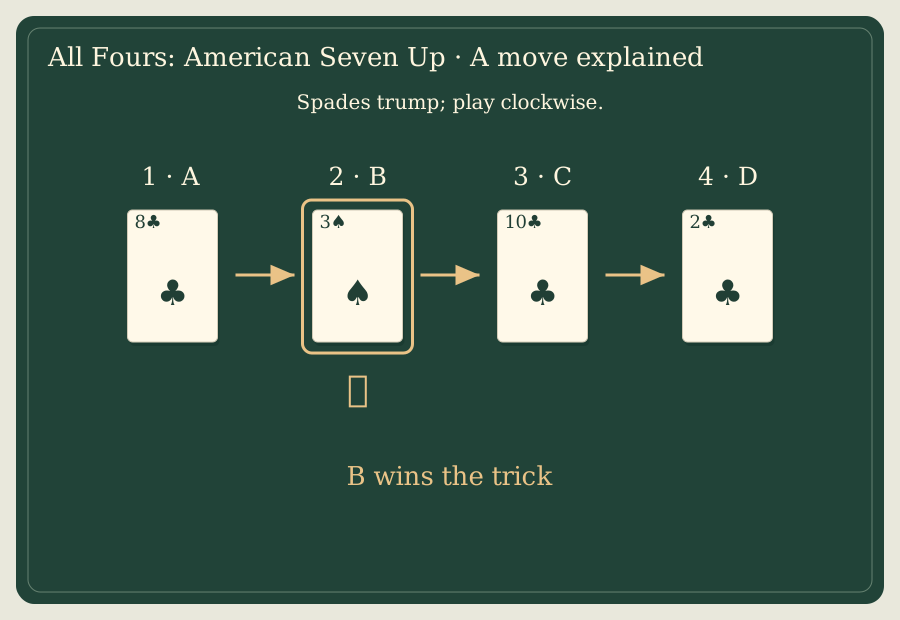
The player left of dealer leads. Follow a trump lead with trump if possible. On a non-trump lead, either follow suit or trump, even when holding the led suit. If void, play anything. Overtaking is unnecessary. Highest trump wins; otherwise highest card of the led suit. The winner leads next. Play all six cards.
05 /
Score and finish
Award one each in order: High to the original holders of the highest trump in play; Low to the original holders of the lowest; Jack for capturing the trump jack; Game for the greater captured card-value total. An undealt jack provides no point.
For Game, in every suit A=4, K=3, Q=2, J=1, 10=10, others zero. In this partnership version an equal total awards the point to dealer’s opponents, a significant difference from Yorkshire.
Start at zero; first to seven wins. After play, apply High, Low, Jack, Game strictly in that order to settle apparent simultaneous finishes. The final turn-up-jack bonus and a conceded begging point count before tricks once the hand’s conditions have been settled.
06 /
A tied Game still earns a point
Each partnership has eighteen card-value units in its tricks. North–South dealt, so East–West receive Game. This is one scoring point, not eighteen on the match total. If East–West began on six and no earlier scoring category has already ended the match, that Game point wins.
← On a small screen, scroll the diagram horizontally. →
07 /
Context and boundaries
All Fours was widely described in nineteenth-century North America, with Old Sledge and Seven Up naming this branch. It is not automatically equivalent to every Pitch version: an auction for a number of points belongs to another development. This guide excludes early American ten-point games, three-player gift provisions and later Foster editions with differing procedures.
Common questions
Who receives Low?+
The original partnership holding the lowest trump in play, not its capturers.
Can we retain nine after one running round?+
Some versions do, but this guide always discards back to six.
Who wins a tied Game?+
Dealer’s opponents in the chosen partnership version.