← On a small screen, scroll the diagram horizontally. →
01 /
History and selected rules
War is an international children’s game without tactical choices; its precise author and date are unknown. This selects the English-language game for 2, not every rule of Russian P’yanitsa. Use 52 cards, A–K–Q–J–10–9–8–7–6–5–4–3–2 descending, equal suits. A two never beats an ace. A war uses one face-down card, not three.
02 /
Setup and deal
Anyone shuffles and deals singly, 26 each in face-down packets. Do not inspect, sort or choose cards. Fix collection order beforehand: winner takes table cards in play order, own card before opponent’s when simultaneous, and appends the face-down block beneath their packet preserving that order.
03 /
Playing a hand
Simultaneously expose top cards. Higher takes both. If tied, leave them on the table; each places the next card face down and another face up. Higher new exposed card takes the whole table. Tie again: repeat face down and face up as often as needed. Hidden ranks do not decide anything. There is no separate reserve or reshuffling of captures.
04 /
Ending and result
One player owning all cards wins, with no point score. Our shortage rule: unable to complete the next required war step, you lose; if both fail at the same step, draw. Do not reuse a last exposed rank. An exact repetition of both ordered packets at a round boundary is a draw, since play would repeat forever. You may agree a time limit, stopping after a resolved war and declaring a draw without comparing card counts.
05 /
Worked example
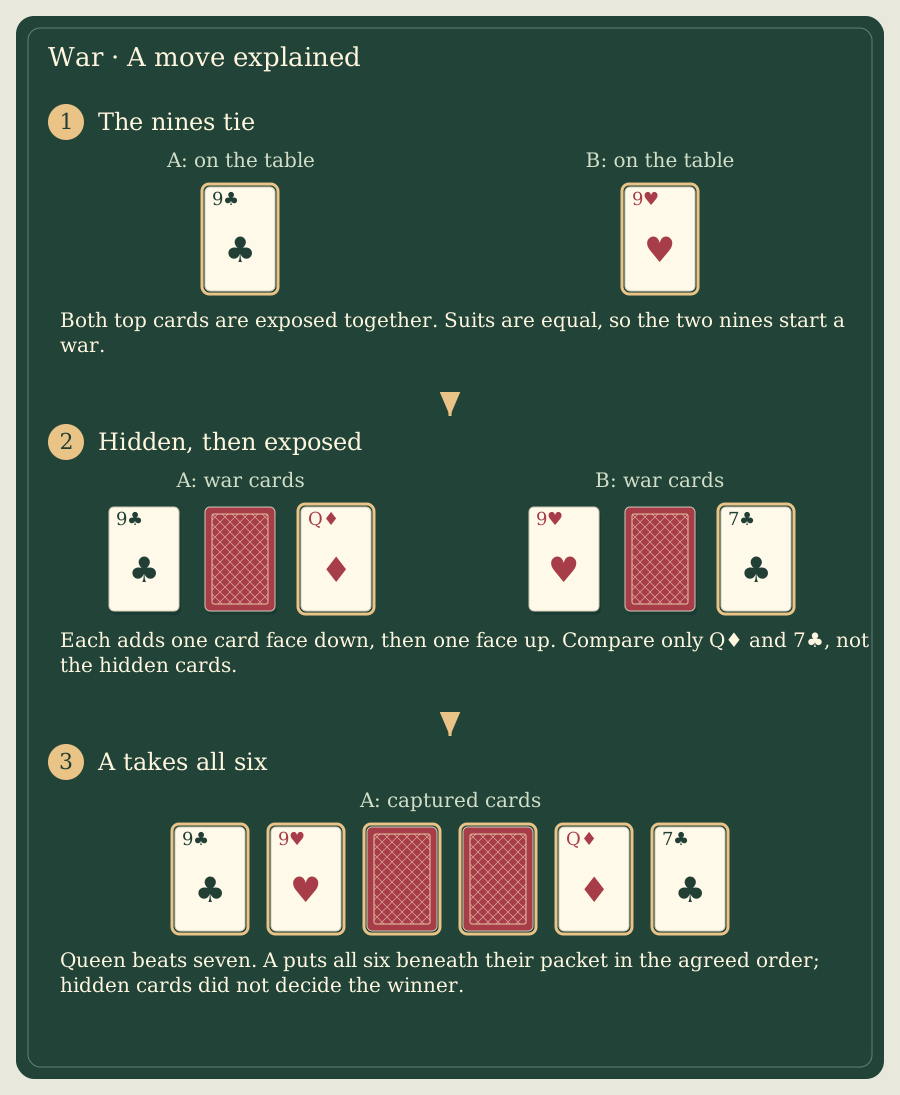
9♣ and 9♥ tie. Next 3♦ and K♠ are face down; then Q♦ and 7♣ face up. The queen wins all 6 cards; the hidden king does not enter the comparison.
← On a small screen, scroll the diagram horizontally. →
06 /
Other agreements
Russian P’yanitsa is a separate relative. Pagat describes 36 cards, 6–7–8–9–10–J–Q–K–A; usually 2 players receive 18 face down each. Normal ranks apply except a 6 beats an A when they meet. Without an ace, six remains lowest. For ties agree beforehand: expose the next card immediately, or place one face down then one face up. Repeat until different. The source documents both procedures and opposite objectives: losing all cards loses, or collecting all cards loses. Name the objective first; the main profile above uses the ordinary collecting-all victory. This source does not fix collection order, so agree it beforehand; the shortage rule above may serve as a house rule, not a claim about every Russian table.
Common questions
May I reorder my packet?+
No. This profile preserves the fixed order.