← On a small screen, scroll the diagram horizontally. →
01 /
Pack and auction
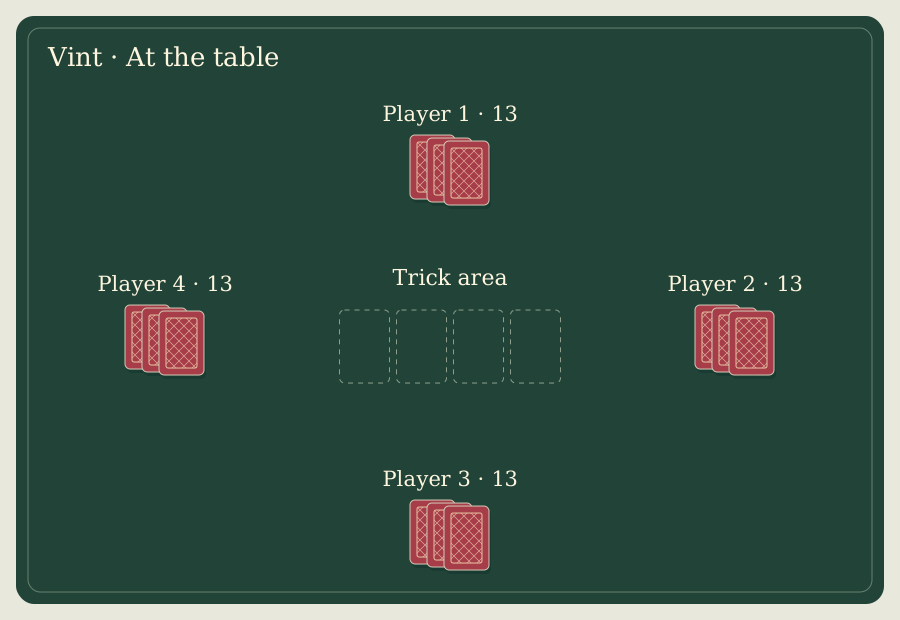
There are 4 players in 2 opposite-seat partnerships and 52 cards, ranked A K Q J 10 9 8 7 6 5 4 3 2. Choose the initial dealer randomly; our procedural agreement rotates left after each deal. Shuffle, have the right neighbour cut, and deal 13 each singly clockwise. Dealer speaks first.
Bid a level from 1 to 7 and a suit or no-trump. The promise is level plus 6 tricks. Denominations rise spades, clubs, diamonds, hearts, no-trump. A new bid must have higher level or the same level with higher denomination. You may pass and return later, including raising your own former bid. There are no doubles. If nobody bids, 8 consecutive passes cause a redeal by the next dealer. Once a bid exists, only 12 consecutive passes close the auction; a new bid restarts the count. The final bidder, not the first bidder in the suit, is declarer.
02 /
Play all the hands
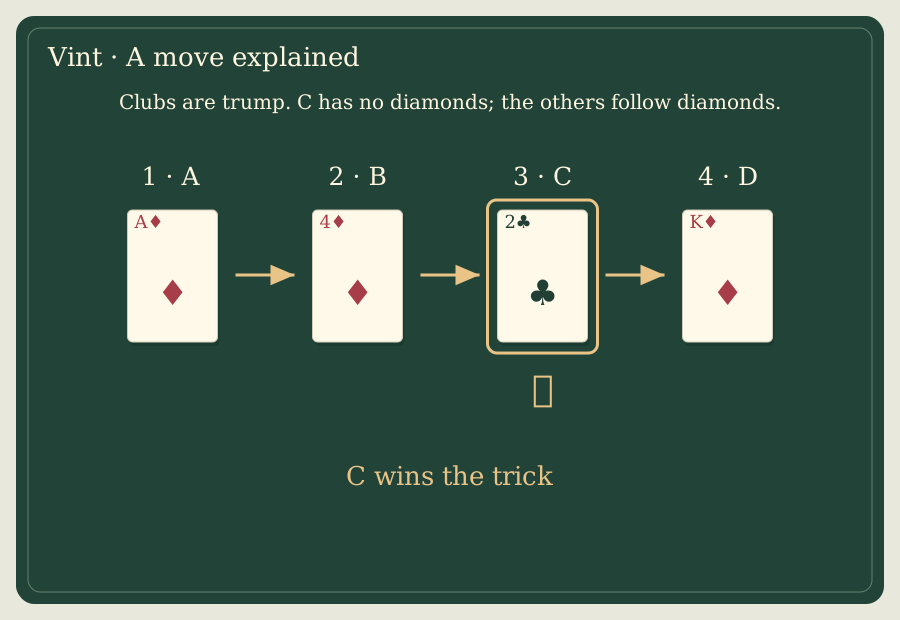
Declarer’s left leads any card. Every player keeps and plays their own concealed hand; there is no dummy. Follow suit if possible, otherwise play anything. There is no compulsory trumping or overtaking. Highest trump wins, or highest of the led suit without a trump; at no-trump only the led suit can win. Winner leads next. Play all 13 tricks, keeping their order so the first side to cross the game threshold can be identified.
03 /
Below the line: all tricks count
Keep separate partnership columns above and below a horizontal line. Only below-line points make a game. Compute trick value V from the final contract: at level 1, spades 4, clubs 6, diamonds 8, hearts 10, no-trump 12. Add 10 for each level above 1. Both sides record their entire number of tricks multiplied by V below the line, even if the contract fails. Do not subtract the first 6 tricks as in bridge.
04 /
Above the line: the full bonus table
Taking 12 tricks gives 500, taking 13 gives 1000, regardless of the bid. Additionally, a bid at level 6 fulfilled with at least 12 gives 3000; a level 7 bid fulfilled with 13 gives 5000. These add to the actual-trick slam bonus, so a fulfilled grand slam gives 6000. A failed level 7 contract taking 12 still earns the ordinary 500, but not the bid bonus.
With a trump suit, its honours are A K Q J 10. The partnership originally holding 3, 4 or 5 between them receives respectively 20, 30 or 40 times V above the line. In every denomination, the side holding most aces receives 10 times V for each ace it holds. If aces split evenly, the side winning most tricks scores for 2 aces. No-trump has the ace award but no trump-honour award.
If declarer falls short, defenders receive 500 times the bid level times the number of missing tricks. A failed level 6 bid adds another 3000 penalty; failed level 7 adds another 5000. These penalties are above the line and do not remove either side’s trick points or honour awards.
05 /
Games, rubber and final margin
The first side accumulating 500 below the current line wins the game. Determine the crossing trick in actual play order, even if both sides finish above the threshold. Finish the deal and record all awards before drawing a new line; both sides then start the next game at 0 below it. First game won gives 500 above the line; winning a second game wins the rubber and gives 1000 instead. A rubber lasts 2 or 3 games.
At rubber’s end, add every above- and below-line score and compare totals; their difference is the point margin. A rubber winner can have the lower total because game wins and aggregate points measure different things. Equal totals give a zero margin, although the rubber winner remains recorded. Traditionally partners change for 3 rubbers so each pairing is used; our complete session is a single rubber, with that rotation optional.
06 /
A failed bid can still earn points
From a fresh game line, North–South bid 3 clubs and take 8 tricks: they needed 9, so fail by 1. V is 26. Trick scores are 208 and 130. North–South held 4 trump honours and 3 aces, scoring 780 for each award. Defenders receive 1500 for the undertrick. Totals for this deal are 1768 and 1630: North–South gain a margin of 138 despite failing. Neither side has yet reached the game threshold.
← On a small screen, scroll the diagram horizontally. →
07 /
Historical context and descendants
The selected code was printed in Moscow by Volchaninov’s printing house. Lobashev and McLeod identify it as a comprehensible historical Russian source while warning that Vint evolved in other versions. The name evokes a tightening screw, like its rising auction. The Finnish Skruuvi tradition continued along another path. This guide documents one historical profile without presenting its unusual suit order or bonuses as modern bridge rules.
Common questions
Do only the bidders score below the line?+
No. Both sides score every trick won at the same contract-dependent value.
Can I raise my own bid after everybody passes?+
Yes, before the required sequence of passes ends the auction.
Does winning the rubber guarantee the larger point total?+
No. Add all scores to determine the separate final margin.