← On a small screen, scroll the diagram horizontally. →
01 /
Context and chosen profile
Thousand belongs to the Eastern European marriage-game tradition and is documented in Russia, Ukraine, Belarus, Poland and Lithuania. The cited rules do not establish a single inventor. Gambler publishes both club conventions and a separate 2013 Repino tournament code; those are not interchangeable.
Here we use the current club structure: target 1000, no golden round, no ace marriage, no blind bidding or 555 reset. Two players may occupy the barrel. Rospis always deducts the contract. Barrel details and redeals below fix our teaching-table agreements where club options differ.
02 /
Pack and deal
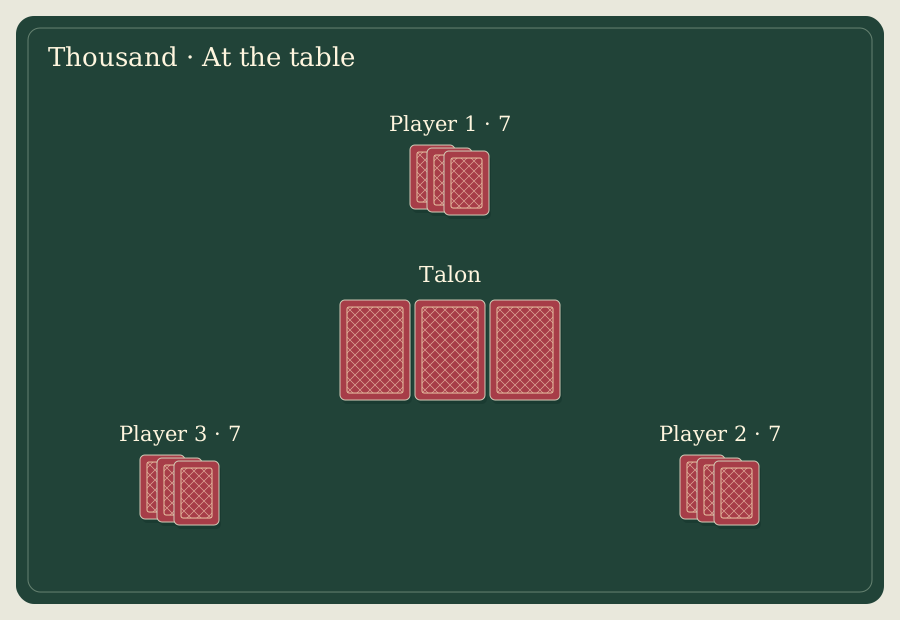
Three play individually with 24 cards: A, 10, K, Q, J, 9 in each suit, ranked in that order. Their values are 11, 10, 4, 3, 2, 0: the pack contains 120 card points. Choose the first dealer randomly; deal, bidding and play go clockwise and deal passes left.
Shuffle, have the player on the right cut, and deal seven cards each plus three face-down talon cards. Deal singly, inserting the talon cards between the first and last rounds. Our table redeals an exposed-card or wrong-count deal without a score or penalty, with the same dealer. We do not use bottom-card rituals.
03 /
Auction and talon
Dealer’s left opens at 100 and cannot pass initially. In turn, raise by a positive multiple of 5 or pass; a pass is final. The sole remaining bidder is declarer. Without a marriage in hand, bidding above 120 is forbidden. Our ceiling is 120 plus the total value of marriages actually held; a speculative hoped-for talon marriage does not count.
Our table requires bidding to stop at 120 before passing that level. Reveal the talon, add it to declarer’s seven, and give one card face down to each opponent: everyone now has eight. Declarer fixes a final multiple-of-5 contract no lower than the auction price, subject to the same marriage ceiling. Before passing cards, declarer may instead choose rospis: subtract the contract and credit half to each opponent. Record halves exactly; there is no additional third-rospis penalty here. Rospis is forbidden from the barrel.
04 /
Eight tricks
Declarer leads any card. Others follow suit if possible; otherwise they must trump if a trump suit exists and they have one. With neither, discard anything. There is no duty to beat or overtrump. Highest trump wins, or highest card of the led suit if no trump was played. The winner leads next and keeps the three cards in a separate pile. There is no draw; play all eight tricks.
05 /
Marriages change trumps
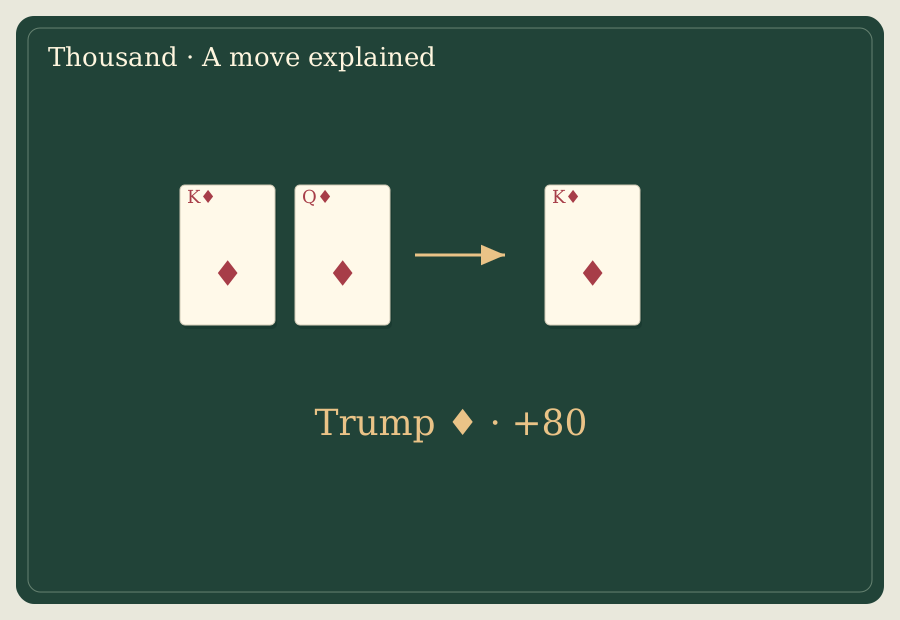
A marriage is the king and queen of one suit still held together: spades 40, clubs 60, diamonds 80, hearts 100. Initially there are no trumps. After winning a trick, a player leading the next may declare a marriage and lead its king or queen. Show the partner card to verify the pair. Its suit becomes trump immediately, including that trick.
Both opponents can declare as well as declarer. Later declarations replace the trump suit; earlier earned bonuses remain. A pair cannot be declared on the first trick, when following, or after either member has left the hand. An undeclared pair scores nothing.
06 /
Contract, defenders and bolts
Add each player’s captured card values and declared marriage bonuses. Declarer adds exactly the contract if the unrounded total reaches it; otherwise subtract exactly the contract. Surplus is lost. Defenders add their own totals rounded to the nearest 5: remainders 1–2 round down, 3–4 up. Negative cumulative scores are allowed.
A defender outside the barrel who scores zero raw points receives one bolt. On every third bolt subtract 120 and reset that counter; the bolts need not be consecutive. Declarer receives the contract result instead of a bolt. Our rospis deals create no bolts.
07 /
The barrel, redeals and finish
When a score first reaches or passes 880, cap it at 880: that player enters the barrel. No one wins by jumping over it. During the next three completed deals the player must win the auction, declare at least 120 and fulfil that contract to win the match at 1000 or more. Defender points and bolts are suspended on the barrel. Each completed deal counts as an attempt, even when another player buys the talon.
A failed barrel contract subtracts its value and ends that barrel visit immediately: this is our explicit table agreement. If three attempts expire without success, subtract 120 to 760. Count forced displacements as failed visits too; after a third failed visit reset the score to zero. Two may sit on the barrel; a third arrival displaces both existing occupants by 120. Simultaneous new arrivals all remain, up to two. Only one declarer can complete a winning contract, so there is no winning tie.
Our permitted no-score redeals, by the same dealer, are: four nines or fewer than 14 card points before bidding; talon worth fewer than 5 points before exchange; four nines after exchange before the first lead. Reveal the qualifying cards. Redeals do not consume barrel attempts.
08 /
Worked score
The contract is 160. Declarer captures 84 card points and legally announces diamonds for 80: 84+80=164, so the score changes by +160. The other card totals are 23 and 13; together 84+23+13=120. Defenders record +25 and +15. Without declaring the marriage, 84 would fail and declarer would record −160.
From 880, a fulfilled 120 contract gives 1000 and wins. A defender sitting at 880 receives nothing for that deal and uses one of the three attempts. Three such unsuccessful deals reduce 880−120 to 760.
← On a small screen, scroll the diagram horizontally. →
09 /
Keep other variants separate
Some tables use a 1001 target, a 200-point four-ace declaration, a doubled golden round, a single barrel occupant, different rospis penalties or a 555 reset. The Repino code also has different first-lead and procedural provisions. None of those rules is added halfway through this profile. The four-player sitting-out version is not covered here.
Common questions
May I declare a marriage on the opening lead?+
No. First win a trick, then lead one member while still holding both.
Does 119 fulfil a 120 contract after rounding?+
No. Declarer must reach the contract before rounding.
Are the defenders a permanent partnership?+
No. They may both oppose the contract but keep separate tricks and scores.