← On a small screen, scroll the diagram horizontally. →
01 /
History
Pagat dates the earliest printed Svoi Kozyri descriptions to the nineteenth century and records this modern form from Alexey Lobashev. Besikovitch’s symmetrical open game, published in Eureka in 1953, is a separate two-player version. The source identifies no sole inventor of the overall tradition.
02 /
Setup
4 play individually. Assign four different personal trump suits before dealing and announce them openly. Use 36 cards ranked A–K–Q–J–10–9–8–7–6. Choose the first dealer randomly; later the loser deals. Shuffle, cut on the right and deal everything singly clockwise, 9 each.
Before play, give every six to the owner of its suit as trumps. Hands may become unequal; everyone has their trump six. Dealer’s left starts with any single card. There is no shared trump suit: when covering, use only your own trumps, regardless of the previous card owner’s suit.
03 /
Cover and lead
Play onto a shared face-up pile with its top visible. On your turn either beat that top card and immediately lead any other card from hand over it, or pick up the required number of top cards. Never draw or pick up between covering and the new lead. Beat a nontrump with a higher card of its suit or your trump; a trump needs a higher card of its suit. Following suit is optional.
After completing the action, turn passes on. If a pickup leaves a pile, the next player faces its newly exposed top. If empty, that player leads any single card. Before deciding, you may inspect cards you would have to pick up and the next card beneath. Show the covering card on request if both cards were played together.
When no replenishment is available and the covering card empties your hand, leave without making a further lead. Apply the final-card rules below.
04 /
Pickup quantity
Unable or unwilling to cover, take the top 3 if the top card is not your trump; 5 if it is your trump other than ace; the entire pile if it is your trump ace. With fewer than the required quantity, take all. Pickup ends your turn; do not immediately play again. No stock, replenishment or separate discard exists.
05 /
Final cards
An empty hand leaves immediately and is skipped. If a player exits with a covering last card while at least two others remain, the next player freely leads over it instead of covering. Track what the last card did: a cover and a new lead produce different endings.
The last holder of cards loses. Exception: if their sole card can beat the opponent’s final free lead and it is now their turn to answer, the game is drawn. If the opponent’s card was only a cover without a new lead, there is no final response: the remaining player loses even holding a higher card. After a draw, keep the same dealer. No points are required; a session may count defeats.
06 /
Worked chain
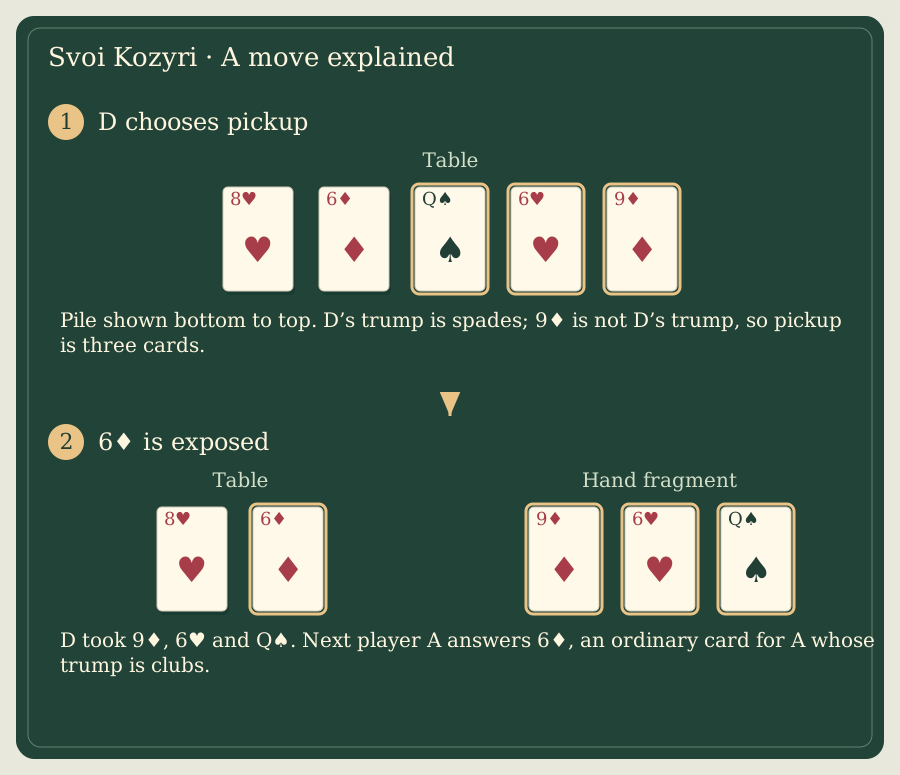
A owns clubs, B diamonds, C hearts, D spades, clockwise. A leads 8♥. B covers with 6♦ then leads Q♠. C covers the queen with 6♥ then leads 9♦. The pile contains 5 cards.
D declines to cover: 9♦ is not D’s trump, so D takes the top 3, namely 9♦, 6♥, Q♠. The new top is 6♦. A may cover it with 9♣, then must lead again: diamonds was B’s trump but is ordinary during A’s turn.
← On a small screen, scroll the diagram horizontally. →
Common questions
Can my trump beat another player’s trump?+
Yes. Only your own trump suit has special power on your turn.
Are new cards dealt after a turn?+
No. The whole pack is already in hands or the play pile; no stock exists.