← On a small screen, scroll the diagram horizontally. →
01 /
History and selected rules
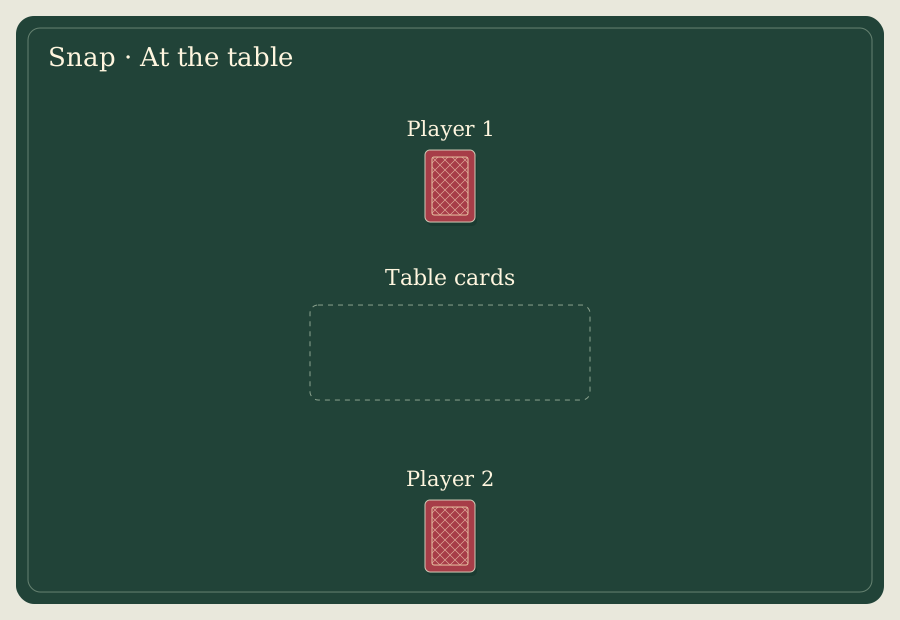
Snap tests observation and reactions and is known in Britain and North America; Pagat cautiously places its appearance in the late nineteenth century. Select 2–6 players with individual exposed piles and central disputed pools. Use 52 cards, matching rank only, never suit. Do not confuse this with the single shared-pile variant.
02 /
Setup and deal
A random dealer deals all cards singly clockwise; uneven packets are acceptable. Keep yours face down without inspection. Starting left of dealer, take turns exposing the top card onto your own separate pile. Turn away from yourself so you do not see it early. Calling does not require waiting for your turn.
03 /
Playing a hand
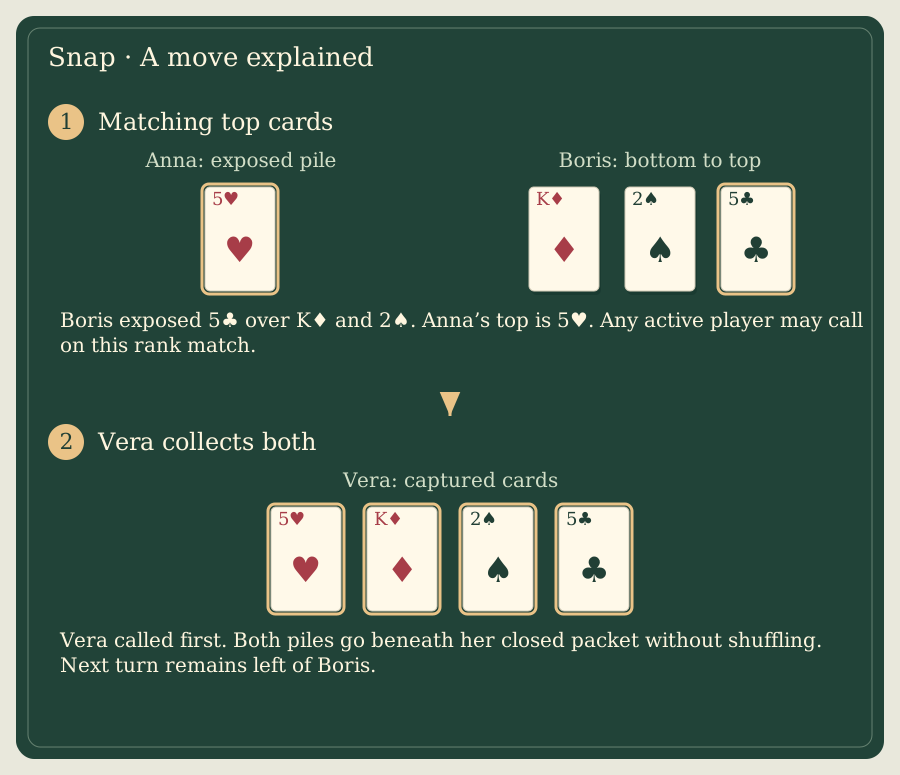
Matching tops of two personal exposed piles allow any active player to call “Snap!” first and take both entire piles. If more than two match, identify the pair claimed. Append captures face down beneath your packet without shuffling. Revealing order stays unchanged: next left of the last revealer. When your closed packet empties, turn your exposed pile down without shuffling on your turn.
An indistinguishably simultaneous call moves the matched piles into a separate central pool. A false “Snap!” sends the caller’s exposed pile there. Matching a personal top to a pool top allows the first “Snap pool!” caller to take both. Simultaneous pool calls add the matching personal pile to that pool. Separate pools never merge automatically. Without a personal exposed pile, a false call transfers nothing here.
04 /
Ending and result
With no cards in either personal pile, leave and stop calling. Last active player receives remaining pools and wins all cards. In the rare case disputed calls move every final card into pools with no personal cards remaining, declare a draw. There are no points. A session may record one win per game with a pre-agreed game count.
05 /
Worked example
Anna’s top is 5♥; Boris exposes 5♣ over his K♦–2♠. Even Vera, owning neither five, can call first and win both exposed piles. A matching 5♦ buried inside another pile does not count.
← On a small screen, scroll the diagram horizontally. →
Common questions
May I call on other players’ piles?+
Yes. Any player still in may call.