← On a small screen, scroll the diagram horizontally. →
01 /
Context and deal
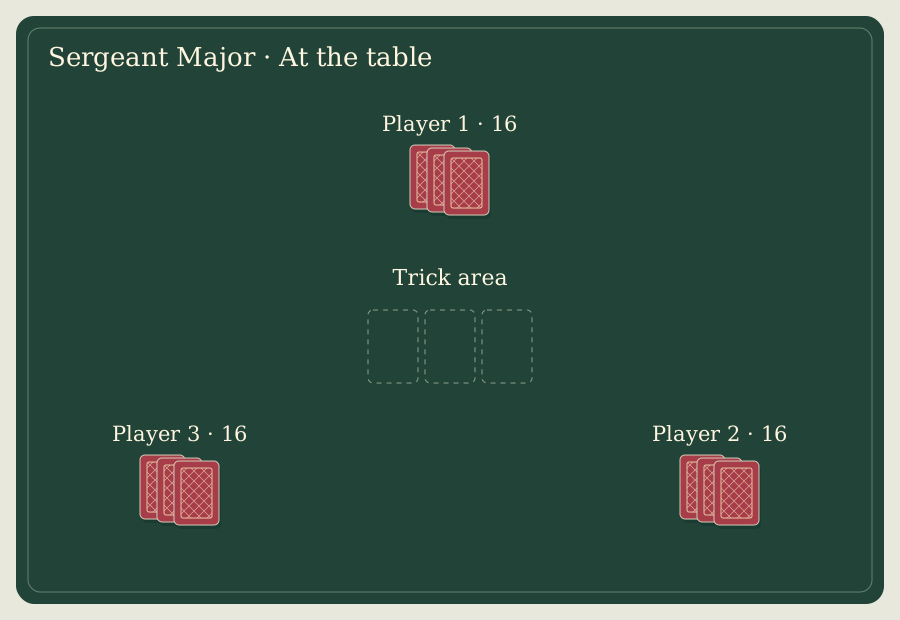
The cited account, supplied by John Card, reports play in Britain’s Royal Air Force. It does not establish an inventor. This is Sergeant Major, distinct from Canadian 9–5–2. Three individuals use 52 cards without jokers, ranked A K Q J 10 9 8 7 6 5 4 3 2. Choose first dealer randomly and rotate clockwise. Shuffle, cut, deal 16 each singly, leave four face down as kitty. First deal has no quota exchange. Dealer names a trump suit, discards four face down BEFORE looking at the kitty, then takes all four kitty cards.
02 /
Play and quotas
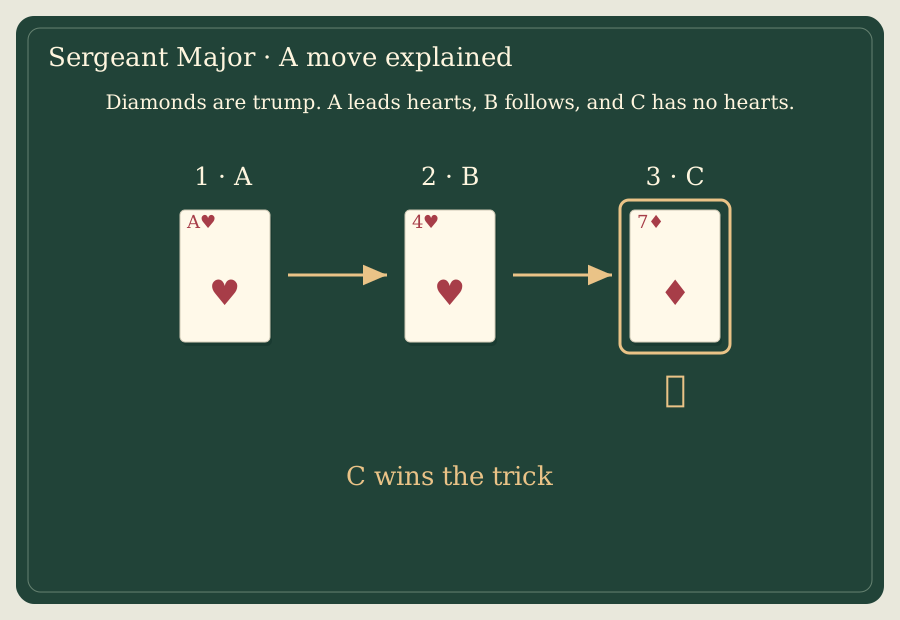
Dealer’s left leads any card. Play clockwise and follow suit if possible; if void, any card is legal, without compulsory trumping or overtrumping. Highest trump wins, otherwise highest led-suit card. Winner leads next. Play all 16 tricks without drawing. Quotas: dealer 8, left 5, right 3. Each hand’s balance is actual tricks minus quota; record positive and negative units without money. Balances sum to zero.
03 /
Next hand’s compulsory exchange
After the next deal, before naming trumps or using kitty, last hand’s surplus players exchange with deficient players. A surplus player sends one unwanted card per surplus; the recipient adds it then returns their highest card of that same suit. If the received card is their only card of that suit, return it. Multiple same-suit requests receive that many highest cards, not the same card twice.
One surplus player sends each deficient opponent as many cards as that opponent’s shortfall, simultaneously. With two surplus players, the one with the higher CURRENT quota exchanges first, then the other; use each player’s PREVIOUS surplus. After exchanges, dealer names trumps, discards four, then takes kitty. If dealer previously had to surrender high cards and obtains higher cards of those suits from kitty, privately show them to the relevant exchanging players.
04 /
Worked quotas
Dealer wins 10 tricks, left 4, right 2:10+4+2=16. Balances are 10−8=+2,4−5=−1,2−3=−1. Next deal that former dealer gives one unwanted card to each opponent and receives each opponent’s highest card of its suit. The new quotas follow seats, not last hand’s performance.
← On a small screen, scroll the diagram horizontally. →
05 /
Finish and variants
The first player taking at least 12 tricks in a hand wins the game, regardless of the cumulative unit balance. Two players cannot both do that in sixteen tricks, so no winning tie. Continue until this happens; there is no fixed number of deals. Pickup-before-discard, cumulative target games and the 9–5–2 quota system are separate variants.
Common questions
Do I choose trumps before seeing the kitty?+
Yes, and discard four before taking it in this profile.
Do exchange priorities use old or new quotas?+
Current quotas decide who exchanges first; previous surplus decides how many cards.