← On a small screen, scroll the diagram horizontally. →
01 /
Deal, carte blanche and exchange
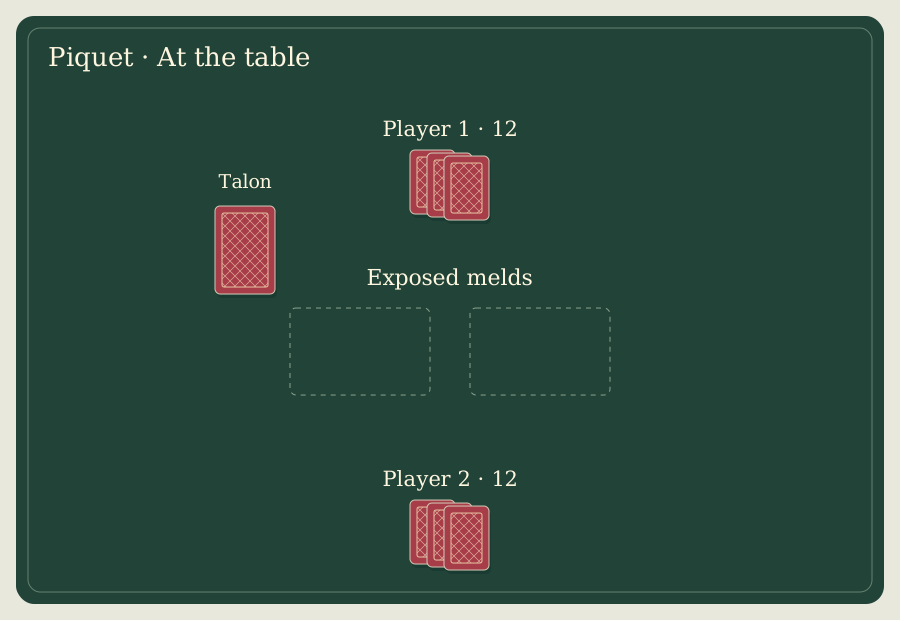
For 2 players use 32 cards, ranked A K Q J 10 9 8 7, with no trumps. Cut high to choose who deals first, recutting ties; alternate thereafter. Shuffle, cut and deal 12 each in packets of 3, leaving an 8-card stock face down. Keep the same packet size on your later deals. Non-dealer is elder hand, dealer younger hand.
An original hand without J, Q or K may claim carte blanche for 10. Announce it promptly and prove it before your exchange, after the opponent has committed their discards. If elder claims, announce the exchange quantity first so younger can set aside discards without seeing the proof. New face cards drawn later do not invalidate the original claim.
Elder discards 1 to 5 cards face down and draws that many from the stock. Younger discards at least 1 and at most all cards remaining in the stock, then draws the same number. Announce taking fewer than your maximum before drawing. Keep your own discards available for reference, separate from captured tricks. Elder may inspect the unused part of the first 5 stock cards; younger may expose any final unused stock only after elder leads.
02 /
Compare three categories
Elder declares first, category by category; younger replies “good”, “not good” or “equal”. Point is the longest suit, worth its card count. Equal lengths compare sums with ace 11, courts 10, and pip cards their face values. An exact tie scores neither.
Sequence is the longest same-suit run. Lengths 3, 4, 5, 6, 7, 8 score 3, 4, 15, 16, 17, 18 respectively. Longer wins; equal length compares the top card; exact equality cancels the category. The category winner scores all other separate runs as well, without counting shorter runs inside a longer one.
Sets count only ranks A, K, Q, J, 10. A quatorze of 4 scores 14 and beats every trio of 3, worth 3. Between equal-sized sets, higher rank wins. The winner also scores all other eligible sets; the opponent scores none. The same cards may contribute to different categories. You may conceal an announcement, but cannot later improve a declaration already answered. After declaring, elder leads; younger then scores winning categories or categories elder omitted. Either may request proof of scored or exactly tied combinations after that lead.
03 /
Tricks and special bonuses
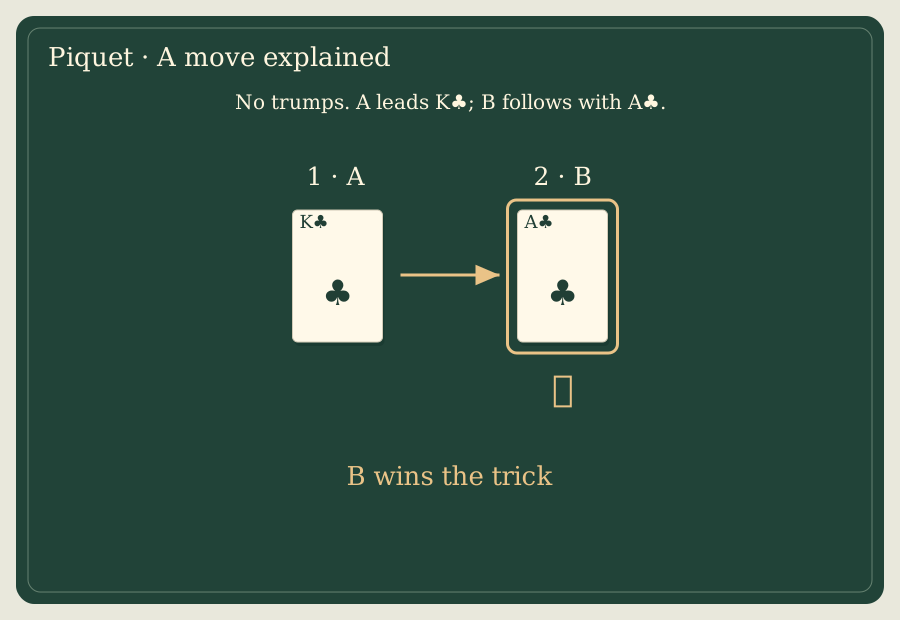
Play 12 tricks. Follow suit if possible; otherwise discard anything. Highest of the led suit wins and leads again; overtaking is optional. Score 1 whenever you lead and 1 whenever you capture the opponent’s lead, plus 1 for winning the last trick. Either player may inspect completed tricks. At the end, a majority of tricks adds 10; all tricks adds 40 instead. A 6–6 split gives neither bonus.
Repique adds 60 if you reach 30 in declarations before the opponent scores. For this test count categories in order: carte blanche, point, sequences, sets, then play, regardless of speaking order. Pique adds 30 if elder reaches 30 in declarations and play before younger scores anything, following actual scoring order. Younger cannot pique because elder already scores for the opening lead. Tied categories do not stop either bonus. End-of-play majority and capot bonuses do not help reach pique; repique replaces pique rather than stacking with it. Announce the running deal score whenever scoring.
04 /
Finish the partie
A partie lasts 6 deals. Add each deal’s results. Higher total wins; at equality play 2 additional deals, then accept a draw if still tied. The Rubicon is 100: if the loser reaches it, the final match margin is the difference of totals plus 100. Otherwise it is the sum of both totals plus 100. This is a point margin, not a requirement to wager money. Reset scores for a new partie.
05 /
A declaration calculation
Suppose elder’s accepted declarations are point of 6, a run of 6 and 4 aces. They score 6 + 16 + 14 = 36. If younger has scored nothing in the prescribed declaration order, repique adds 60, giving 96 before card-play points. A better point held by younger would prevent repique even if elder spoke all those declarations first. Speaking first does not change the category order.
← On a small screen, scroll the diagram horizontally. →
06 /
Historical context and alternatives
Cavendish’s published club laws document the nineteenth-century Rubicon profile, and the older Piquet tradition predates that code. This guide does not identify the modern rules with every early mention of a similarly named game. Piquet au Cent ends at a score target and differs in other details. Likewise, counting the majority-of-tricks bonus early would alter pique; it is excluded here.
Common questions
May I exchange no cards?+
Not in this profile: each player exchanges at least one.
Can I count a run and a set using the same card?+
Yes, they belong to separate categories. Do not score overlapping shorter runs within a longer run.
Does reaching the Rubicon end the game?+
No. Complete the scheduled deals; the Rubicon affects the final margin.