← On a small screen, scroll the diagram horizontally. →
01 /
History and selected agreements
Transfer Durak belongs to the Russian-speaking Durak tradition. Its name describes moving an attack to the next player. Pagat documents ordinary transfer, a later Kyiv version and a pass-card version separately; no exact inventor or invention year is established here.
Two to six play individually with 36 cards. Everyone except the current defender may add attacks, clockwise from the current attacker. Six attacking cards is the limit even in the opening bout. There is no trump-six exchange. Fix these agreements before dealing.
02 /
Cards, deal and opening lead
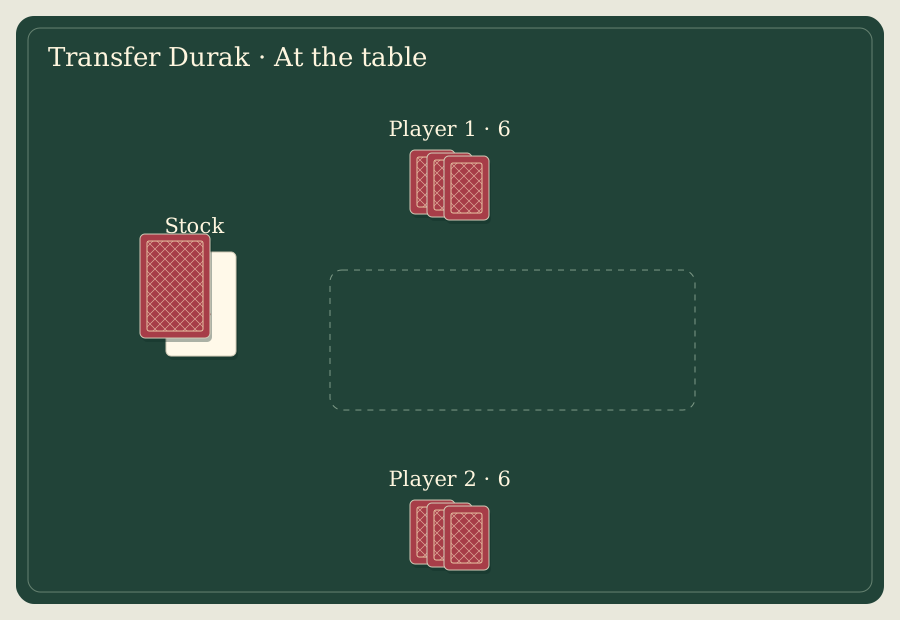
Use 6–7–8–9–10–J–Q–K–A in each suit. Deal six each clockwise. Expose the next card for trumps and place the remaining stock crosswise above it; draw that exposed card last. With six players, expose dealer’s last dealt card for trumps, then return it to dealer’s hand.
The holder of the lowest trump in hand opens the first game, but may attack with any card. If no player has a trump, our agreement gives the opening to dealer’s left. Later games are dealt by the loser and opened by their left neighbour. Following a draw, the same dealer deals again.
03 /
Attack and defence
The next active player clockwise defends. Attack with any card, or several equal ranks within the limit. Beat a nontrump with a higher card of its suit or any trump. Beat a trump only with a higher trump. You may trump even when holding the led suit.
Place each defensive card over the attack it beats, keeping both visible. The defender acts alone and may choose to pick up even when a successful defence is possible.
04 /
When an attack can move
Before any attack card has been covered, the defender may play one or more cards of its rank instead of defending. That player becomes attacker; the next active player clockwise becomes defender against the whole accumulated attack. Another matching rank may transfer it again. With two players it returns to the original attacker.
After every transfer, the total attacking cards must fit both the six-card limit and the new defender’s actual remaining hand. Check that hand, not its original dealt size. After the first cover there is no further transfer in this bout. A matching trump must be played onto the table: showing it alone is insufficient.
05 /
Adding attacks and setting the limit
When defence begins, fix the limit at the smaller of six and the final defender’s hand size. Added attacks must match a rank anywhere on the current table, including defensive cards. The defender acts alone; others may add in clockwise order from the current attacker. Old discards do not qualify.
Covered cards stay covered. New attacks cannot be transferred even by matching their rank: this profile omits late transfer. Choosing to pick up does not enlarge the original limit.
06 /
Defended or picked up
Once every attack is beaten and the eligible attackers stop, discard the whole table face down permanently. The successful defender attacks next.
On a pickup, the defender takes every table card, including cards already used in defence. Eligible attackers may add further legal cards within the original limit before closing the bout. The unsuccessful defender loses the next attack: their next active clockwise neighbour attacks instead. Do not add cards or reverse the decision after closure.
07 /
Replenishment, next lead and finish
After the bout replenish to six. Its original attacker draws first, then the others clockwise, with the final defender last. Exception: if transfer returns to the original attacker, that player keeps first drawing priority. Each takes the full shortage at once. Keep hands larger than six; the exposed trump is drawn last.
A successful final defender attacks next. After a pickup skip that defender; the next active player clockwise attacks. With stock exhausted there are no draws; empty hands leave after the bout and are skipped. The last holder of cards loses. A final successful defence that empties all remaining hands is a draw. No point scoring is necessary; a session can record defeats by deal.
08 /
Example: the next hand is too short
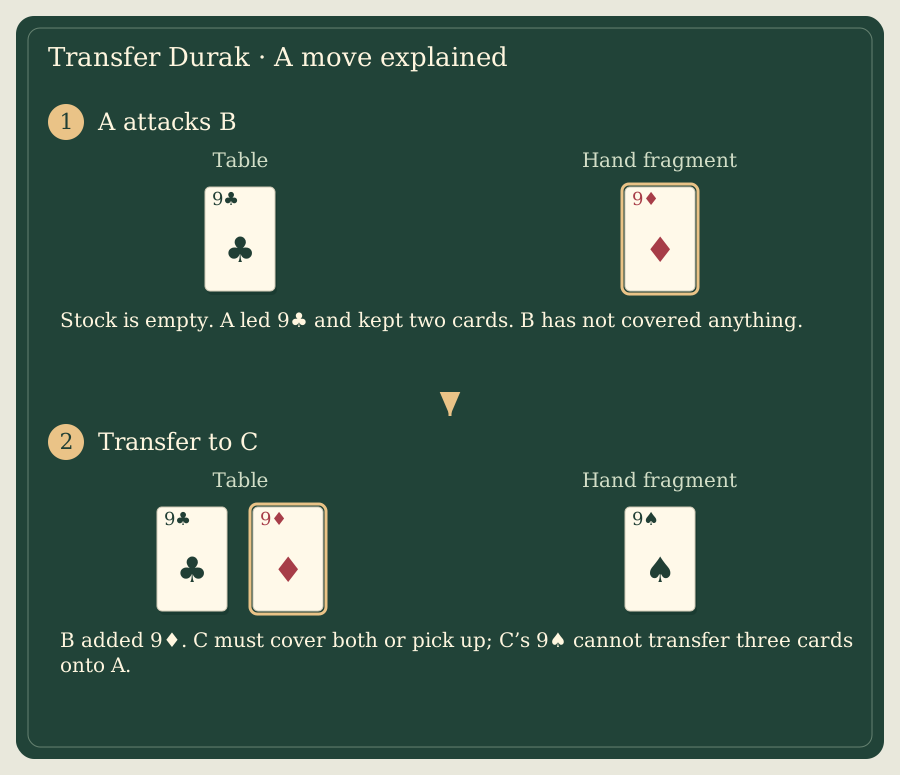
Stock is empty. A, B and C sit clockwise. A starts with 3 cards, leads 9♣ and keeps 2. B transfers by adding 9♦. C now faces 2 nines.
Even holding 9♠, C cannot transfer back to A: that would make 3 attacks against A’s 2 cards. C must cover both nines or pick up the table. The transfer card’s suit is irrelevant; the next hand’s size is decisive.
← On a small screen, scroll the diagram horizontally. →
09 /
Other agreements
A pass card lets a matching trump transfer by being shown and retained. The Kyiv variant permits later transfer of new attacks after earlier cards were covered. Both need additional restrictions and are excluded here. Partnership play and a five-card opening limit are other agreements.
Common questions
Can I transfer after the first cover?+
Not in this profile, even when a new attack of a matching rank is added.
Can I transfer to someone holding one card?+
Only if the whole incoming set fits that hand; the usual two-card transfer to one card is illegal.