← On a small screen, scroll the diagram horizontally. →
01 /
Deal and objective
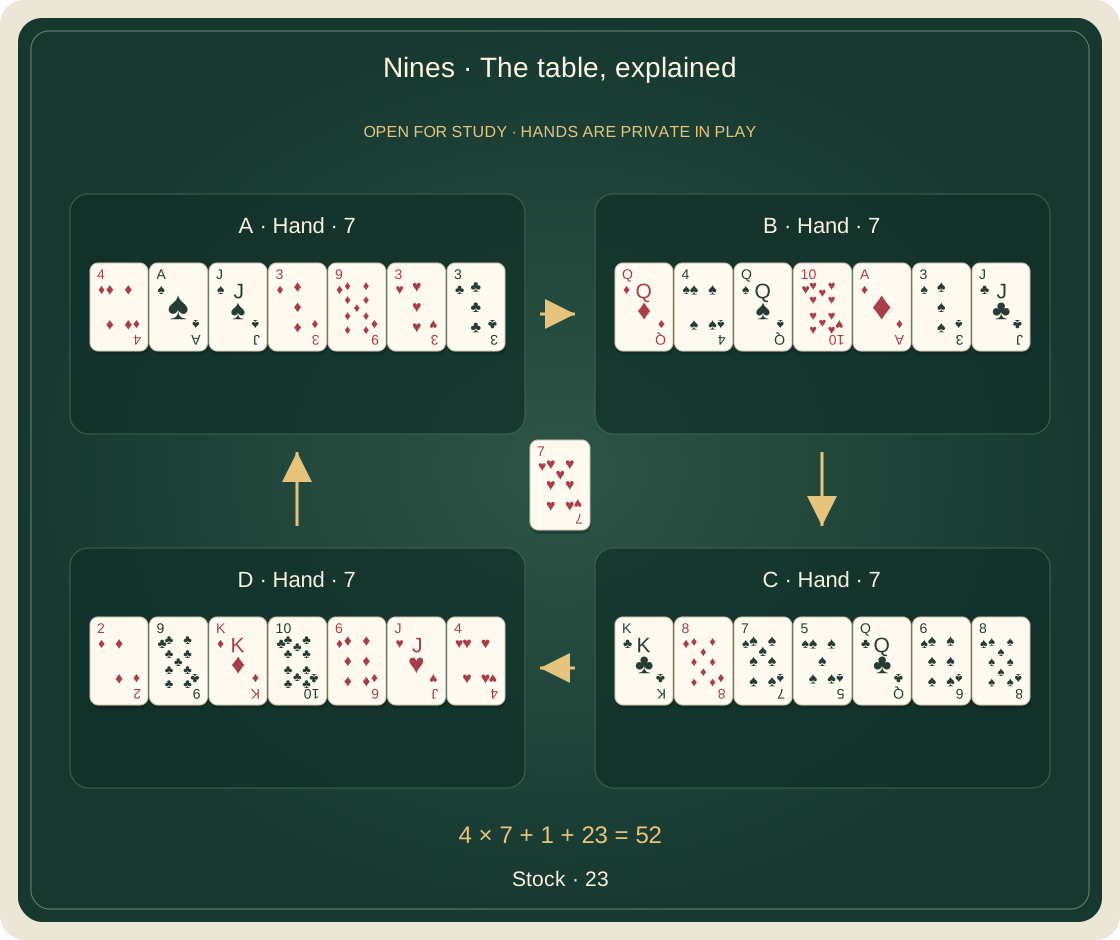
Use 52 cards for 2–6 players. Deal 7 each with 2–4 players, or 5 each with 5–6. Turn one further card up as discard; the rest is stock. Four players therefore use 28 + 1 + 23 = 52. Dealer’s left starts, clockwise; dealer rotates left each round. Empty your hand to end a round; minimise cumulative penalties to win the match.
02 /
Play one or draw one
Play one card matching the top discard’s suit or rank. If you have a legal card, play; voluntary drawing is excluded here. Without a legal card, draw exactly one. You may immediately play that drawn card if it fits; otherwise keep it and end your turn. You cannot draw repeatedly or play a different held card after drawing. Other ranks have no action powers.
03 /
Wild suit and stock exhaustion
Any 9 is legal on any card. Announce the active suit; the next player must follow that suit or play another 9, regardless of the printed suit of the previous 9. If the opening card is 9, dealer announces the suit. When stock empties, preserve the top discard and active suit, shuffle the remaining discards into a new stock. If no stock can be formed, an unable player passes. Our deadlock agreement ends the round after a complete circuit without a play: everyone scores their remaining cards.
04 /
Ending and penalty values
A legal last card, including a 9, ends the round immediately. Winner adds 0. Others add held cards: A = 1; 2–8 and 10 = face value; J Q K = 10 each; 9 = 15. At the end of a round, if any cumulative score is at least 100, the match ends; lowest total wins, equal lowest totals share under our agreement. Otherwise shuffle the whole pack for another round. No last-card warning or penalty is used.
05 /
A nine changes the next legal play
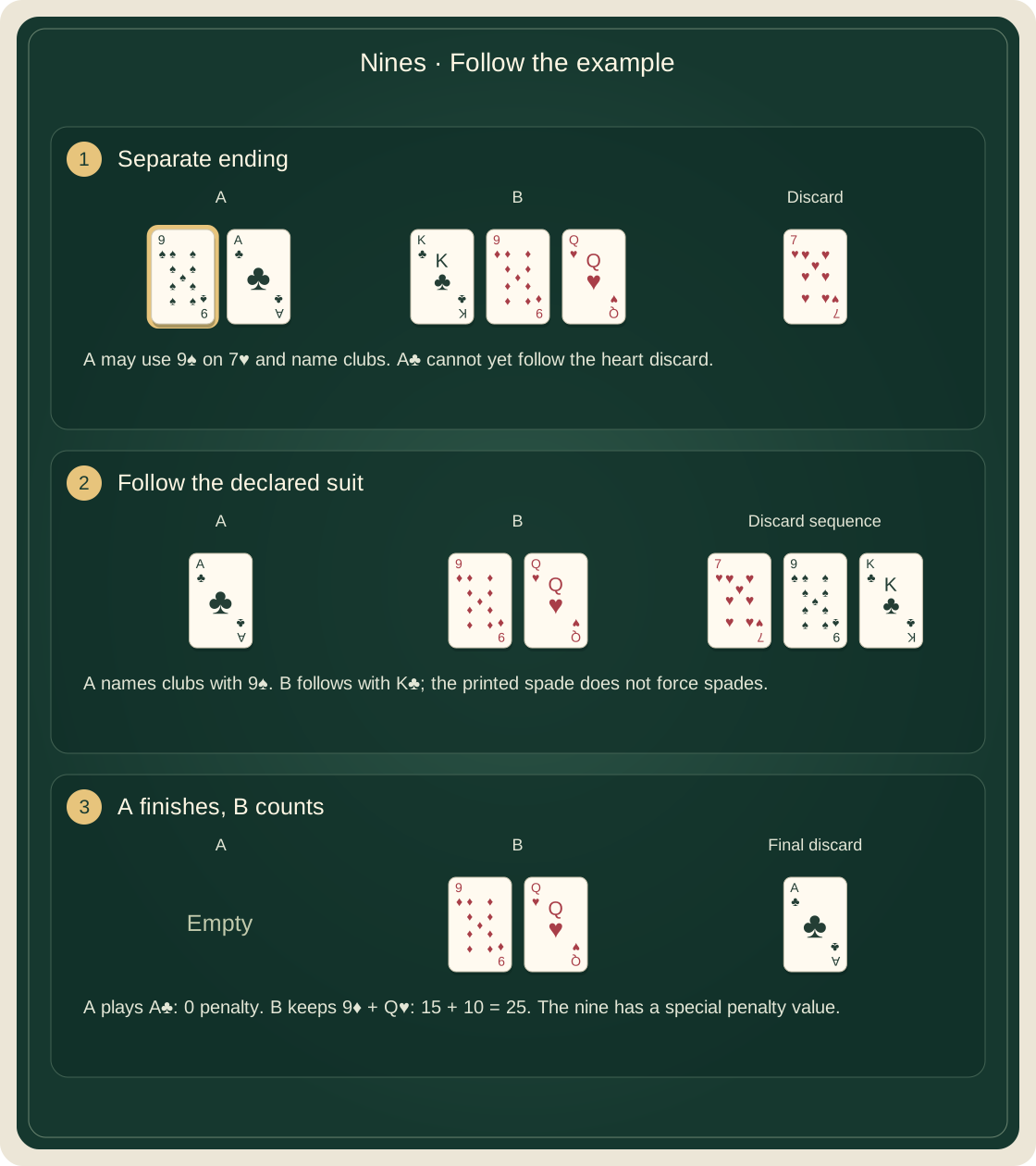
Separate late position for 2 players: discard 7♥; A holds 9♠ A♣, B holds K♣ 9♦ Q♥. A plays 9♠, declaring clubs. B plays K♣, then A plays A♣ and goes out. B’s 9♦ + Q♥ costs 15 + 10 = 25, not the printed rank sum. A adds 0. If B previously had 80, the new 105 ends the match, but the lowest cumulative score wins, not automatically the last round winner.
← On a small screen, scroll the diagram horizontally. →
06 /
A name shared by unrelated games
This ruleset belongs to the match-by-rank-or-suit family usually associated with Crazy Eights. The selected source does not establish an inventor or a first publication for this wild-nine form. Canadian Le Neuf is instead a quota trick-taking game; Eastern European Devyatka builds suit rows. Neither supplies rules for this page. Draw-until-playable, action cards and a ban on finishing with a nine are different agreements, excluded here.
Common questions
Does a nine have to match suit?+
No. It is always wild and names the next active suit.
Can I finish with a nine?+
Yes, in this profile.
Does the first person to reach the cutoff win?+
No. The cutoff ends the match; the lowest cumulative penalty wins.