← On a small screen, scroll the diagram horizontally. →
01 /
A Victorian family shedding game
Muggins is an English family card game associated with Victorian parlours and still described in later collections of household games. It combines personal face-down stocks with shared building piles and a penalty for missing the correct move. The name also occurs in cribbage and dominoes; those are separate uses, not the rules taught here. This is the rank-adjacency card game, not an adding-to-a-target variant. The account below uses the four-player deal and states the correction procedure explicitly so beginners can finish a fair hand.
02 /
Personal stocks and common piles
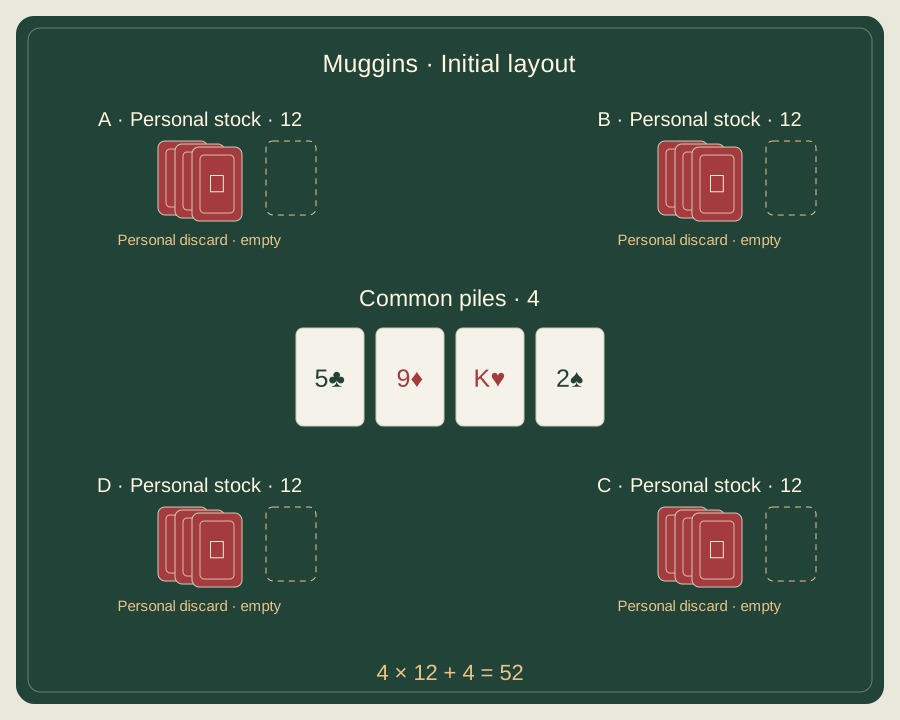
Use 52 ordinary cards without jokers. Suits never matter. Rank is A 2 3 4 5 6 7 8 9 10 J Q K, with no wrap between K and A. For 4 players deal 12 face down to each and turn the remaining 4 face up as separate common piles: 4 × 12 + 4 = 52. Each player has an initially empty personal face-up discard beside their closed stock. Nobody looks through a stock. Choose the first dealer at random; dealer’s left starts, then clockwise. Rotate the dealer between hands.
03 /
Turn one card and obey priority
On your turn expose only the top card of your closed stock. First look at all common pile tops: if your card is exactly one rank above or below any of them, you must put it there. When several common piles fit, choose one. Only if none fits may you play onto another player’s personal face-up discard top one rank above or below your card. If several opponents fit, use the first eligible opponent clockwise to your left. You cannot seed an empty opposing discard. If neither destination exists, put the card on your own discard, regardless of rank. End your turn even after a successful play; there is no bonus turn.
04 /
Recycle without shuffling
When your closed stock runs out and your personal discard still contains cards, turn that whole discard over, without shuffling, to become your next closed stock. Its formerly bottom card will be drawn first. Do not inspect or rearrange it and do not move an old exposed discard card instead of turning a fresh stock card on your turn. Covered common cards stay in their piles; only their current tops are playable destinations. There is no general draw pile and no shared-stock redeal. A single ace can touch a two; a king can touch a queen. Equal ranks never fit.
05 /
Call an error, correct it, transfer cards
An observer may call “Muggins!” for an illegal placement or a missed mandatory destination. Identify the specific error and restore the card to its correct destination. Each other player then gives 1 top card from their closed stock to the bottom of the offender’s closed stock: normally 3 penalty cards in this deal. These are existing cards, not new cards from outside the pack. A donor with an empty closed stock first turns over their discard without shuffling. For this teaching profile, a donor with no cards gives none, an unsupported call has no penalty, and challenges must be made before the next player exposes a card. Pause at a claimed finish to check its legality before confirming the winner.
06 /
Finish and other player counts
Win as soon as a correct final play leaves both your closed stock and personal discard empty, after any timely correction and penalty. Cards on common piles are no longer yours; cards sent onto an opponent’s discard belong to that opponent. A hand has no point tariff. Play an agreed number of hands and count wins; ties share. You may agree a time limit beforehand and draw an unfinished hand. Other deals use 3 players with 17 each and 1 common pile; 5 with 10 each and 2 common; 6 with 8 each and 4 common; 7 with 7 each and 3 common. Each distribution uses the same full pack and turn priorities.
07 /
Common first, then nearest opponent
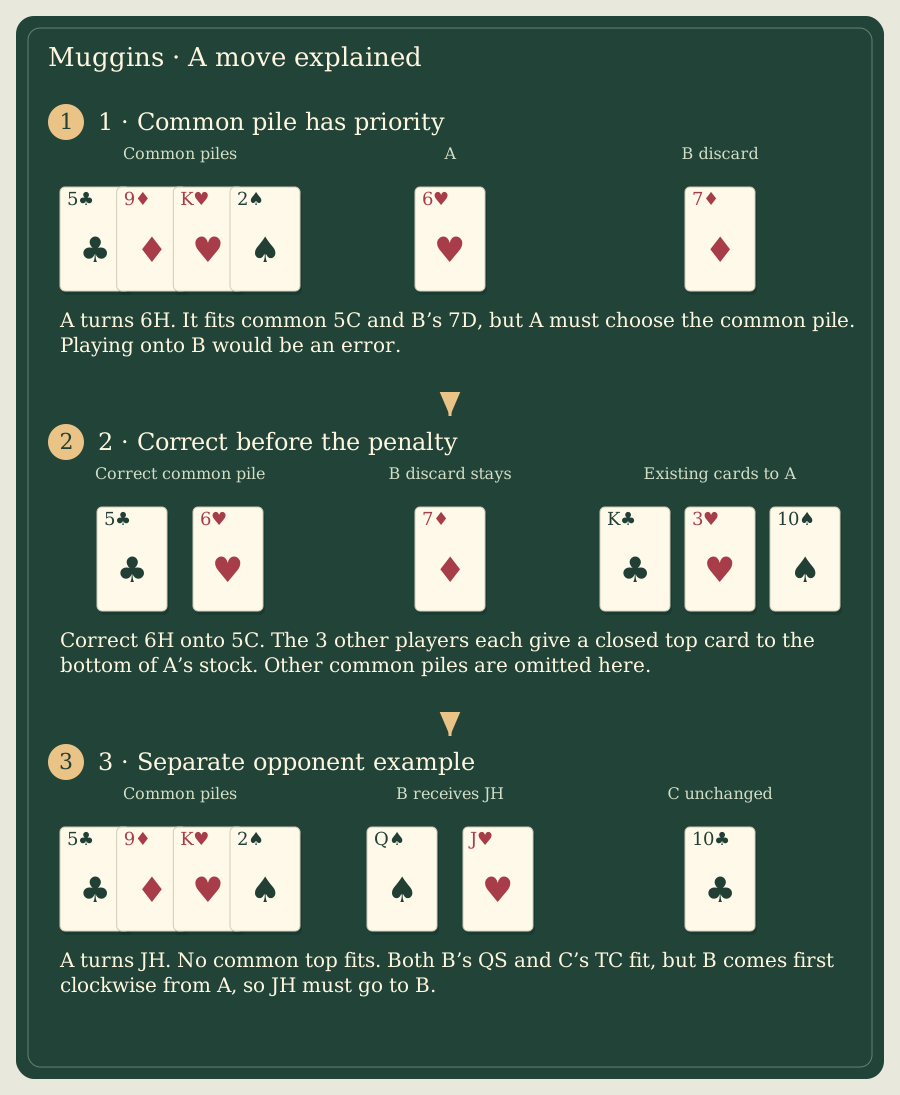
Common tops are 5♣ 9♦ K♥ 2♠. A turns 6♥; B’s discard shows 7♦. Both ranks fit, but the common 5♣ has priority. If A puts 6♥ on B’s 7♦, call the error, move 6♥ onto 5♣ and transfer the penalty cards from the other players. For example K♣, 3♥ and 10♠ go to the bottom of A’s closed stock. No card is destroyed or invented. In a separate position with the same common tops, A turns J♥, B has Q♠ and C has 10♣ on their discards. No common fits; B is the first eligible opponent clockwise, so J♥ must go to B, not C.
← On a small screen, scroll the diagram horizontally. →
Common questions
Does suit matter?+
No; only a difference of one rank matters.
Can I choose an opponent first?+
No, any legal common destination has priority.
Do I shuffle my recycled discard?+
No, turn the complete pile over without rearranging.