← On a small screen, scroll the diagram horizontally. →
01 /
A pair-removal patience, not a casino hand
Monte Carlo belongs to the traditional pair-removal patience family and appears in printed and digital solitaire collections. Good Neighbours and Weddings are alternative names used for the same core idea. The title evokes a famous place, but does not establish that a casino invented the game. No precise inventor or earliest date is asserted here. We use equal-rank neighbouring pairs with stable row-order compression; sum-to-thirteen variants and larger grids change the puzzle and are not mixed into these rules.
02 /
Deal a five-by-five grid
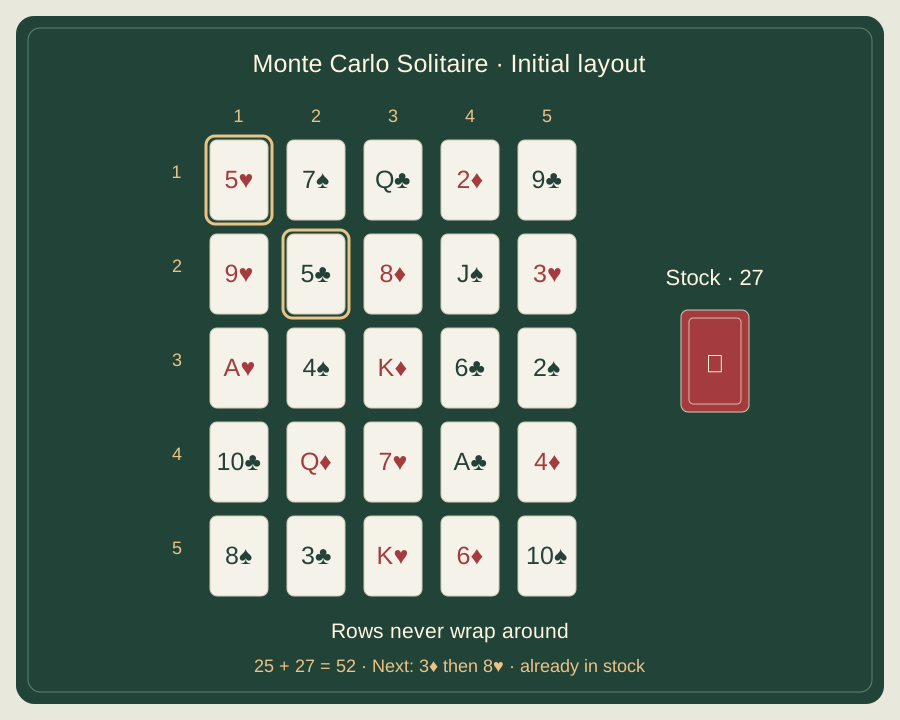
One player uses 52 ordinary cards without jokers. Shuffle; deal 25 face up in 5 rows of 5, filling left to right and then the next row. Leave 27 face down as stock and an empty side space for removed pairs. No foundations, private hand, waste or reserve. Suits and colours do not affect matching; ranks do. Keep gaps visible when removing cards during a wave instead of immediately sliding cards together. Coordinates below number rows top to bottom and columns left to right, beginning at 1.
03 /
Equal rank and touching cells
Remove 2 cards together if their ranks match and their cells share a side or corner. Horizontal, vertical and diagonal adjacency all count. Equivalently row difference and column difference are each at most 1, with different cells. Distance cannot jump an empty cell. There is no wrapping: row-end column 5 and next-row column 1 are not neighbours. A king needs another adjacent king, not solo removal; A does not pair with K or Q. A card can belong to only one removed pair. With competing matches choose a pair, then reassess the unchanged grid positions.
04 /
Finish the wave, then preserve reading order
In this wave-based profile remove available pairs until none remain, without closing gaps between individual removals. Then collect survivors in row-reading order and repack into the first cells from top left, left to right and onward to the next row. Relative order never changes; do not sort by suit, stack a column upward independently or choose convenient destinations. New adjacencies can appear at row boundaries after compression. The move is compulsory housekeeping, not an extra shuffle or an opportunity to exchange a card.
05 /
Refill only the empty cells
After compression deal from stock into remaining empty cells in the same reading order, up to 25 cards. If stock has fewer cards than spaces, deal all it has and leave trailing cells empty. Begin another pair-removal wave. No card may be dealt over an occupied cell and you cannot discard an unwanted stock card. Even after stock exhaustion compression is still allowed when there are gaps, and can create another pair. A full unchanged grid with no pair is blocked even if stock remains: there is no empty cell to refill and no legal way to reach those stock cards.
06 /
Clear the entire pack, not just the grid
Win when all 52 are removed as 26 legal pairs, leaving grid and stock empty. Lose when no legal pair or effective compression/refill remains. Empty grid with stock cards is not the final goal: refill and continue. For a progress record count removed cards, 2 per pair, rather than inventing suit bonuses. There is one pass through stock and no redeal. Before undoing an accidental handling error restore the exact positions; a casual restart is a fresh deal, not a continuation with the difficult cards thrown away.
07 /
A diagonal pair changes later neighbours
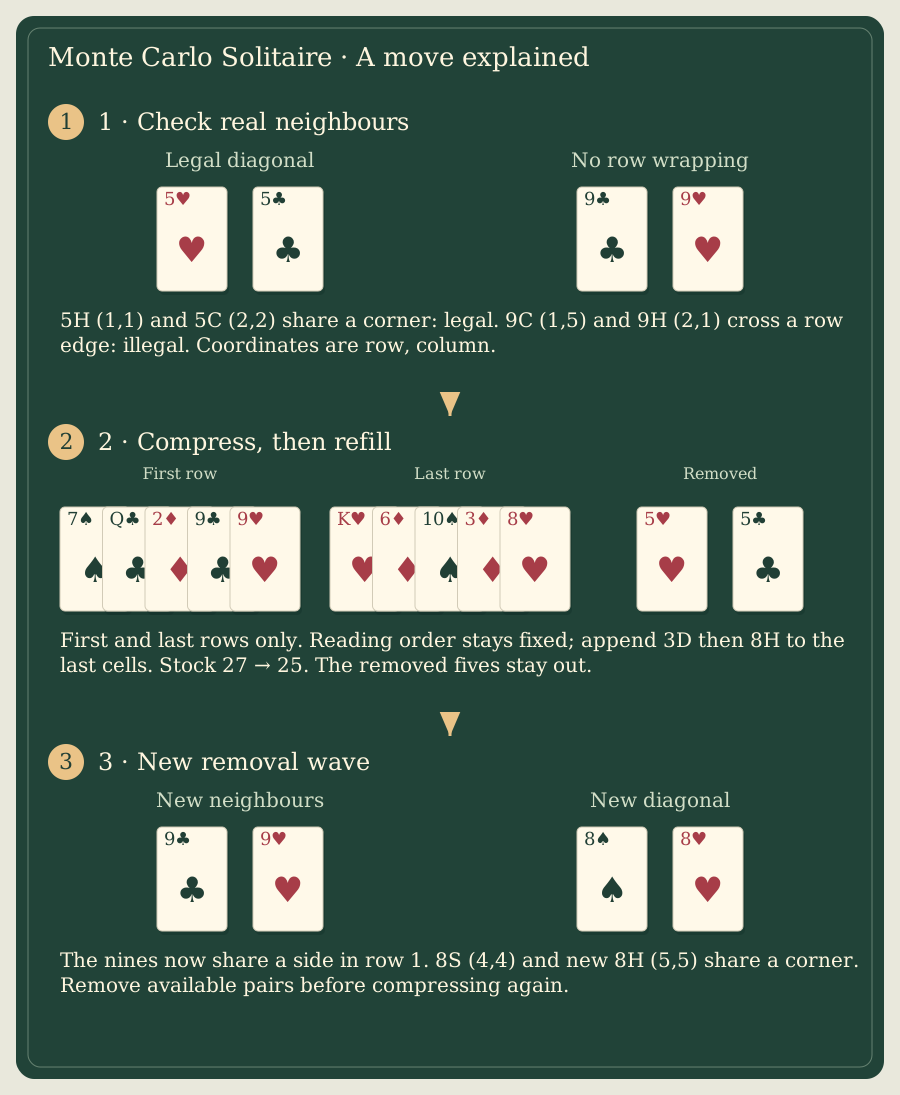
In the pictured opening remove 5♥ at row 1 column 1 and 5♣ at row 2 column 2: diagonal neighbours. Do not remove 9♣ at row 1 column 5 with 9♥ at row 2 column 1: row wrapping is forbidden. After the fives and stable compression, first row becomes 7♠ Q♣ 2♦ 9♣ 9♥; the nines now really touch. With next stock cards 3♦ then 8♥, the last row becomes K♥ 6♦ 10♠ 3♦ 8♥. Stock falls from 27 to 25. Those two new cards are part of the unseen remainder in the setup, not extra cards. Begin the next wave before another compression.
← On a small screen, scroll the diagram horizontally. →
Common questions
Do diagonal pairs count?+
Yes, matching cells may share a corner.
Can rows wrap around?+
No, the end of a row is not adjacent to the start of the next.
Does unused stock prevent a loss?+
No, a full unchanging grid with no pair is blocked.