← On a small screen, scroll the diagram horizontally. →
01 /
Commercial poker against a paytable
Mississippi Stud is a modern commercial poker-based table game, published in the specialty-game range now represented by Light & Wonder. Despite “stud” in the name, players do not compare hands with a dealer or compete for one shared poker pot. Its identity comes from staged decisions before shared cards are revealed and a fixed payment schedule. This guide explains the base game using abstract units; optional side bets and venue-specific limits are outside the profile. No origin story is inferred merely from the Mississippi name.
02 /
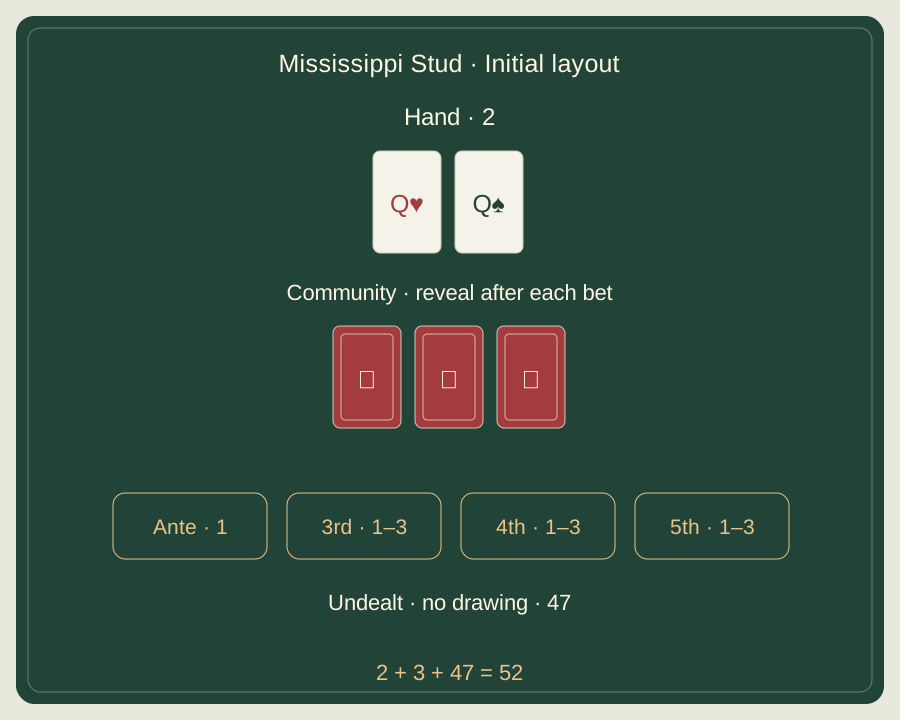
Two private cards and three shared cards
Use 52 ordinary cards, no jokers, for 1–6 player positions plus a non-playing dealer. Each player commits an Ante, the base unit for that hand. Shuffle; deal 2 private cards to each player and 3 community cards face down. Dealer has no competing hand. Inspect only your own cards. All players share the community cards but settle independently. Our one-position diagram has 2 private, 3 shared and 47 set aside. The remainder is not a draw pile and nobody changes cards. Start a fresh shuffled hand after settlement.
03 /
Bet or fold before each reveal
After inspecting 2 cards, either fold or place 3rd Street equal to 1, 2 or 3 times Ante. Then reveal the first community card. With 3 cards visible, fold or place 4th Street at 1–3 times Ante, then reveal the second. With 4 visible, fold or place 5th Street at 1–3 times Ante, then reveal the last. There is no check or free card. Each new amount is based on original Ante, not the preceding bet. Continuing to the end commits at least 4 and at most 10 Ante units in total. Resolve everyone’s decision before each reveal.
04 /
Use all five cards in ordinary poker order
Final hand is your 2 private plus all 3 community cards, exactly 5. Rank: royal flush; other straight flush; four of a kind; full house; flush; straight; three of a kind; two pair; one pair; high card. Flush means one suit, straight consecutive ranks, full house a triplet plus pair. A may be low in A 2 3 4 5 or high in 10 J Q K A, never wrapping Q K A 2 3. Suits have no superiority. No other player’s private card may be used and there is no sixth card to discard or replace.
05 /
Base paytable and the push band
Profit odds on every live base bet: royal flush 500:1; other straight flush 100:1; four of a kind 40:1; full house 10:1; flush 6:1; straight 4:1; three of a kind 3:1; two pair 2:1; pair J Q K or A 1:1. Pair 6 through 10 pushes: return all live stakes with no profit. Pair 2 through 5 or high card loses all live stakes. Apply the best category once to Ante and every street bet, not just the final bet. A higher category always overrides a low pair within it; a full house containing low ranks is still a full house.
06 /
Profit, returned stake and folding
If total committed is T and winning odds are m:1, profit is m × T and gross return is (m + 1) × T, including original stakes. A push returns T, net 0; a loss is −T. Folding at any stage immediately loses every base bet already placed, while unplaced later bets cost nothing. For example Ante 1 plus 3rd Street 2 followed by fold loses 3, not only the Ante. Each hand ends independently; there is no mandatory match target. For a home demonstration keep a net-unit ledger. Restore an accidentally early exposed community card by restarting that demonstration hand, not by changing a decision after seeing it.
07 /
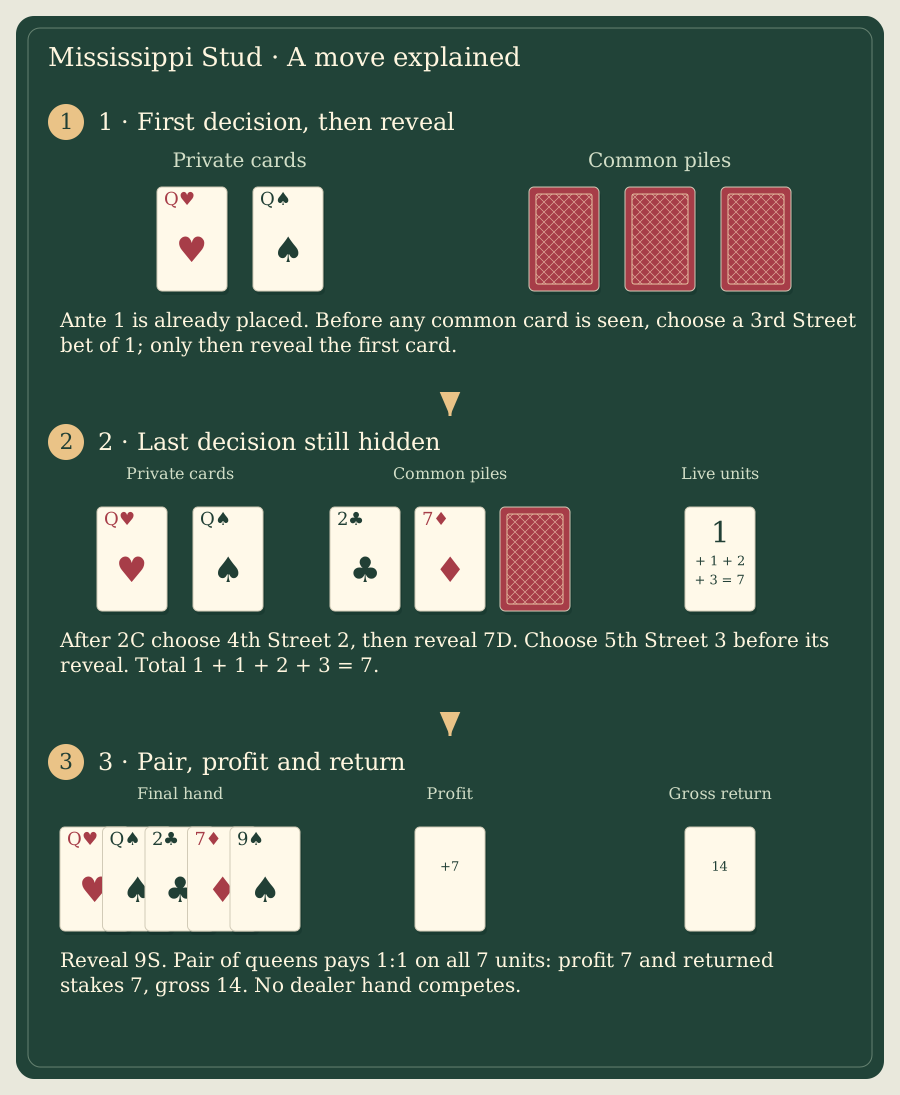
A high pair pays on all four bets
Private Q♥ Q♠. Ante 1; choose 3rd Street 1 before seeing 2♣, 4th Street 2 before 7♦, 5th Street 3 before 9♠. Total 1 + 1 + 2 + 3 = 7. Final five have a pair of queens, paying 1:1: profit 7 and returned stake 7, gross 14. These choices illustrate accounting, not an optimal strategy. In a separate hand 6♥ 6♠ with A♣ 9♦ K♣, the single pair of sixes only pushes. A pair of queens does not need to beat anyone else’s hand to receive its payment.
← On a small screen, scroll the diagram horizontally. →
Common questions
Does dealer need to qualify?+
No competing dealer hand exists in the base game.
Does a low pair win profit?+
The middle pair band only returns stakes; smaller pairs lose.
Is only the final bet paid?+
No, the base odds apply to every live base bet, including Ante.