← On a small screen, scroll the diagram horizontally. →
01 /
A game of discovering rules
Mao belongs to the matching-card family associated with Mau-Mau and Crazy Eights. Camp, school and university groups transmit it orally, often refusing to explain rules to newcomers. There is no universal official code or securely documented single inventor; the name alone does not establish a connection to the Chinese leader. This article openly explains a complete teaching profile. The surprise is a written secret law, not an incomplete account of how to take a turn.
02 /
A fixed profile before the silence
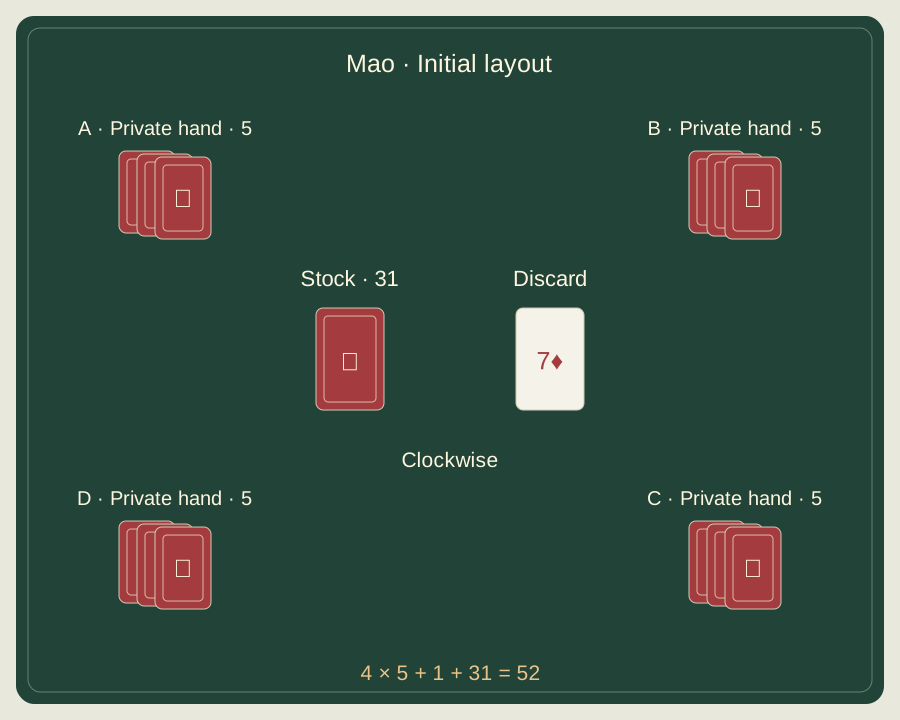
For 3–6 players use 52 ordinary cards, no jokers. Appoint an experienced referee who may also play. Before dealing, referee writes one compatible secret law and announces the base rules below. Deal 5 each clockwise, turn a starter onto the discard pile and leave the rest as stock. With 4 players, 20 are held, 1 exposed and 31 in stock. Dealer says play begins; left neighbour starts clockwise. Starter activates no speech or secret trigger: triggers begin only with played cards.
03 /
Match, or draw and stop
On your turn play 1 card matching the top discard’s suit or rank, provided the active secret law also allows it. Otherwise, or voluntarily, draw 1 and end your turn without playing the drawn card. There are no automatic skips, reversals, wild eights or stacked draw penalties in this profile. A secret requirement restricts legal plays; it never permits a rank or suit mismatch. Pass clockwise after a play or draw. Only the top discard determines the next match; there is no trump or card-point score.
04 /
Required calls and point of order
Otherwise remain silent. When playing a spade say its rank and “spades” in the agreed language. Say “Mao” immediately after a legal play leaving 1 card, and again after the final card. If both apply, make both calls before the next player acts. Missing or unnecessary speech draws 1 penalty card; a missed final call cancels the empty-hand win. “Point of order” pauses play: put hands face down, do not touch cards, and discuss only turn state or safety, not secret laws. The caller ends the pause and the same turn resumes.
05 /
One secret law, written in advance
For the illustrated tutorial, the law is: after a played queen, the next played card must be black as well as matching normally. Drawing does not clear that restriction; a legal black play does. In a surprise round only referee sees the written law initially. On an illegal attempt restore the card to its owner, draw 1 penalty and end that turn, announcing a brief reason such as “wrong colour”. Never invent retrospective penalties. After the round reveal and discuss the law; winner may write a replacement for the next round, with referee checking consistency.
06 /
Refill the stock and finish fairly
When stock empties, keep the top discard, shuffle the rest into a new stock, and preserve the current secret restriction. A legal empty hand with required calls wins immediately. Our finite-session fallback, not a universal Mao rule: if a required draw or penalty cannot be supplied even after recycling, stop the round. Count cards held plus the undelivered penalty; fewest wins, equal fewest tie without a round win. First to 3 round wins takes the match; rotate dealer. An out-of-turn play is restored and penalised without stealing the rightful player’s turn.
07 /
Matching is necessary, not sufficient
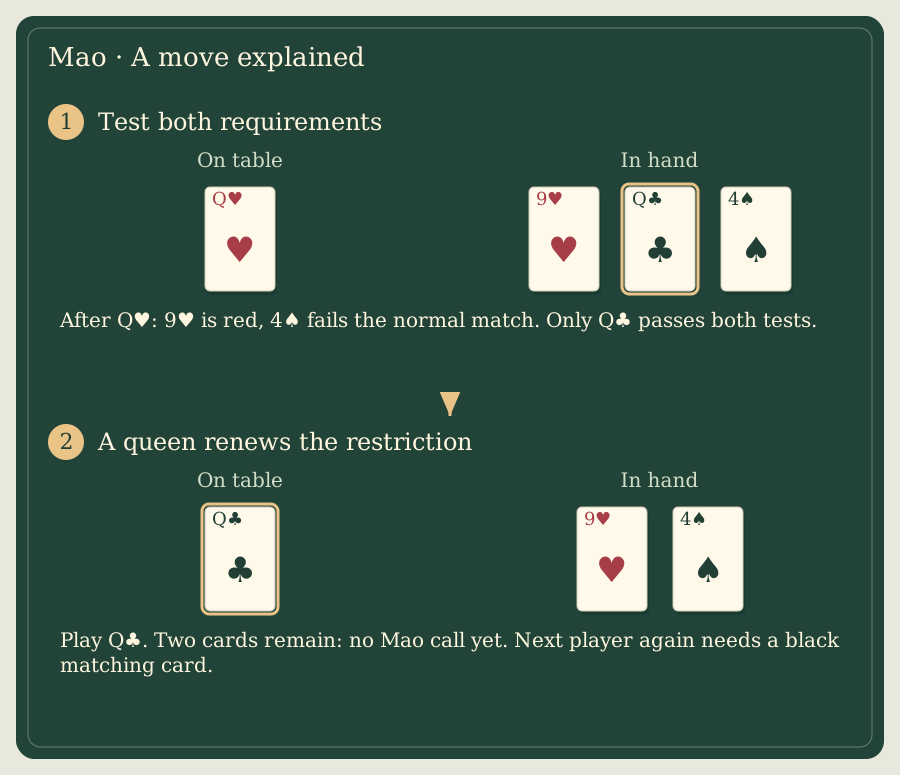
The top is a played Q♥ and the secret law requires a black card next. You hold 9♥, Q♣, 4♠. The 9♥ matches suit but is red; 4♠ is black but matches neither suit nor rank. Only Q♣ is legal. Play it; because it too is a queen, the next player again needs a black matching card. If these are your last 3 cards, you now have 2, so no “Mao” call yet. The diagram is a local turn example, not a full starting hand.
← On a small screen, scroll the diagram horizontally. →
Common questions
Are the rules universal?+
No. Agree the base profile and referee before play.
Can a drawn card be played?+
Not in this profile; drawing ends the turn.
Must I explain the secret law?+
Referee writes it before play and reveals it after the round.