← On a small screen, scroll the diagram horizontally. →
01 /
Belgian manille for two
Manillen is the Flemish name used within the Belgian manille tradition. Its defining manille is the ten, stronger than the ace. This guide selects the popular two-person form with private hands and partly hidden table cards. It differs from partnership Manille: every trick has only 2 cards, and uncovering a pile changes your available choices. A separate dummy-hand form makes larger tricks; do not mix that form into this deal. A precise inventor or founding date is not established.
02 /
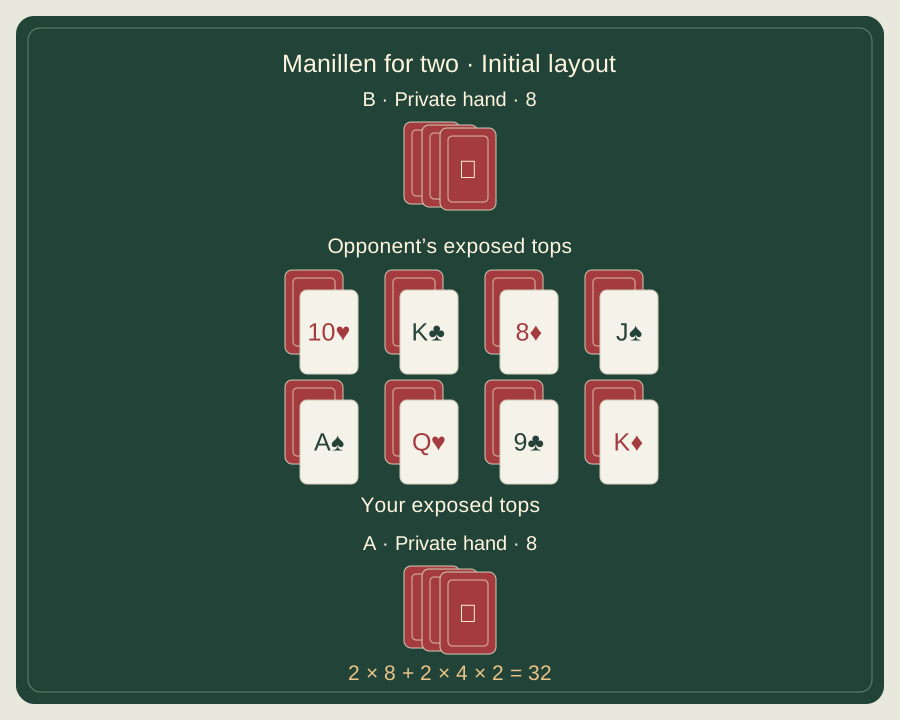
Eight in hand and four double piles
Use 32 cards, A K Q J 10 9 8 7 in each suit, no jokers. Cut for first dealer, then alternate. Deal 3 into each private hand; 4 face-down table cards to each person, alternating; 2 more into each hand; a face-up card onto each table card, alternating; finally 3 into each hand. Each player controls 8 private cards and 4 double piles: 16 cards altogether. No stock remains. Keep the opposing rows separate and never look at the hidden bottoms.
03 /
Trump, no trump and doubling
Dealer names a trump suit after inspecting their cards, or chooses no trump. Non-dealer leads first. No trump doubles the deal’s score. Before play the opponent may double, and dealer may redouble; these multiply by 2 and 4 respectively, not by adding fixed points. Our introductory profile stops there and excludes blind no-trump calls and further redoubles. Announce all multipliers before the first lead and record them so that nobody invents a higher stake during play.
04 /
Hand and exposed cards are both available
Rank high to low: 10 A K Q J 9 8 7. Lead from your private hand or any exposed top of your own piles. Reply using that same pool of available cards: follow suit and beat the lead if possible. If void, play a trump if you have one; if also out of trumps, discard anything available. Highest trump wins, otherwise higher led-suit card wins. Take both cards; at the end of the trick turn over any newly uncovered bottom cards. Winner leads again. Hidden bottoms cannot satisfy an obligation before they are exposed.
05 /
Sixty card points, sixteen tricks
Tens score 5, aces 4, kings 3, queens 2, jacks 1, others 0: 60 in the pack. Tricks themselves add nothing. After 16 tricks, a player above 30 records the excess over 30; the other records 0. Multiply this excess by the announced factors. Taking every trick doubles the base 30 to 60 before other multipliers; capturing all valuable cards while conceding a worthless trick is not a sweep. First to 101 match points wins this boam. A longer session can use a previously agreed number of boams.
06 /
Ties, exposure and corrections
At 30–30 nobody scores. In this profile the next decisive deal is doubled; repeated ties keep one pending double, not an ever-growing multiplier. This carry convention is stated explicitly because local tie rules differ. If a bottom was exposed early, restore it face down before anyone plays; the information cannot be forgotten. Check a suspected failure to follow against the hand and exposed tops as they stood at the time. Agree before starting whether a confirmed revoke forfeits the deal; our learning table restores the position when possible, otherwise redeals without points.
07 /
Win with an exposed ten, reveal a seven
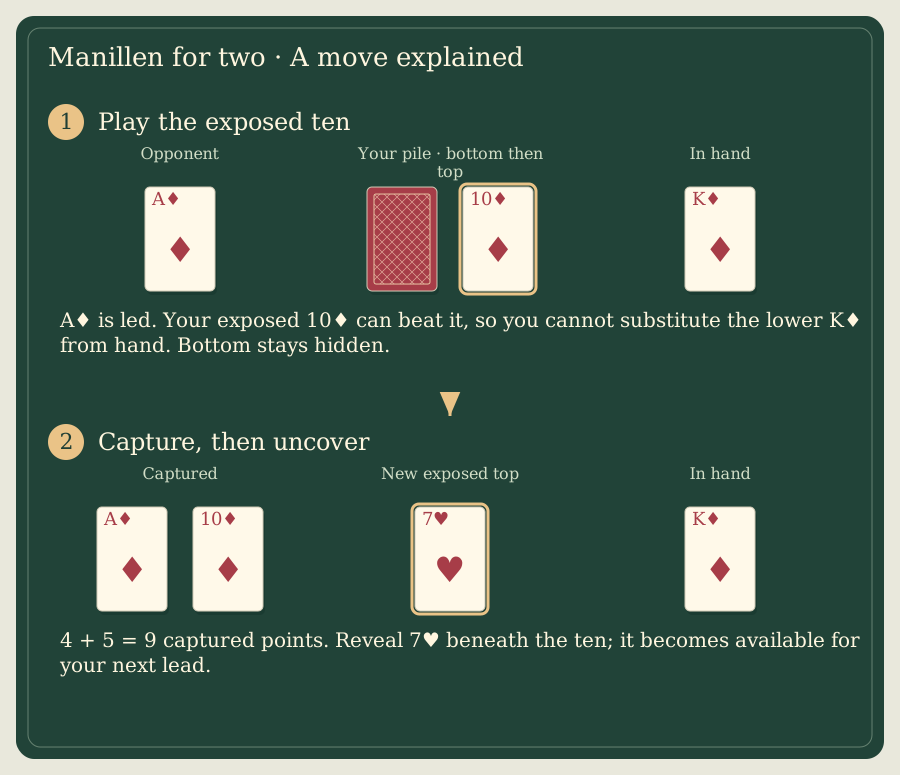
Spades are trumps. Opponent leads A♦. Your exposed pile shows 10♦ over a hidden 7♥. Even with K♦ privately held you must play the available winning 10♦. Take A♦ and 10♦ for 4 + 5 = 9 card points, then reveal 7♥ and lead again. The newly exposed seven cannot be played in the trick just finished. In a separate completed deal, 42 captured points gives 42 − 30 = 12 match points; with no trump and an opponent double, 12 × 2 × 2 = 48.
← On a small screen, scroll the diagram horizontally. →
Common questions
Can I use a table card?+
Yes, your exposed tops and private hand are one pool of available cards.
Does a trick itself score?+
No, only captured card values count.
Is this partnership Manille?+
No, this guide uses a two-person deal with table piles.