← On a small screen, scroll the diagram horizontally. →
01 /
Hungarian Lórum is a compendium
Lórum in Hungary combines several games under one score ledger. It is related to Balkan Lora, while Slovak Lórum is a different game. Local collections disagree on contracts, order and payments, so a single name is insufficient. This guide uses a fixed Hungarian sequence of seven contracts with a common pool collected in the final layout game. The precise inventor is unknown; we do not assign an unsupported origin date.
02 /
One dealer runs a whole cycle
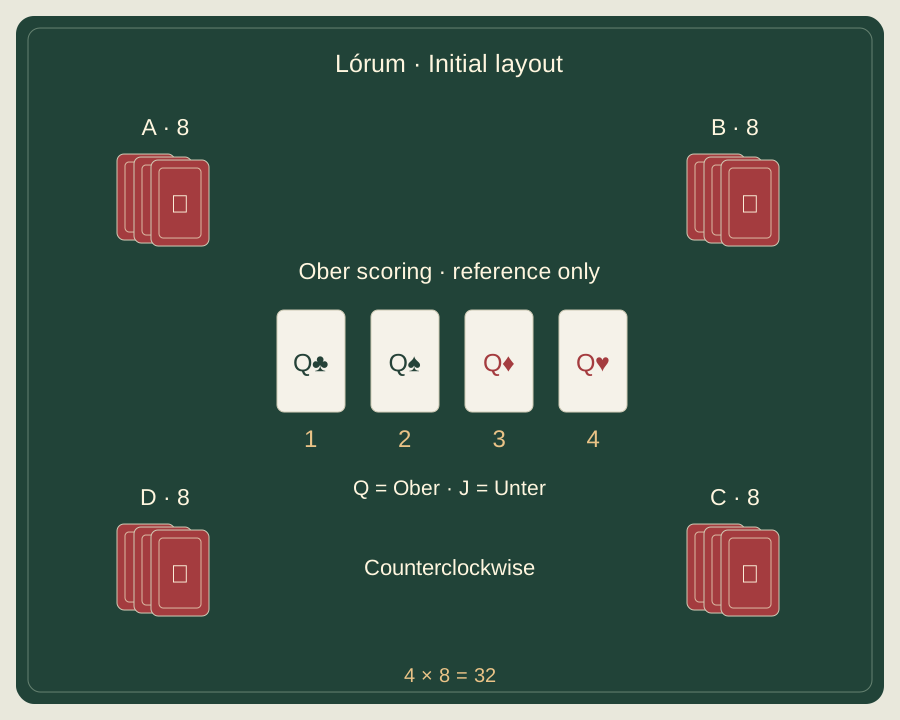
Play 4 individually with a 32-card Hungarian pack. French cards are a declared substitute: hearts = hearts, bells = diamonds, leaves = spades, acorns = clubs; Ober = Q, Unter = J. Rank A K Q J 10 9 8 7 downward. Deal 8 each in packets of 2, counterclockwise; cut at dealer’s left. One dealer completes all 7 contracts in order, then passes right: 28 deals overall. Start the pool empty and record counter transfers, permitting negative balances. Highest final balance wins; ties share.
03 /
How the trick contracts work
In Hearts, Obers, No Tricks and Hairy Monkey, dealer’s right leads any card. Proceed counterclockwise, following suit if possible, otherwise discarding freely. No trumps and no obligation to head the trick. Highest led-suit card wins and leads next. Capture piles must preserve which penalty cards each player took. The other contracts use different play described below; do not apply follow-suit rules to the layout or rank-chain games.
04 /
Contracts one to three: avoid or sweep
1 Hearts: each heart taken costs 1, total 8. If all players take hearts, payments enter the pool; if 3 do, the untouched player receives 8; if 2 do, the untouched pair receive 4 each. A player taking every heart instead receives 8 from each opponent. 2 Obers: Q♣ costs 1, Q♠ 2, Q♦ 3, Q♥ 4, total 10. Use the same distribution by untouched players: 10 to a lone untouched player, 5 each to an untouched pair; all Obers taken by one earns 10 from each opponent. 3 No Tricks: each trick costs 1, with exactly the Hearts distribution and all-trick exception.
05 /
Contracts four and five: play chains
4 Quads: dealer’s right starts any card. The holder of the next higher same-suit card plays it, even if that means consecutive plays by one person; 7 follows A. After 4 cards, or earlier if the next required card was already used, clear the chain. Its last player starts another. 5 Fast Train: first card free, then each player in counterclockwise order must play the next higher rank of any suit, or pass if unable; A wraps to 7. In either contract, the first empty hand wins immediately and receives 1 per card left in each opponent’s hand.
06 /
The king and the final layout
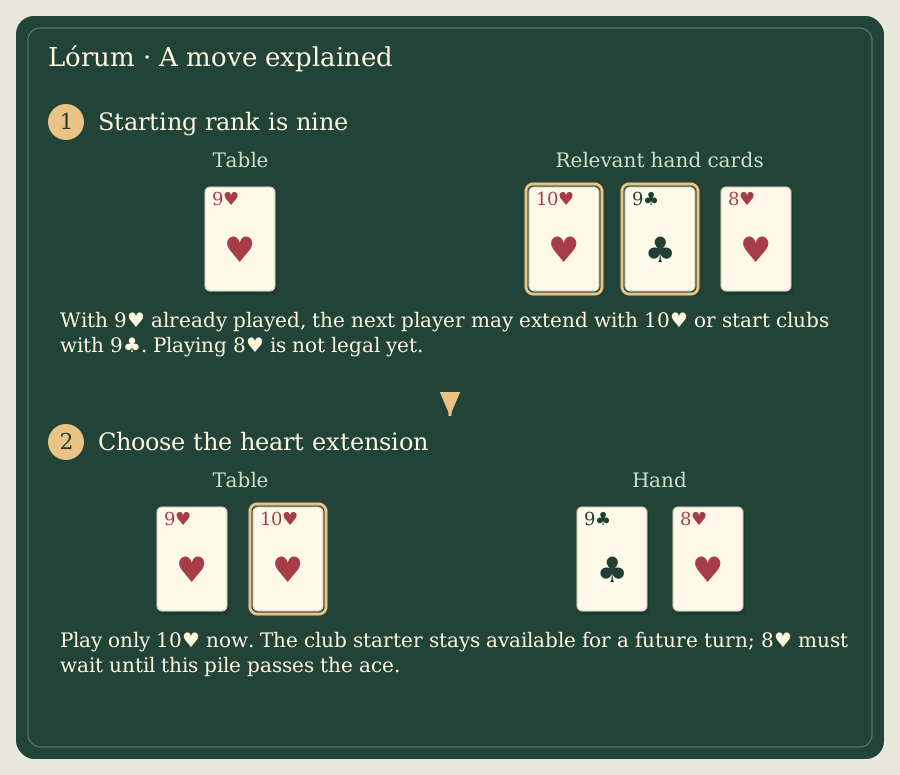
6 Hairy Monkey: whoever captures K♥ pays 10 to the pool; other cards and tricks have no score. 7 Lórum/Dominó: dealer’s right chooses a starting rank by playing a card. Each suit gets its own pile starting at that rank. Counterclockwise, play one legal starter or the next higher card on a pile; 7 follows A. Play if able; otherwise pass and pay 1 to the pool. At the first empty hand stop: others pay 1 per card left to the pool, then the winner collects the entire accumulated pool.
07 /
A clear ledger and a legal layout
Hearts contract: A takes 3 hearts, B 3, C 2, D none. A pays 3, B 3, C 2; D receives 8. Net sum is 0; no payment enters the pool. In a separate Dominó position starting on 9♥, the next player may play 10♥ or start another suit with its 9. Playing 8♥ downward is illegal. Later the same pile wraps A♥ to 7♥, then 8♥. Keep the contracts in their fixed order so the final winner can collect the stored pool.
← On a small screen, scroll the diagram horizontally. →
Common questions
Is Slovak Lórum the same game?+
No, it has a different structure and changing partnerships.
Can I choose contracts freely?+
Not here; the fixed order keeps the pooled payments coherent.
Does Dominó build downward?+
No, only upward from the chosen rank, wrapping after the ace.