← On a small screen, scroll the diagram horizontally. →
01 /
Contracts with a cutting bonus
Liverpool Rummy is a name used for several home versions of Contract Rummy, a family developed from earlier contract games. There is no single international Liverpool code. Here the distinctive rule is a bonus for cutting the exact dealing packet. The final contract uses three runs, not a single long run. We describe a complete four-player profile rather than silently mixing different club versions.
02 /
Two packs and three jokers
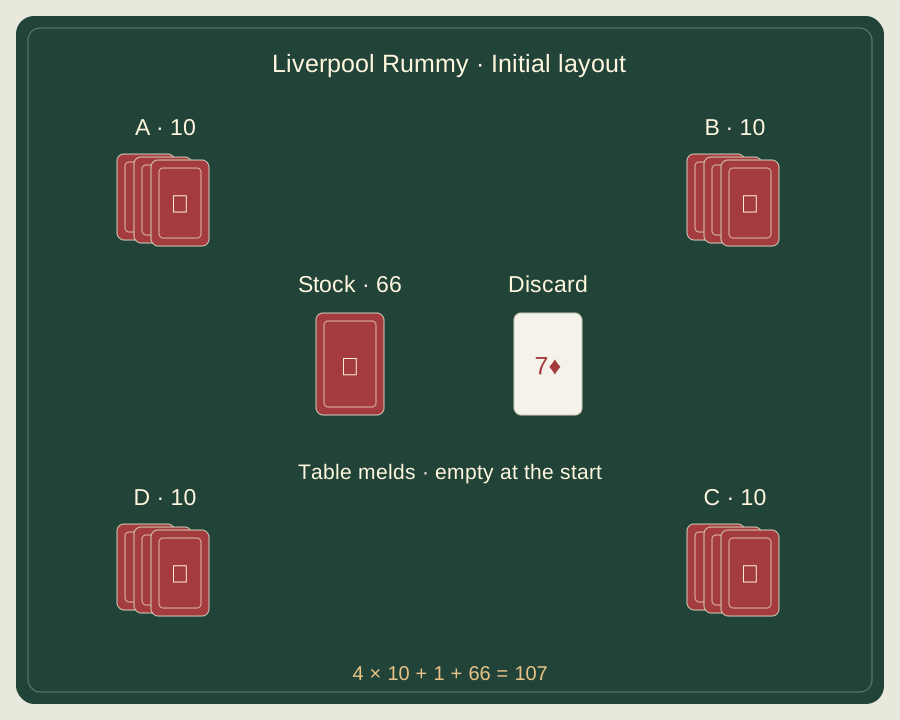
For 4 players combine 2 standard packs with 3 jokers: 107 cards. Choose a dealer randomly, then rotate clockwise. The right neighbour cuts before dealing; an exact packet of 41 cards in the first 3 rounds, or 49 in the last 4, reduces that cutter’s score by 50. Deal singly clockwise: 10 each in rounds 1–3, 12 in rounds 4–7. Turn the next card up as discard, keep the rest as stock. Dealer’s left begins.
03 /
The seven opening contracts
Contracts in order: 1 — 2 sets; 2 — 1 set and 1 run; 3 — 2 runs; 4 — 3 sets; 5 — 2 sets and 1 run; 6 — 1 set and 2 runs; 7 — 3 runs and empty your hand. A set starts with exactly 3 equal ranks, suits unrestricted and duplicate cards allowed. A run starts with exactly 4 consecutive cards of one suit. Aces may be low or high, never wrapping K A 2. Multiple runs in the same suit must overlap or have a gap; adjacent runs cannot satisfy separate requirements.
04 /
Draw, open, extend, discard
Normally draw the top stock or discard card. You may open only by laying your entire current contract together, at its minimum size; no partial opening and no later new melds. Extra cards can be added to any existing meld only on a later turn after your own opening. Do not lay off on the opening turn. End by discarding a card. Keep a card for the required discard in ordinary rounds; the final contract has the exception below.
05 /
Taking a discard out of turn
If the active player wants the discard, they take it normally and nobody can interrupt. Otherwise another player may request it, taking that card plus 1 stock penalty card, with no melding or discarding. Priority goes to whoever plays soonest after the active player. A different player may then request the newly exposed discard in the same way; nobody takes 2 successive discards this way. The original player finally draws stock and resumes the interrupted turn. Buying does not steal the turn.
06 /
Wild cards and the final contract
A joker represents a missing card in a set or run. A joker in a set stays there. On a later turn after opening, replace a run joker with its exact natural card and immediately lay off that joker elsewhere; never keep it. In round 7, lay your whole hand at once as 3 runs, with no discard. Runs may now exceed 4 cards to absorb every card drawn or bought. No preliminary opening or leftovers are permitted in that final round.
07 /
Recycling and penalty points
When stock runs out, leave the top discard and shuffle the rest into new stock. If nothing can be replenished and a required draw is impossible, end without a winner and score everyone’s hand. Otherwise the player out scores 0; others count numerals at face value, J Q K at 10, aces and jokers at 15. Add each round to the ledger, including any cutting bonus. After 7 rounds the lowest cumulative score wins; tied totals share.
08 /
Opening does not permit instant layoffs
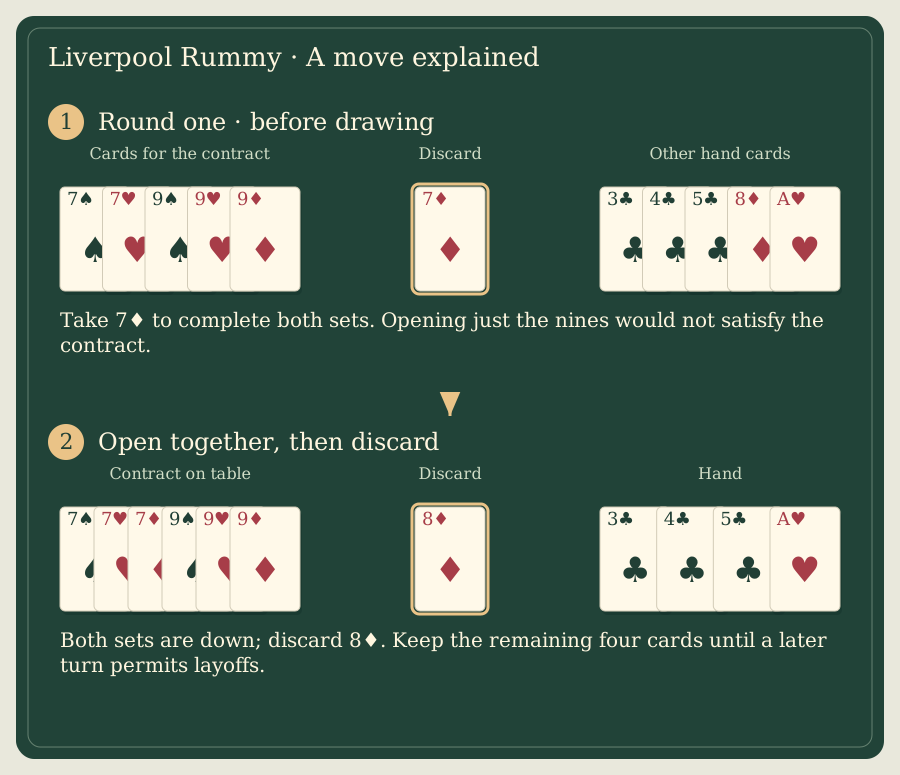
In round 1, take discard 7♦ with hand 7♠ 7♥ 9♠ 9♥ 9♦ 3♣ 4♣ 5♣ 8♦ A♥. Lay 7♠ 7♥ 7♦ and 9♠ 9♥ 9♦: both required sets together. You now have 5 cards. Discard 8♦, leaving 4. You cannot add extras to table melds until a later turn. A different player left holding A♠ K♦ 4♥ scores 15 + 10 + 4 = 29. An exact opening cut of 41 would separately reduce the cutter’s score by 50.
← On a small screen, scroll the diagram horizontally. →
Common questions
Can I lay off as I open?+
No, wait until a later turn after your opening.
Is the final contract a single run?+
No, three runs use the entire hand, without a final discard.
Does buying give me the turn?+
No, take the penalty card and let the active player continue.