← On a small screen, scroll the diagram horizontally. →
01 /
The risk of ending early
Knock Rummy, also called Poker Rum, belongs to the North American rummy tradition described in card manuals. Its defining decision is not whether the hand is perfect, but whether everyone else is likely to have more unmatched cards. A precise inventor is not established. Unlike Gin Rummy, this profile has no maximum deadwood threshold for knocking and allows a larger table. It also has no layoff onto an opponent’s combinations. These differences matter more than the shared word “knock”. We use a point ledger rather than money.
02 /
A low ace and a fixed hand size
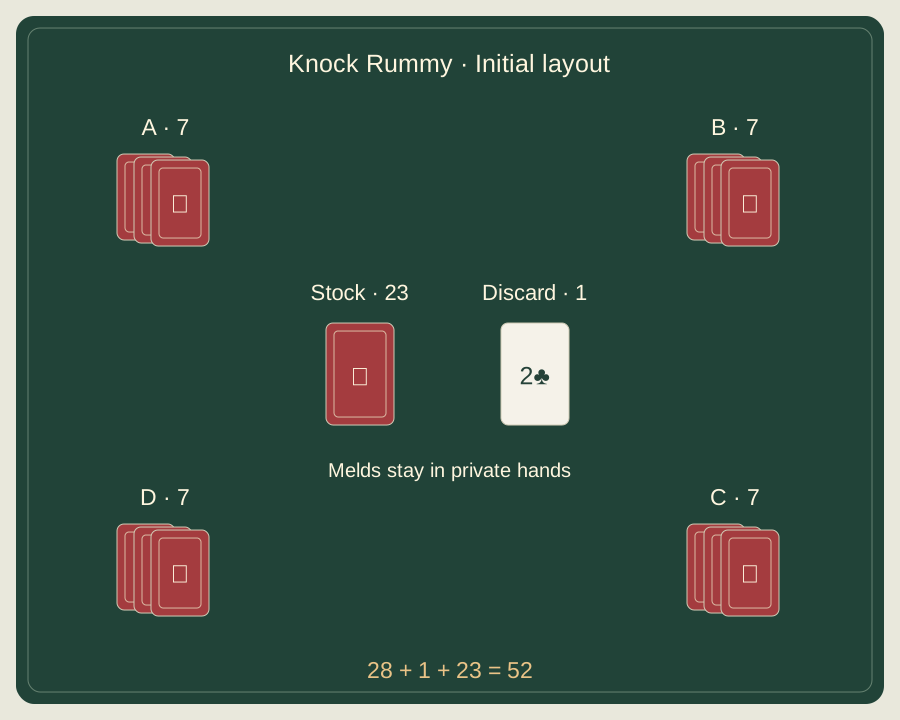
Use 52 cards without jokers for 2–5 people, individually. Aces are low: A 2 3 through 10 J Q K. Choose first dealer randomly, cut at the right and deal singly clockwise from the left. With 2 players deal 10 each; with 3–5 deal 7 each. The next card starts the face-up discard, remainder is face-down stock. Four-player opening: 28 held + 1 discard + 23 stock. Dealer rotates left after each hand. No one exposes melds during ordinary play. Before starting, agree to play one complete dealer rotation for a finite point session.
03 /
Minimise deadwood without reusing cards
A set contains 3 or 4 cards of one rank; a run contains at least 3 consecutive cards in one suit. A 2 3 is valid, Q K A is not. A card belongs to only one combination. Arrange overlapping possibilities to minimise the remaining deadwood, rather than blindly choosing the longest meld. Deadwood values: ace 1, ranks 2–10 face value, J Q K each 10. Meld cards themselves score zero deadwood. Keep combinations private until the ending, then each player independently chooses the best legal arrangement. You cannot reduce your count by laying onto another player’s cards.
04 /
Draw, then discard or knock
Player left of dealer starts. Draw 1 stock card or top discard. Return 1 hand card face up to continue, or face down on the discard pile to knock and stop everyone immediately. You may knock on your first turn, with any deadwood count; opponents receive no final extra turn. A discard taken from the table cannot be immediately returned, including as the knocking discard. If stock is empty and the next player declines the available discard, stop and compare hands with no knock penalty or zero-deadwood bonus. Do not recycle stock in this profile.
05 /
Differences, ties and going rum
Lowest deadwood wins; each loser transfers the difference to the winner’s point ledger. A knocker beaten by a lower count additionally transfers 10. If knocker ties for lowest, the other tied player collects from higher hands and knocker neither pays nor receives; no 10 penalty. Several lowest non-knockers share winnings and the beaten knocker’s extra penalty equally, recording fractions if needed. Knocking at zero is going rum: knocker wins even against another zero, and each opponent transfers deadwood + 25. At session end highest net ledger wins, ties shared. Transfers must sum to zero.
06 /
A valid knock can still lose
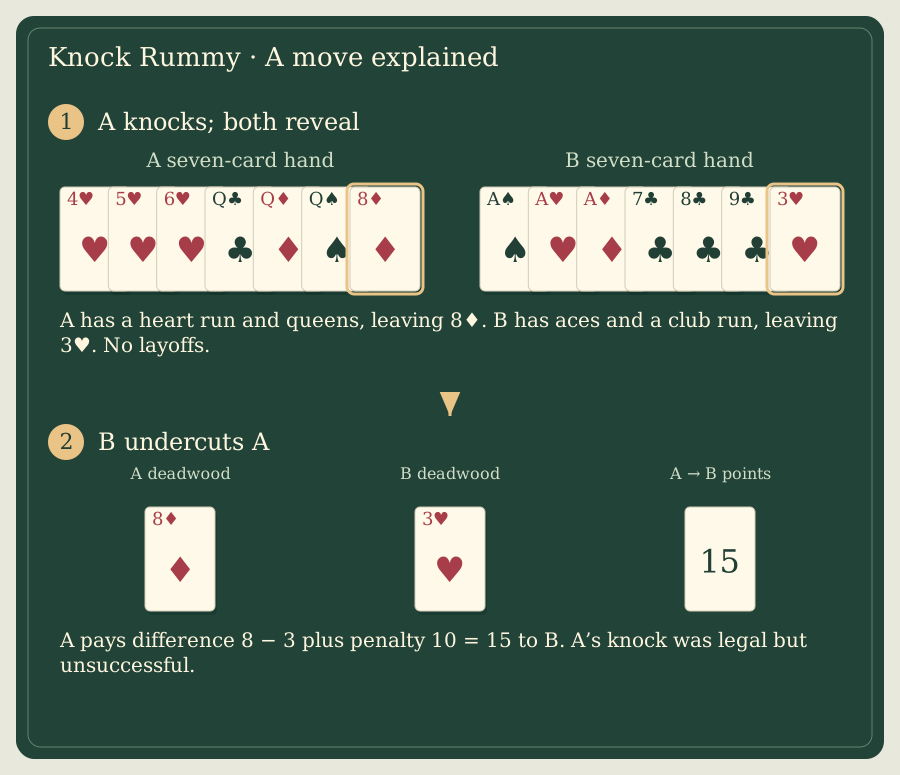
A’s final 7 cards are 4♥ 5♥ 6♥, Q♣ Q♦ Q♠, 8♦: deadwood 8. B has A♠ A♥ A♦, 7♣ 8♣ 9♣, 3♥: deadwood 3. B wins; A transfers 8 − 3 + 10 = 15. The run and queen set do not make A safe from an undercut. In a larger game the other losers also transfer their difference to B. Choose non-overlapping melds before comparing, and remember that a legal knock can still be a poor decision.
← On a small screen, scroll the diagram horizontally. →
Common questions
Is there a deadwood limit for knocking?+
No. Any count is legal after drawing and discarding, including on the first turn.
Can I lay off onto opponents?+
No. Count only your own non-overlapping combinations and remaining cards.
Does a tied knocker pay the penalty?+
No. A tied knocker neither pays nor receives; the other lowest hand collects from higher hands.