← On a small screen, scroll the diagram horizontally. →
01 /
Competitive patience around a cross
Kings in the Corner, also called Kings Corners or Kings in the Corners, brings patience-style building to a shared multiplayer table. Players race to empty their hands rather than complete suit foundations. A reliable individual inventor and exact first date are not established. Its memorable feature is spatial: ordinary piles form a cross, while only kings start the diagonal corners. Published rules disagree about when to draw. This page consistently uses the play-first, draw-at-end form, so a newly drawn card waits until your next turn.
02 /
Seven each and four open piles
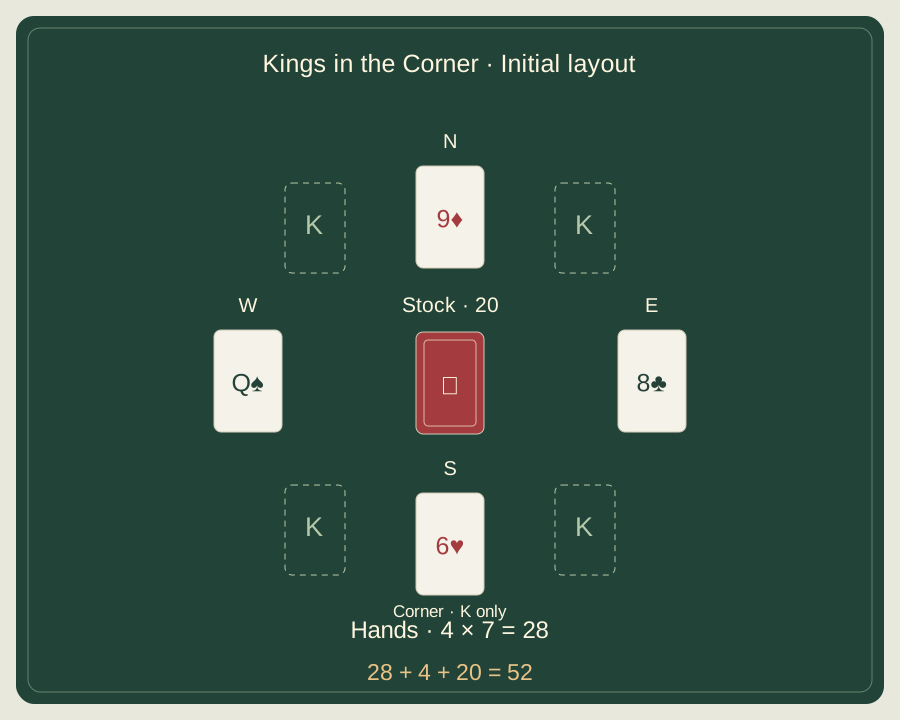
Use 52 cards without jokers, here for 2–4 players individually. Rank K Q J 10 down to 2 A: ace is low. Red means hearts or diamonds; black means clubs or spades. Choose dealer randomly and rotate left after each deal. Deal 7 each clockwise from dealer’s left; place the remaining stock face down centrally and turn 4 cards up at north, east, south and west. Leave diagonal corners empty. With 4 players: 28 in hands + 4 exposed + 20 stock. Overlap future cards so every rank remains visible. Left of dealer takes the first turn.
03 /
Play any number of legal moves
During your turn, play hand cards one rank lower and opposite colour onto exposed pile ends. For example red Q on black K, then black J on that Q. Suits themselves need not match. A king from hand may start any empty corner, then receives a descending alternating chain. An ace closes its pile: no wrapping to king. There is no requirement to play a king before other moves in this profile. You may stop voluntarily; every move uses a hand card or a whole pile under the next rule, never a hidden draw or a transfer to another player.
04 /
Move a whole pile, never a segment
Move an entire pile onto another if its bottom, oldest card fits one rank below and opposite colour to the destination’s exposed end. Keep its internal order; no lifting a convenient segment. A vacated side position may be filled with any hand card. An empty corner still needs a king. You can combine these moves repeatedly during the same turn. If an initial side card is a king, it may move to a corner on the first turn; the freed side can then take any hand card. A corner pile headed by king cannot move onto a queen, since the bottom king would not fit.
05 /
Draw to end, score what remains
If hand becomes empty, end the deal immediately without drawing. Otherwise draw 1 stock card after your chosen moves, or after passing with no moves; that draw ends your turn and cannot be played now. If stock is empty, continue without drawing. If everyone is unable or unwilling to move, declare the blocked deal finished. Each remaining king costs 10 penalty points, every other hand card 1; exposed table cards cost nothing. Add penalties and redeal until someone reaches at least 25, then lowest total wins, ties shared here. Draw-at-start rules are a valid other version, but must not be combined with this turn sequence.
06 /
Merge, fill the gap, then stop
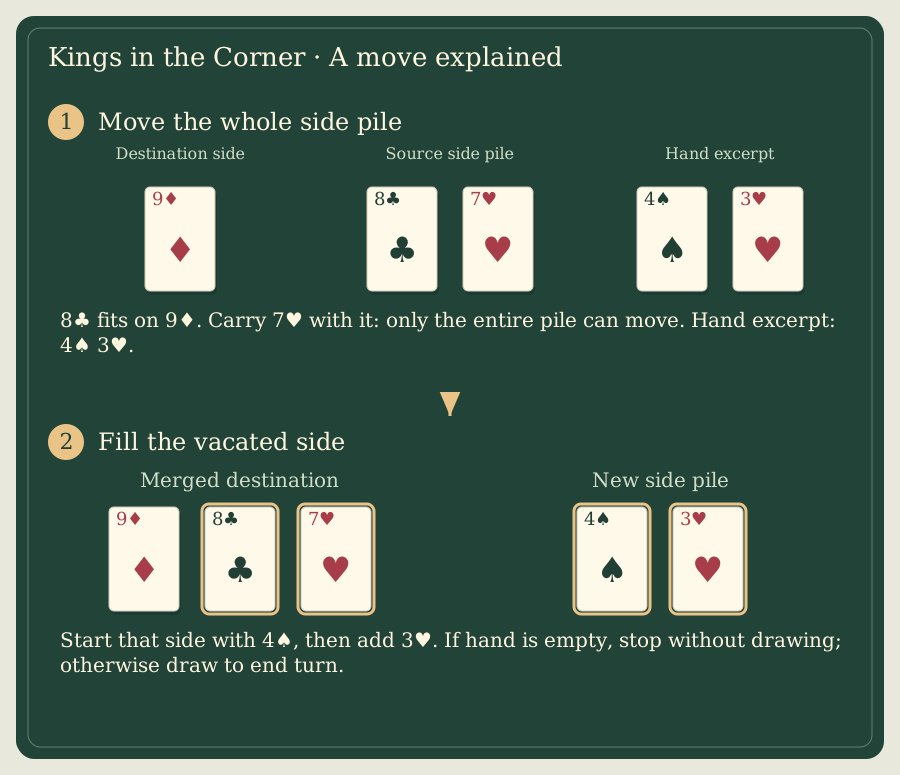
A side pile holds 8♣ then 7♥; another ends with 9♦. Move the entire 8♣–7♥ pile onto 9♦: black 8 fits red 9. Fill the vacated side with 4♠ from hand, then play 3♥ on it. You could not move only 7♥ onto an 8♦, since colours would match and a segment cannot be detached. If 3♥ was your last hand card, stop and do not draw. Otherwise take the end-of-turn stock card. A losing hand with K♠ Q♦ 2♣ costs 10 + 1 + 1 = 12. Look for whole-pile merges because they create places to unload awkward cards.
← On a small screen, scroll the diagram horizontally. →
Common questions
When do I draw?+
At the end of your turn, unless you went out. The drawn card cannot be played immediately in this profile.
Can I move part of a pile?+
No. Transfer the entire pile, testing its oldest bottom card against the destination’s exposed end.
Does any card start an empty corner?+
Only a king. Any hand card may fill a vacated side, which is a different position.