← On a small screen, scroll the diagram horizontally. →
01 /
Prairie partnerships and two unusual cards
Kaiser belongs to Canadian partnership trick games, especially associated with Saskatchewan and communities with French, German and Ukrainian roots. Its ancestry is disputed; the name alone does not prove an imported European game. Related commercial and regional forms include Lost Heir, Joffre and Les Rois. The explanation here uses the ordinary-card Canadian form: capture the bonus heart, avoid the penalty spade, and bid for the right to choose trump. A specially printed Kaiser deck is convenient but unnecessary.
02 /
Build the exact pack
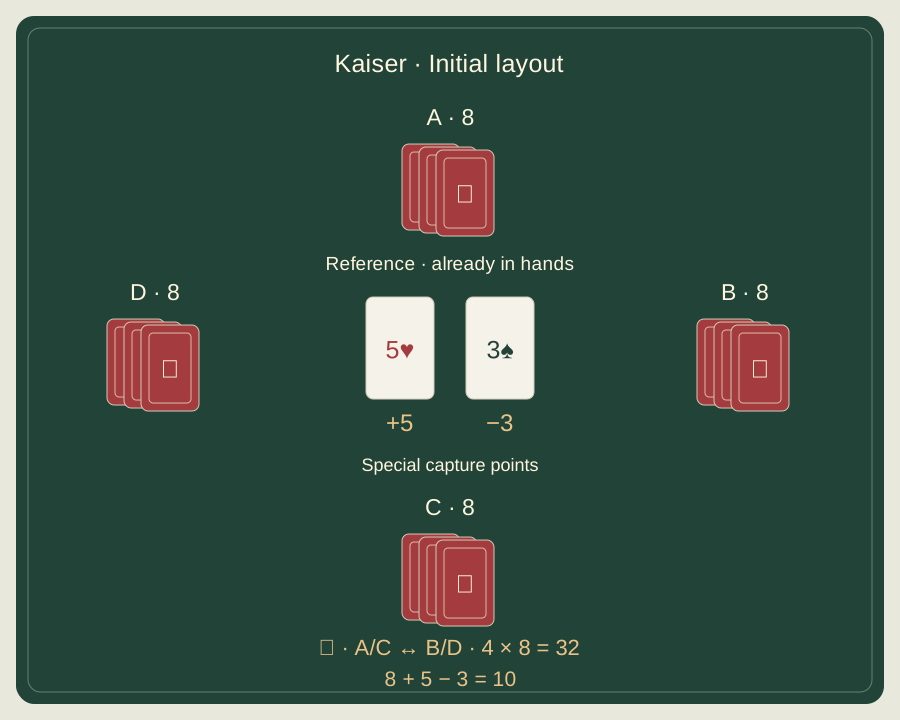
Seat 4 players in opposite partnerships. Start with 7 through A in every suit, replace 7♥ with 5♥ and 7♠ with 3♠: 32 cards. Rank A K Q J 10 9 8, then the remaining low card of that suit. The special cards are ordinary members of their suits when following. Choose dealer randomly; deal all cards singly clockwise from the left, 8 each. Rotate dealer left after every hand. There is no stock or kitty. Before bidding, a hand containing no ace, picture card, 5♥ or 3♠ may request a redeal by the same dealer.
03 /
One chance to bid
Beginning left of dealer, each player passes or bids once: 6 to 12, either with an unnamed trump suit or explicitly no trump. Equal-number no trump outranks a suit bid; the next number outranks both. A new bid must outrank the standing bid, except dealer may match it and take the contract. If everyone else passes, dealer must bid at least 6. Winner names the suit unless already committed to no trump, and leads first. These are point promises, not numbers of tricks: 7 tricks plus the bonus without the penalty can make 12 points. There is no special instant-win Kaiser bid in this profile.
04 /
Follow suit and protect the bonus
Play clockwise, one card each. Follow the suit led if possible; otherwise play anything, including trump. No compulsory trump or overtrump. Highest trump wins; without trump in the trick, highest of the led suit wins. Winner takes the cards for the partnership and leads next. Complete 8 tricks. The 5♥ bonus belongs to whoever captures it, not whoever was dealt it. Similarly the 3♠ penalty follows its captured trick. Partners cannot exchange information through agreed signals or advice.
05 /
Count before applying the contract
Raw points = tricks + 5 for captured 5♥ − 3 for captured 3♠. Both teams together have 10 raw points, but one team can have 12 while the other has −2. A successful bidder scores its actual raw points; failure loses the bid instead. In no trump, double only the bidding team’s award or loss. Defenders score raw points undoubled, but if their total before the hand is at least 45, positive raw points add nothing; negative points still subtract. First to at least 52 wins; if both cross together, give priority to a successful bidding team as our tie agreement. Target stays 52 here: variable targets and kitty play are separate variants.
06 /
A low card changes the result
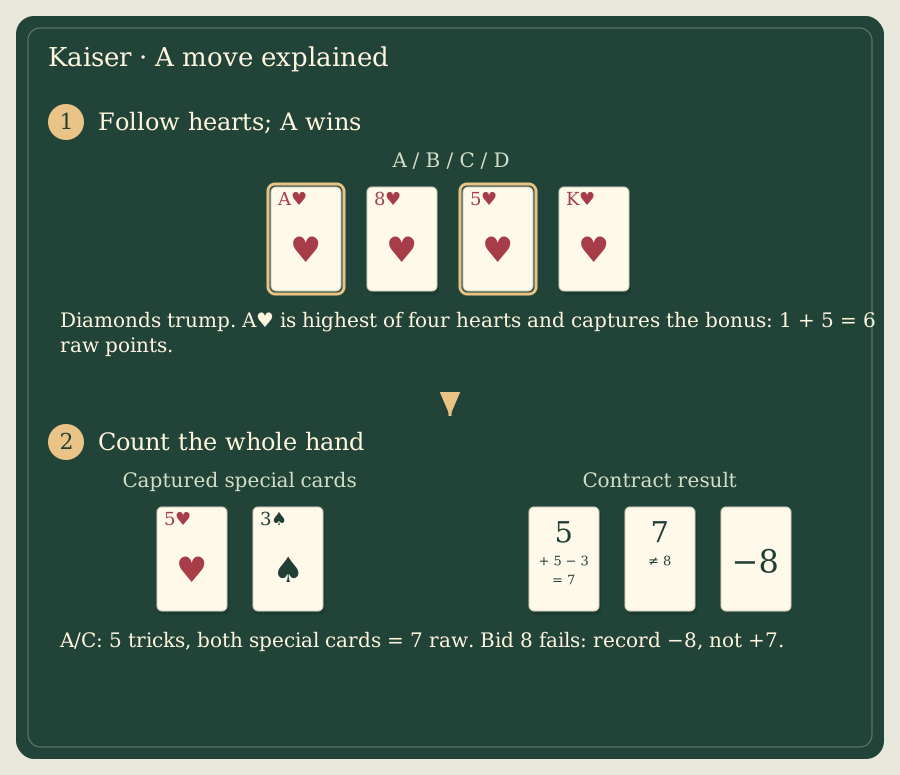
With diamonds trump, A leads A♥, B follows 8♥, C follows 5♥ and D follows K♥. A wins: that trick is worth 1 + 5 = 6. Suppose A/C finally take 5 tricks including both special cards: 5 + 5 − 3 = 7. A bid of 8 fails, so A/C record −8, while B/D’s 3 ordinary tricks score 3 if below the defensive threshold. In a separate hand, 7 tricks with 5♥ but without 3♠ give 12; the remaining trick containing 3♠ gives the other team −2. The bonus card’s low rank makes control of its suit more useful than simply holding it.
← On a small screen, scroll the diagram horizontally. →
Common questions
Is a special deck required?+
No. Modify an ordinary pack as described, retaining exactly 32 cards.
Can a team score more than ten?+
Yes. Seven tricks with the bonus but without the penalty give 12 raw points; the other team has −2.
Does no trump double both teams?+
No. Only the bidding team’s success or failure is doubled in this profile.