← On a small screen, scroll the diagram horizontally. →
01 /
A simultaneous collecting race
James Bond is a modern social and children’s matching game, also reported as Atlantis and Chanhassen. Accounts describe players in North America and several European countries; a precise inventor or publication year is not established. The title is the winning call, not evidence that the film franchise published this game. It belongs to the exchange family: the middle row is both your supply and your opponent’s supply. This guide uses one-card exchanges and keeps unfinished and completed packets closed until the final claim.
02 /
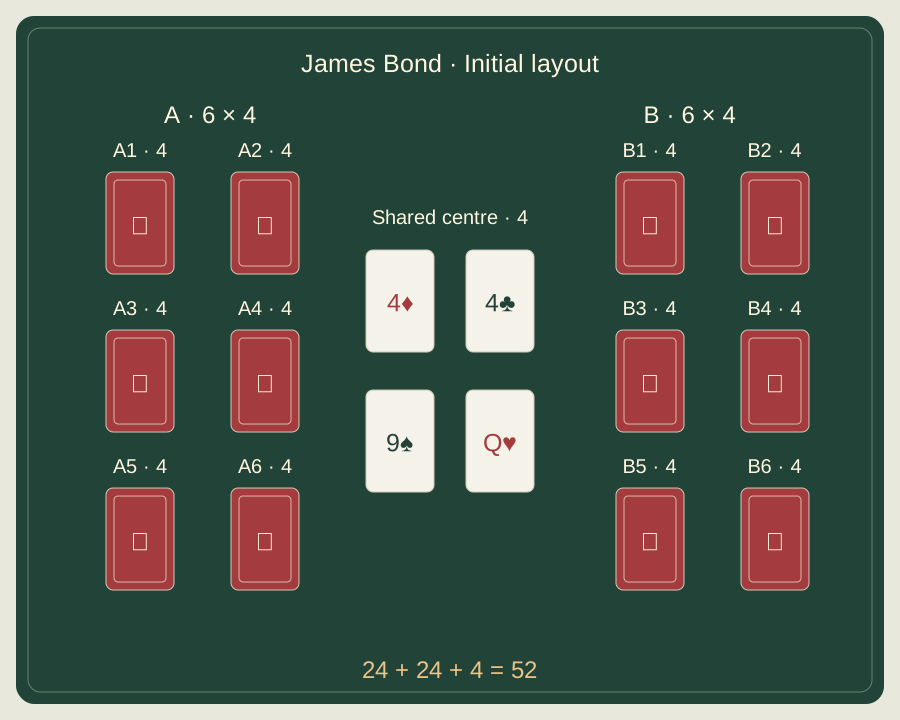
Twelve packets and four shared cards
Use 52 cards without jokers for 2 or 3 individual players. Shuffle into 12 closed packets of 4: 6 packets each with 2 players, 4 each with 3 players. Place the final 4 cards face up in the middle. There is no stock and ranks have no high-to-low order. Do not inspect packets before the start signal. Arrange your packets separately so you can replace each in its own place. In the illustrated two-player deal, 24 + 24 + 4 = 52.
03 /
One packet in hand at a time
On Go, everyone acts simultaneously. Pick up one of your packets and inspect it. Before picking up another, return the current packet face down; never spread or inspect several packets together. You may remember earlier cards. Only exchange between the packet currently held and the centre, never directly between your own packets or with an opponent’s packet. Do not reach into another player’s area. A completed packet stays closed in this profile; turning it up early is a different convention.
04 /
An exchange preserves both counts
Trade exactly 1 held card for 1 visible centre card, immediately leaving your replacement face up. After each exchange your packet has 4 and the centre has 4. Complete one exchange before beginning another; no grabbing multiple useful cards and replacing them later. Agree before play that a simultaneous reach for the same centre card stops the action: restore the disputed exchange, settle who touched first, then resume. If no order can be agreed, leave that card in place and restart together. This is a practical dispute agreement, not an extra source of cards.
05 /
Complete every packet before calling
A packet is complete only with all 4 suits of one rank; pairs, runs and flushes do not count. First to complete every personal packet calls James Bond. Freeze play and expose that player’s packets for checking. If correct, that player wins the deal; if incorrect, no win is awarded, replace packets face down and resume under this guide’s explicit false-call agreement. A genuine simultaneous correct call shares the win. You can play single deals or agree a number beforehand and count deal wins. No points depend on the rank collected.
06 /
Two exchanges complete the fours
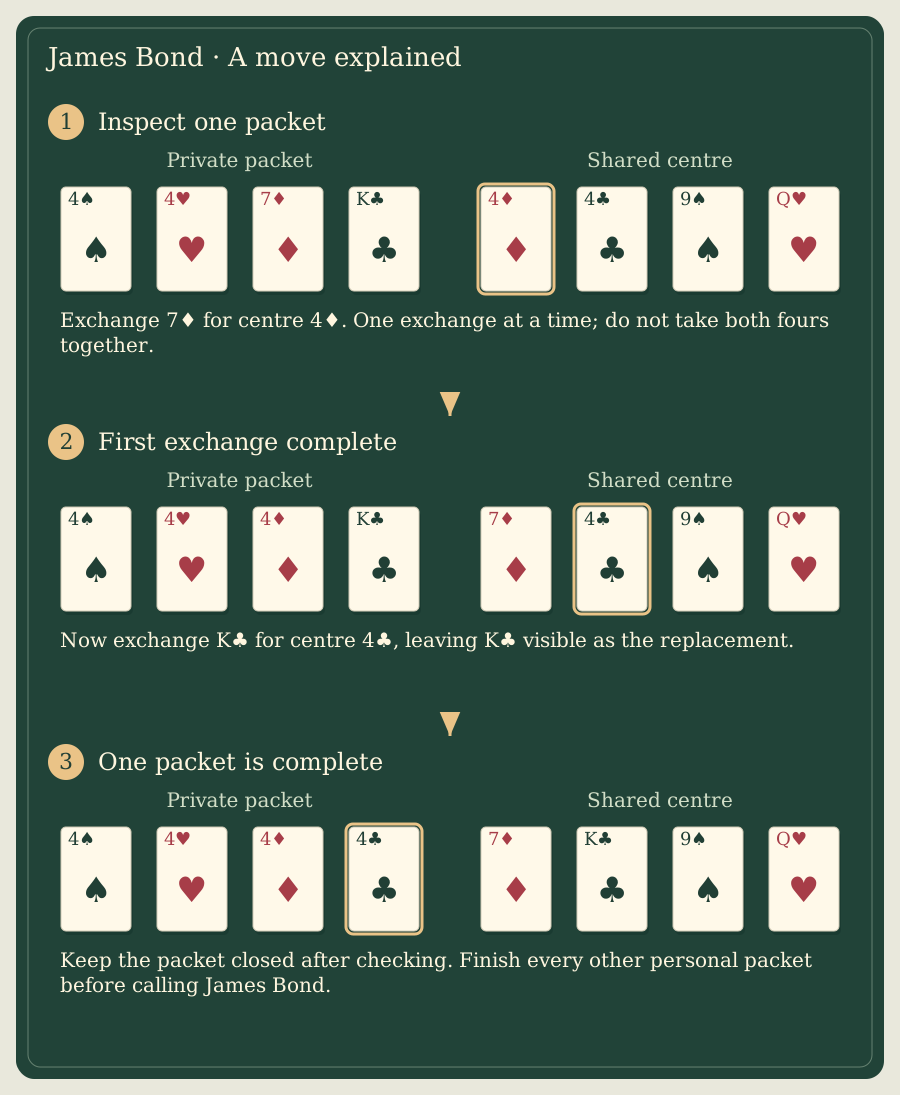
Your current packet is 4♠ 4♥ 7♦ K♣; centre 4♦ 4♣ 9♠ Q♥. First exchange 7♦ for 4♦: packet 4♠ 4♥ 4♦ K♣, centre 7♦ 4♣ 9♠ Q♥. Then exchange K♣ for 4♣: all four fours complete the packet, centre becomes 7♦ K♣ 9♠ Q♥. Every step leaves 4 cards on each side. You still cannot claim until your other packets also match. Releasing K♣ may help an opponent collecting kings, so remember which ranks they have taken.
← On a small screen, scroll the diagram horizontally. →
Common questions
Can I inspect several packets together?+
No. Return the held packet face down before picking up another; memory is allowed.
May I swap between my own packets?+
Not directly. Every exchange must pass through the common centre and preserve both card counts.
Does the first completed packet win?+
No. Every personal packet must contain four of one rank before the final call.