← On a small screen, scroll the diagram horizontally. →
01 /
Paplu and the two lives
Indian Rummy is a broad name for local rummy traditions; Paplu is especially associated with India and Maharashtra. Gathering sequences before exposing a complete hand distinguishes this form from games with shared table melds. The original life is a natural sequence; the second life is another sequence. No single inventor or secure first date is established here. We select the physical-card Paplu profile, with written point transfers and no cap, rather than blending modern online penalty schedules into it.
02 /
Deal and mark the wild rank
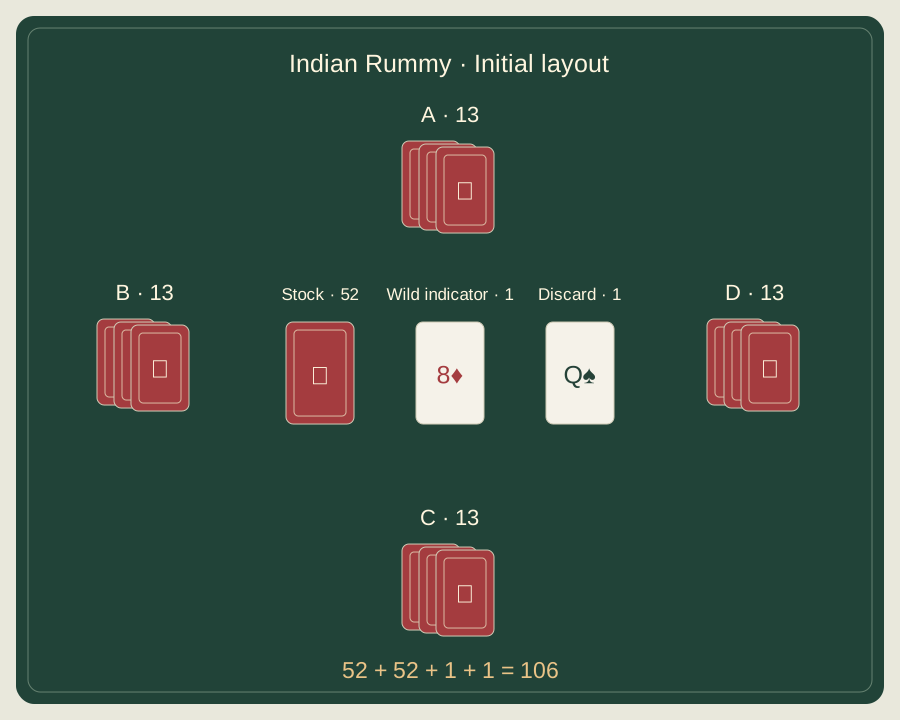
For 2–6 players mix 2 packs of 52 with 2 printed jokers, 106 total. Draw cards to choose first dealer: lowest deals, highest chooses a seat, others sit by descending rank to that player’s right; gather and shuffle again. Player left of dealer exposes a random indicator, then cuts. All other cards of its rank and printed jokers are wild; indicator stays aside. A printed-joker indicator makes only the remaining printed joker wild. Deal 13 each counterclockwise, expose 1 discard and keep the rest as stock. Player right starts; dealer rotates right. At four players: 52 dealt + 52 stock + 1 discard + 1 indicator = 106. Ties in the initial selection are redrawn by the tied players.
03 /
Sequences, triples and purity
A sequence is at least 3 consecutive cards of one suit. Ace may be low or high, never wrapping K A 2. A set in this Paplu profile is exactly 3 equal ranks in different suits; two identical copies do not make a legal set. Groups cannot share a physical card. A substitute joker can fill a missing card, but at least one sequence must be pure, with no substitution. A wild-rank card used in its own natural position is pure: with eights wild, 7♥ 8♥ 9♥ still qualifies. Printed jokers never have a natural position.
04 /
Draw and discard, keeping groups private
Take 1 top stock or discard card, then discard 1 face up. A discard just picked up cannot be returned on that turn. Even a wild opening discard may be taken. Keep developing groups in hand, with no table melds or layoff onto opponents. A normal turn changes 13 to 14 and back to 13. Declare only when every remaining card belongs to valid groups including at least 2 sequences, one pure. Discard the extra card, expose and check. An invalid declaration wins nothing; our teaching agreement treats that player as a later drop and continues. If last stock card is drawn without a valid finish by turn end, void the hand; do not recycle.
05 /
Pack before drawing
Instead of drawing at turn start you may pack. Before your first draw it costs 10 to the eventual winner: shuffle your 13 cards into the stock bottom. A later pack costs 40; set your cards aside, not into stock. If everyone but one packs, the survivor wins. If the hand becomes void, no packing penalties are paid. This chosen profile has no online-style penalty cap or automatic ace-wild conversion. Record who packed and when so their fixed amounts are not also counted as leftover-card penalties.
06 /
Protect groups before counting penalties
Values: A K Q J 10 each 10, 2–9 face value, all jokers 0. Without a pure sequence count the whole losing hand. With a pure sequence only, protect its cards but count the rest, even an otherwise good set. With a pure sequence and another sequence, exclude every valid non-overlapping group and count only leftovers. Each active loser transfers that amount to winner; packed players transfer their fixed penalty. A winner on their first drawn turn halves the unmatched penalties of players who have not yet had a turn. Preserve fractional points exactly on paper.
07 /
Hand Rummy and the session
If the dealt 13 already satisfy all grouping rules, declare Hand Rummy at your first turn without drawing. We explicitly select the no-double-premium variant: normal protected-card penalties apply, including normal rate for players still awaiting a turn. Early drops stay at 10. A valid hand winner gains all transfers and losers subtract them, so the score ledger sums to 0. Play one complete dealer rotation as the stated session agreement, then greatest net score wins; equal leaders share. A void deal scores nothing and dealer still rotates.
08 /
A complete thirteen-card declaration
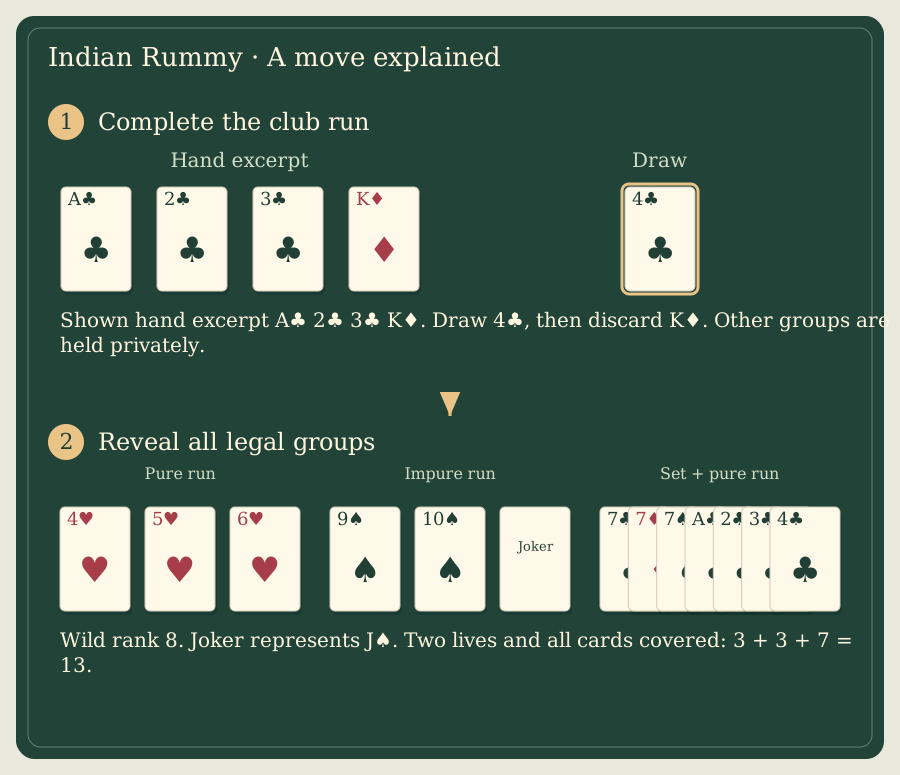
With eights wild, hold 4♥ 5♥ 6♥; 9♠ 10♠ printed joker as J♠; 7♣ 7♦ 7♠; A♣ 2♣ 3♣ K♦. Draw 4♣ and discard K♦. The 13 now form a pure heart run, an impure spade run, a legal triple and a pure club run: 3 + 3 + 3 + 4 = 13. All requirements hold. Separately, a losing hand with both lives protecting its groups and only K♣ 5♦ left pays 15. A hand with merely one pure run cannot also protect its set. The wild indicator itself was never drawn into either hand.
← On a small screen, scroll the diagram horizontally. →
Common questions
Can a wild-rank card be in a pure run?+
Yes, when used as its own rank and suit, not as a substitute. Printed jokers cannot do this.
Can I lay groups before declaring?+
No. This Paplu profile keeps groups concealed until a complete valid declaration.
Do we reshuffle when stock runs out?+
No. If the last-stock turn produces no valid winner, the hand is void and even drop penalties are cancelled.