← On a small screen, scroll the diagram horizontally. →
01 /
Dutch hearts, a different short pack
Hartenjagen means hunting hearts. Dutch tables use the name for several penalty games, including a compact short-pack form and the international full-pack Hearts game. This guide selects the Dutch short-pack form: the club jack matters as well as hearts and the spade queen. There is no universally fixed national code or established individual inventor. A name shared with an app does not identify its rules: check the pack, the opening lead and whether scoring reverses halfway through.
02 /
Prepare and deal
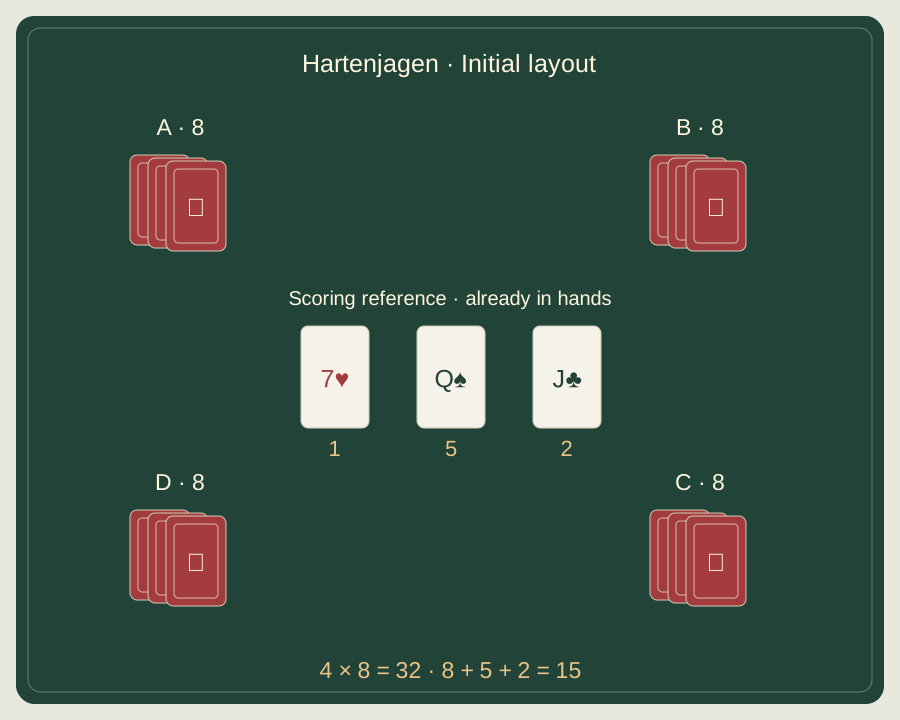
For 4 individual players use 32 cards, keeping 7–A in each suit and removing 2–6 and jokers. Rank is A K Q J 10 9 8 7. Shuffle and deal 8 cards each, clockwise; there is no stock, exchange or passing. Rotate the dealer left after every deal. Our chosen opening requires the holder of 7♣ to lead that card. All scores start at 0. Before playing agree the finish: this page uses a single upward race to 50, with the lowest total winning.
03 /
Follow suit, then avoid the burden
A trick contains 1 card per player. Follow the led suit if possible; otherwise discard any card. There are no trumps and no obligation to beat a previous card. The highest card of the led suit takes all 4 cards; that winner leads next. Keep captured piles separate until all 8 tricks are over. After the compulsory opening you may lead any suit, including hearts: there is no hearts-breaking restriction and no special ban on penalty discards in the opening trick.
04 /
Fifteen points and the pit
Each captured heart counts 1, Q♠ counts 5 and J♣ counts 2. Other cards count 0. A normal deal distributes 8 + 5 + 2 = 15 points. The player capturing all scoring cards makes a pit: record 0 for that player and 15 for each opponent instead. It is not enough to capture hearts alone, and winning every trick is unnecessary. Under this scoring choice a pit records 45 points across the table, so do not force the score sheet to sum to 15 after a sweep.
05 /
Finish and table variations
Add each completed deal to the totals. When anyone reaches or exceeds 50, finish the match after that deal; the smallest total wins and tied leaders share victory. This is a declared one-phase finish. Another Dutch tradition switches everyone to subtracting captured points after the threshold, racing back towards zero; agree its sweep and overshoot rules separately. Other tables let the player left of the dealer lead freely or let a pit subtract points. Do not apply these alternatives halfway through our selected profile.
06 /
A costly club trick
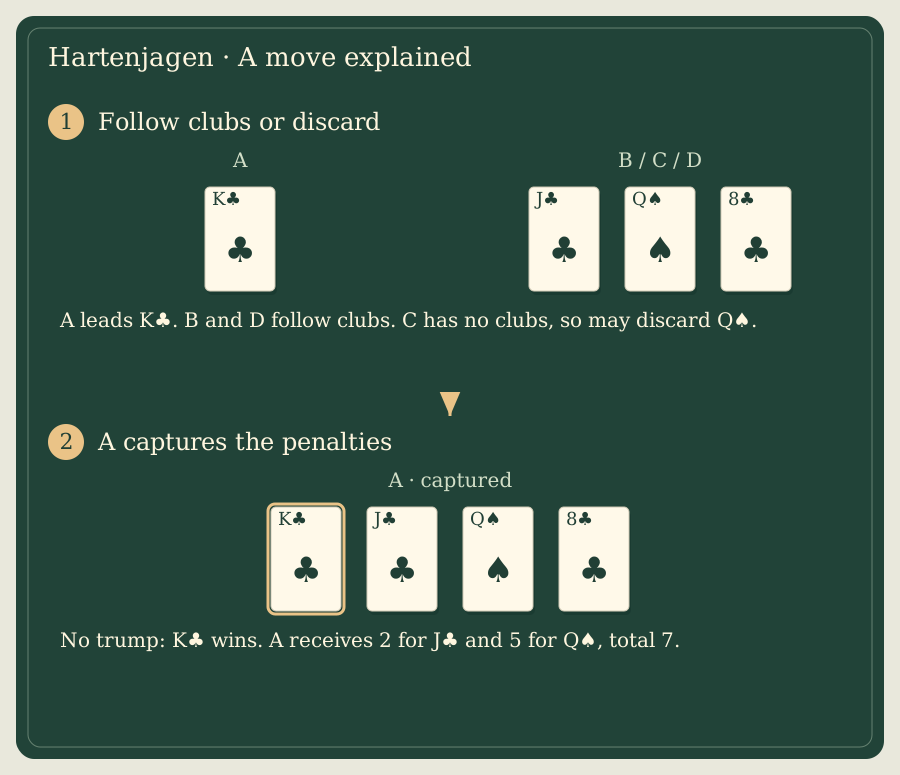
In a later trick A leads K♣, B follows J♣, C has no clubs and discards Q♠, D follows 8♣. K♣ wins: Q♠ is not a trump and C was allowed to discard it only because C was void. A captures 2 + 5 = 7 points. If A later captures 2 hearts and no other points, A scores 9 for the deal. This cannot be a pit because the other hearts went elsewhere. Keeping a small club might have let A avoid leading the king into these penalties.
← On a small screen, scroll the diagram horizontally. →
Common questions
Is this ordinary Hearts?+
No. The selected Dutch pack and penalty cards are different; do not import passing or broken-hearts rules.
Must hearts be broken before leading them?+
No. After the compulsory club-seven opening, any suit may be led in this profile.
Does a pit require every trick?+
No. Capture all hearts, Q♠ and J♣. Non-scoring tricks may go to opponents.