← On a small screen, scroll the diagram horizontally. →
01 /
British illustrated families
Happy Families belongs to the British illustrated collecting games of the nineteenth century. Jaques editions became associated with occupational households and named family members. Precise launch dates in later advertising and collectors’ histories disagree, so an exhibition anecdote is not treated here as a verified birth certificate. The enduring idea is a polite request for a particular missing member, with public exchanges revealing clues. Modern themed packs change the characters, not necessarily the procedure. This guide uses the no-stock, failed-requester-transfers-the-turn profile and stops after the family-collection phase. The historical extra phase asking for whole completed families is optional, not mixed into this game.
02 /
The family pack and our teaching labels
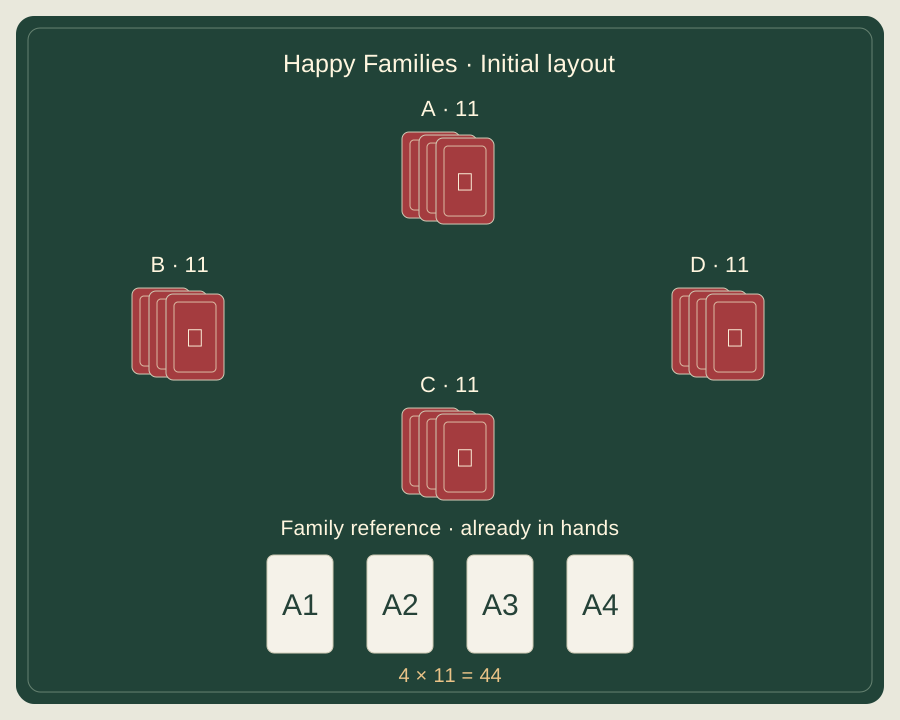
Use a dedicated 44-card set with 11 families of 4 members, or make a fully labelled equivalent. Our original diagrams use neutral family letters A–K and roles 1, 2, 3, 4; these are identification labels, not ranks or point values. No historical publisher artwork is reproduced. A label such as A3 means the third named member of family A, not a playing-card three. An ordinary unmodified pack is not the same equipment: a standard-card adaptation may use suits as members and equal ranks as families, but its family count differs. Count the members and explain the mapping before play.
03 /
Deal everything, with no stock
For 2–6 players, shuffle and deal all 44 cards singly clockwise. Hands differ by at most 1 card when the count is uneven. With 4 players everyone has 11. There is no stock, draw pile or discard pile. Keep hands hidden but let everyone consult a public list of all family members. Put any complete family already dealt face up in front of its owner. The player left of the dealer begins; if that player has no remaining cards, move clockwise to someone who does. Nobody refills an empty hand. A completed family is permanently out of the asking game.
04 /
Ask for an exact missing member
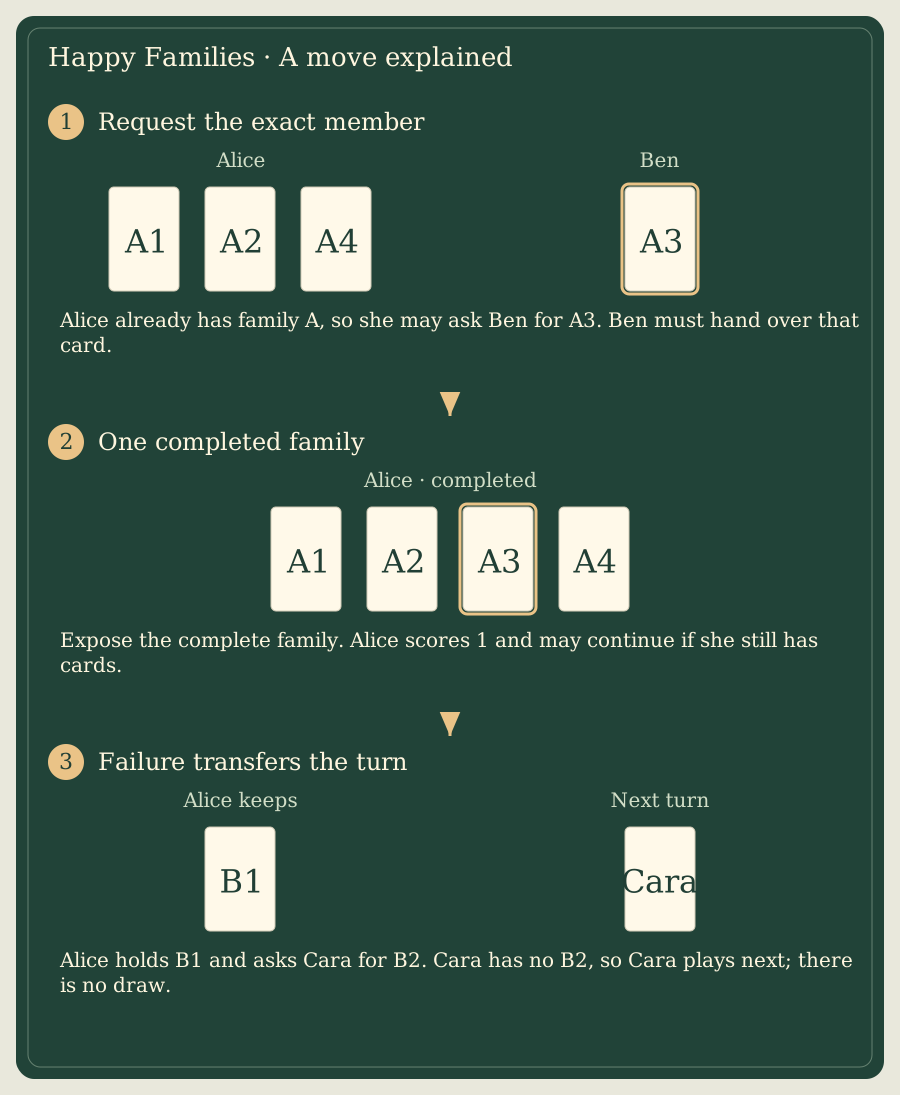
Name an opponent who still has cards and request a particular member of a family represented in your own hand. Do not ask for a family you do not hold or a card you already own. If the opponent holds that member, they must hand it over, and you may ask again, choosing the same opponent or another. Only the named card transfers, not every card from that family. On failure, the opponent says no and receives the next turn themselves; play does not automatically go to the asker’s left. There is no penalty draw. Keep requests and transfers audible and visible, so everyone has the same information.
05 /
Complete, leave play and count
As soon as all 4 members are together, expose the complete family before its owner. It scores 1 family, irrespective of character or occupation. A successful request still continues the turn if the asker has cards left. An empty-handed player takes no further asking turns, but keeps all completed families and can still win. If the active player empties their hand, pass clockwise to the next nonempty hand. Finish when all 11 families are complete. Most families wins; ties share victory. This guide does not add a second phase that could take already scored families away. Agree any multi-game total before the first deal.
06 /
A successful request and a failed one
Alice holds A1, A2 and A4, so she may ask Ben specifically for A3. Ben has it and must transfer it; Alice exposes A1–A4 as a complete family and scores 1. Ben’s other families remain his. If Alice still holds B1, she may next ask Cara for B2. Cara does not have it, so Cara gets the next turn, not necessarily the neighbour to Alice’s left. Alice keeps B1. The diagrams show only the relevant cards, not everyone’s full hand. A failed request is useful information for later, but never permission to lie or to search another player’s cards.
← On a small screen, scroll the diagram horizontally. →
Common questions
Who plays after a failed request?+
The person who was asked takes the turn in this profile, not automatically the next clockwise player.
Do I draw a card after no?+
No. All cards were dealt, so this no-stock version has no penalty draw.
Does an empty hand win immediately?+
No. The winner is determined by completed families after all cards have been collected into families.