← On a small screen, scroll the diagram horizontally. →
01 /
A Canasta relative with many rulesets
Hand and Foot is a North American Canasta relative named for the personal packet played first and the concealed packet played afterwards. Its spread through social card tables produced many incompatible household rules rather than a single universal code. Published guides differ on packet size, wild-card ratios, discard pickup and the books needed to finish. Here we use the four-player partnership profile with equal thirteen-card packets, including a required all-wild book. Eleven-card packets are a real alternative, not an error in somebody else’s game. A precise individual inventor is not established; check the selected profile before comparing scores.
02 /
Two packets per player
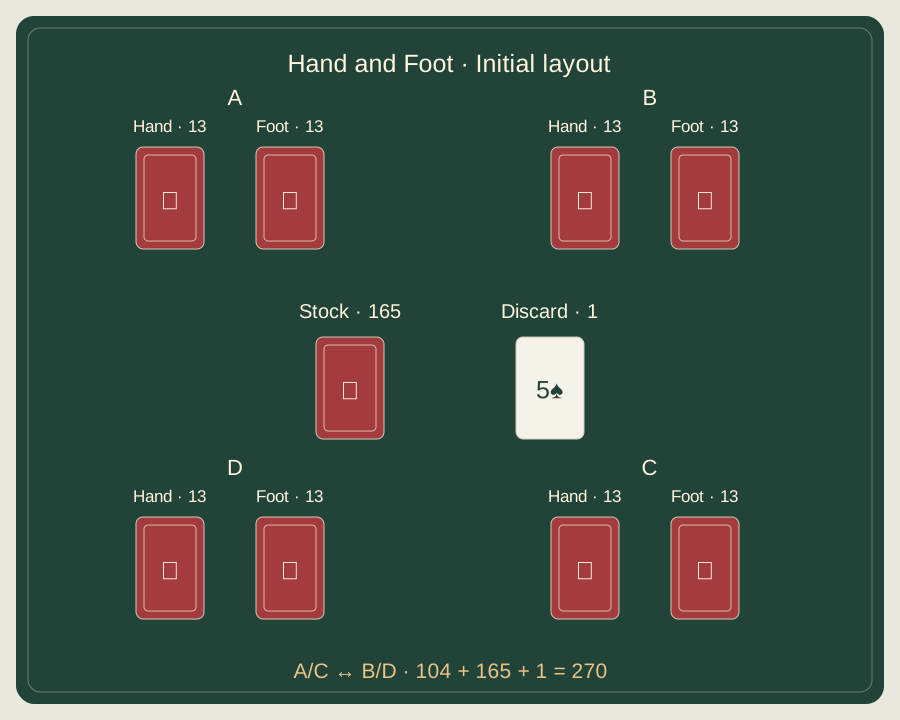
Seat 4 players as 2 partnerships, partners opposite. Mix 5 packs of 54 cards, including 2 jokers per pack: 270 total. Deal each player a 13-card Hand and a separate face-down 13-card Foot. Inspect the Hand only. This uses 104 cards. Expose a legal ordinary card for the discard, leaving 165 hidden stock cards and 1 discard. If the starter is a red 3 or wild, bury it and turn another. This table drawing is before any red-three replacements. The player left of the Hand dealer starts, and turns move clockwise. Play 4 deals, rotating the dealer left each time.
03 /
Melds, wild limits and complete books
A shared team meld has 3–7 equal-rank cards, from 4 through A. Twos and jokers are wild. In a mixed meld, natural cards must be at least twice the wild count: at most 1 wild in 3–5 cards, 2 wilds in 6–7. A separate meld may consist entirely of wilds. Threes never join melds. Exactly 7 cards complete a book: clean with no wilds, dirty with allowed wilds, or all-wild. Books cannot exceed 7. Either partner may add cards, but the team may have only 1 unfinished meld per rank. After completing it, a new meld of that rank may start.
04 /
Draw, open and discard
Draw 2 stock cards, optionally meld or extend team melds, then discard 1. Replace every red three found in a playable packet or drawn from stock immediately, laying it face up; replacements do not replace your normal draw. Black threes cannot meld and are normally discarded to block pickup. To open the team’s melds, card values laid down together must reach 50, 90, 120, 150 in deals 1, 2, 3, 4 respectively. Multiple legal melds may combine to meet it. Red-three bonuses and book bonuses do not count towards opening. After the partnership opens, either member may add legal cards without another opening minimum.
05 /
Taking the discard instead
Instead of the stock draw, take up to the top 7 discards, or the whole pile if smaller. The top must not be a three. Hold a natural matching pair and immediately meld it with the top card; a top two needs matching twos, a top joker matching jokers in an all-wild meld. You must also meet any team opening threshold using your hand plus that top card only. Buried discards cannot make the pickup legal. If that rank already has an unfinished meld, the cards must legally complete it and also start the required new meld; simply adding the top to an existing meld is insufficient. Then take the other cards, meld optionally and discard normally.
06 /
Enter the Foot and qualify to finish
If you meld the last Hand card, pick up the Foot immediately and continue the same turn without another opening draw. If your last Hand card is discarded, that turn ends; start using the Foot on your next turn. Do not inspect it early. To go out from the Foot, your team needs 2 clean books, 2 dirty books and 1 all-wild book. Your partner must already have entered the Foot and played at least part of a turn from it. Ask permission; if granted you must empty your cards by melding, with or without a final discard. If refused or unqualified, retain a card after discarding: do not accidentally end the deal.
07 /
Complete scoring and stock exhaustion
Card values: joker 50; two and ace 20; 8–K 10; 4–7 and black three 5. Add melded card values, subtract cards left in both partners’ Hands and Feet. Exposed red threes give +100 each; hidden red threes left over give −100. Add book bonuses separately: clean 500, dirty 300, all-wild 1500, plus 100 for legal going out. If someone wants a stock draw and too few cards remain, stop without a going-out bonus; legal discard pickups can otherwise continue. Add scores across all deals; highest total wins, equal totals share victory. A book earns its card values as well as its bonus.
08 /
A legal opening from the discard
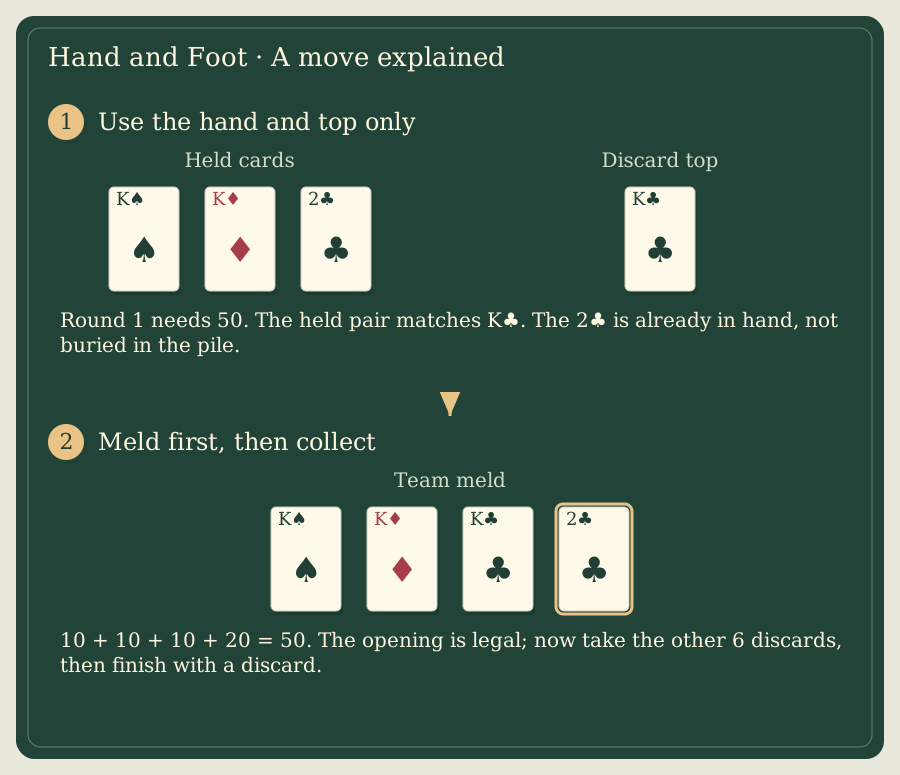
In deal 1 your team needs 50 to open. You hold K♠ K♦ and 2♣; the discard top is K♣, with enough cards below to take 7 in total. Immediately meld the natural kings with the top king and your wild two: 10 + 10 + 10 + 20 = 50. There are 3 natural cards to 1 wild, so the ratio is legal. Then take the other 6 discards and finish the turn normally. If the two were buried in those discards rather than held, you could not use it to qualify. Separately, a clean book of nines scores 70 + 500 = 570; five nines and two twos score 90 + 300 = 390.
← On a small screen, scroll the diagram horizontally. →
Common questions
Can I inspect my Foot before emptying the Hand?+
No. Keep it concealed until the Hand is exhausted; how the last Hand card leaves determines whether play continues immediately.
Does this version require an all-wild book?+
Yes, as part of the team’s going-out requirements. Some other versions forbid or omit it, so keep profiles separate.
May buried discards complete my opening minimum?+
No. Qualify using your held cards and the top discard before taking any other cards from that pile.