← On a small screen, scroll the diagram horizontally. →
01 /
One draw in closed poker
Five-Card Draw is a traditional closed-hand poker form with one exchange. Modern operator rules at PokerStars permit up to 5 replacements, not only 3 as in some home versions. We select an open home ante profile without a “pair of J to open” requirement, jokers or wild cards. Betting limits and session length are explicitly fixed below.
02 /
Ante and private deal
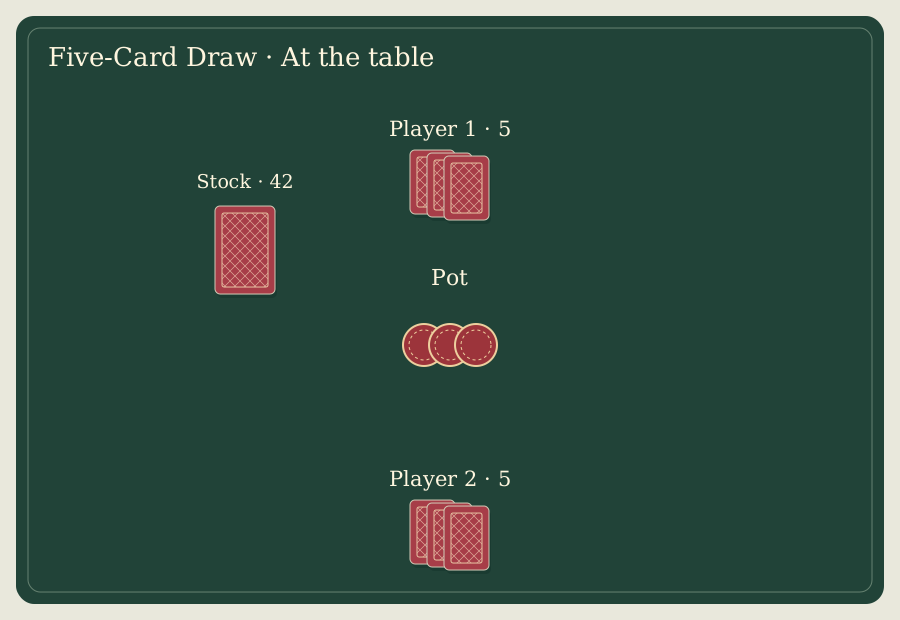
Play with 2–6 and one 52-card pack without jokers. Each starts with 100 notional chips and antes 1 before dealing; there are no blinds. Choose dealer by lot, shuffle and cut at the right. Deal singly clockwise from dealer’s left, 5 concealed each. Remainder is the replacement stock, not community cards. Only your own hand is visible before showdown. Our selected home profile uses no burn cards.
03 /
No-limit betting round
We choose no-limit betting: with no bet, check or open for at least 2; facing a bet, fold, call or raise. Maximum is all your remaining chips, with no borrowing. A full raise adds at least the last full raise increment in that round; after opening, the opening amount is the increment. Each new round resets the minimum to 2. For example, bet 2, raise to 6 adds 4, so the next full raise is at least to 10. Antes are not round bets.
04 /
Full exchange from zero to five
First betting starts with the remaining player left of dealer, then clockwise. Once everyone has responded and matched or checked, each survivor in that order discards 0–5 face down and receives exactly that many. Keeping all is stand pat. Do not change the choice after receiving replacements; showing A is not required to exchange 4 or 5. All-in players still draw.
If undealt cards cannot supply the next player, shuffle the remainder with other players’ previous discards, including folded hands; exclude that player’s current discards until their exchange finishes. Never mix in live hands. The second and final betting round again starts with the first remaining player left of dealer.
05 /
Closing action and side pots
A round ends when all live, non-all-in players have answered the latest bet or all checked. If all but one fold, that player immediately takes the pot without drawing or showing. Unable to call fully, a player may put the remainder all-in. A short increase does not reopen raising for those already responding until cumulative increases they face reach a full increment; players not yet acting may raise fully.
Divide total contributions by level into main and side pots. Each is contested only by unfolded players who covered its level; folded contributions stay. Return uncalled excess. If no further betting is possible, still complete the scheduled draw, then show down.
06 /
Ranking and tied hands
Five-card order, highest first: straight flush, four of a kind, full house, flush, straight, trips, two pairs, pair, high card. Royal is the highest straight flush. Ranks descend A,K,Q,J,10,9,8,7,6,5,4,3,2; A also completes low A–2–3–4–5, but never wraps a run. Compare the principal group: quads, full-house trips or pair rank. Equal groups use remaining kickers descending; two pairs compare higher pair, then lower. Flush and high-card hands compare all cards descending, straights by their top. Suits never break ties.
07 /
Showdown and session
After second betting, last bettor or raiser shows first; without a bet, first remaining left of dealer does. Reveal all 5; the best complete hand wins its pot. Equal hands split it, with an odd chip to the first tied winner left of dealer. No minimum pair is required to win.
We agree on 10 deals or until only one can ante. A player unable to ante leaves, with no rebuys. Highest remaining chips wins, ties share place; dealer moves left every deal.
08 /
A pair becomes quads
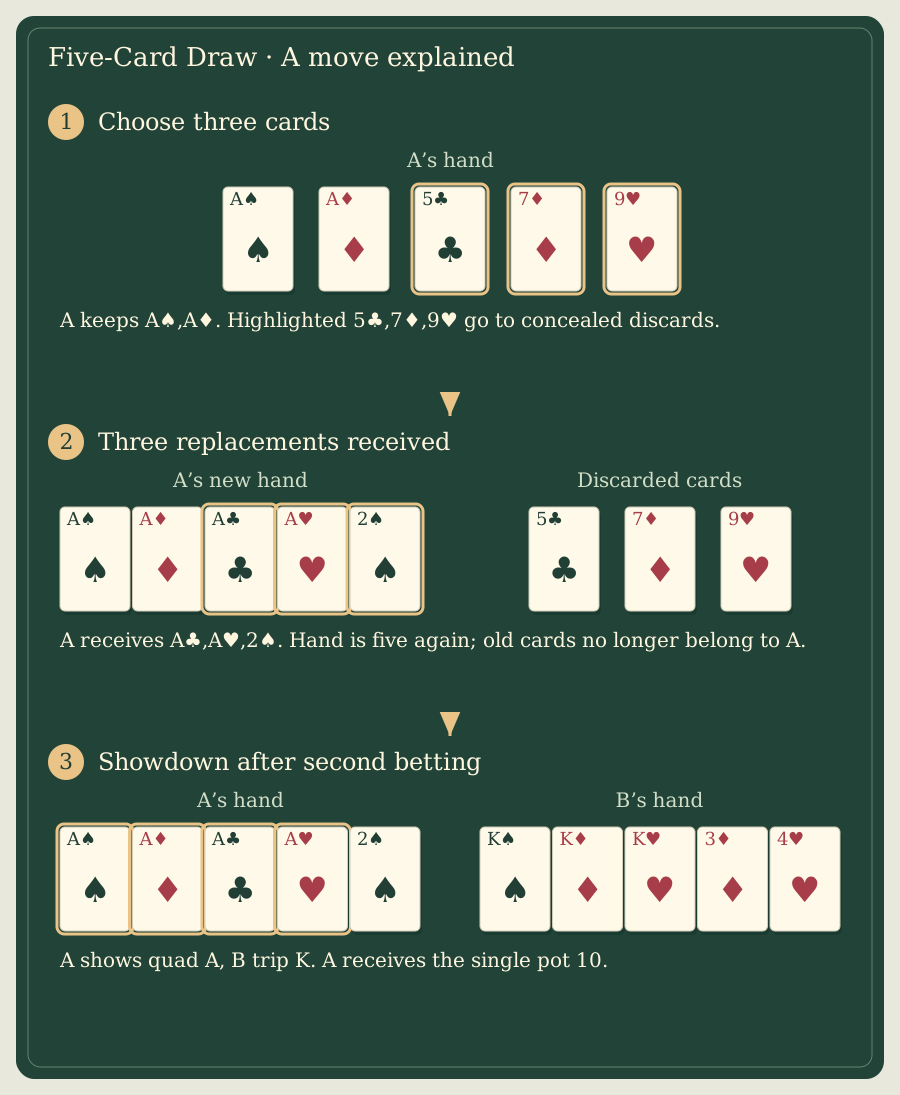
A holds A♠,A♦,5♣,7♦,9♥. Keep the pair and exchange 5♣,7♦,9♥, receiving A♣,A♥,2♠. A now has quad A with kicker 2. B shows K♠,K♦,K♥,3♦,4♥: trip K loses to quads. With ante 1 and further contributions of 4 each, pot is 10; A receives 10 including A’s own 5 contributed. Discards are not community cards.
← On a small screen, scroll the diagram horizontally. →
Common questions
May I change all 5?+
Yes. This open profile allows 0–5 without showing an ace.
Must I open with a pair of J?+
No. Jacks or Better is a different variant.
Can my own discards return immediately?+
No. Exclude the current drawing player’s discards from that reshuffle.